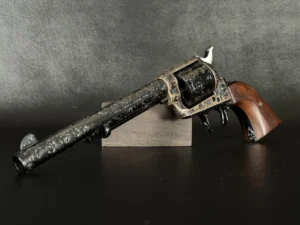

Key Takeaways:
- Completeness isn’t cosmetic, it’s proof. The original box, paperwork, and accessories don’t just “look nice”; they validate authenticity, show care, and tell a story that buyers are willing to pay for.
- The rarer the firearm, the more the extras matter. On modern guns, packaging adds a small premium… but on rare or historical pieces, it can double (or even triple) the value.
- Matching and original always beat “close enough.” A serial-matched box and correct accessories can dramatically increase value, while mismatched or altered packaging adds far less, and sometimes raises red flags.
A Collector’s Guide to Packaging, Paperwork, and the Premium They Command
You’ve probably heard someone say it: “I wish I’d kept the box.” It’s one of the most common regrets in the firearms collecting world, and honestly, it makes perfect sense. We live in an era where condition is king, provenance matters, and completeness can mean the difference between a good deal and a great one. But how much does original packaging really matter when it comes to collectible firearm value? And what about the little extras, things like manuals, cleaning rods, original tags, and test-fire casings?
The short answer is: more than most people think. The long answer, well, that’s what this article is about. Whether you’re a seasoned collector who already knows to keep every scrap of paperwork, or you’re newer to the hobby and wondering why that beat-up cardboard box is supposedly worth hundreds of dollars, this is worth understanding. Because in the collectible firearms market, presentation isn’t just cosmetic. It tells a story. And stories sell.
Why the Box Matters More Than You’d Expect
Let’s start with the obvious question. Why would a cardboard box, or a plastic case, or a wooden presentation box add hundreds or even thousands of dollars to a firearm’s value? It’s not like you shoot with the box.
Here’s the thing. The original packaging is proof. It’s physical evidence that the firearm has been cared for, stored properly, and treated as something more than just a tool. When a collector sees a vintage Colt Python sitting in its original blue box with the Colt logo, that tells them something. It says the previous owner respected the piece. It says there’s a chain of custody that goes back to the factory. And in a market where authenticity is everything, that kind of proof carries weight.
Think of it like a vintage car. Sure, the engine runs the same whether or not you have the original owner’s manual and dealer invoice. But when you’re talking about a ’69 Camaro at Barrett-Jackson, those documents can add five figures to the hammer price. Firearms work the same way.
For certain models, the box itself has become collectible. Original Smith & Wesson boxes from the 1950s and 1960s, with their maroon or gold color schemes, are sought after even when empty. Colt factory boxes from the pre-war era? Those can fetch real money on their own. The packaging becomes part of the artifact, a time capsule that connects the buyer to a specific moment in manufacturing history.
The Hierarchy of Accessories: What Collectors Actually Look For
Not all accessories are created equal. There’s a rough pecking order in the collecting community, and understanding it can help you know what to hold onto, what to look for when buying, and what’s genuinely going to move the needle on value.
At the top of the list, you’ve got the original box or case. This is the single most impactful accessory in terms of value. A matching serial-numbered box (where the serial on the box end label matches the gun) is the gold standard. It confirms that the firearm and the packaging left the factory together, and that’s powerful.
Next comes paperwork. Factory letters, test-fire targets, warranty cards, hang tags, and instruction manuals all matter. A Colt factory letter from their archives, for instance, can confirm the firearm’s original configuration, shipping date, and first destination. For military collectors, ordnance inspection reports and arsenal rebuild records serve a similar purpose. These documents anchor the firearm’s history in verifiable fact.
Then there are the physical accessories: extra magazines, cleaning kits, tools, and specialty items. A Luger with its original loading tool and cleaning rod? That’s a different conversation than a Luger by itself. Original grips, especially if they’ve been replaced on the gun, can add value if included in the package. Some collectors even care about the original shipping sleeve or outer carton, the plain brown box that the fancy box came in.
And then you’ve got the oddities, things that are model-specific. The original belt holster that came with a Colt Single Action Army. The bayonet and scabbard are paired with a Springfield M1 Garand. The scope and mount that left the factory on a Winchester Model 70. These accessories complete the picture, and collectors love a complete picture.
Matching Serial Numbers: The Collector’s Holy Grail
We need to talk about serial number matching, because this is where things get really interesting (and where values can jump significantly).
When a firearm’s box has an end label that matches the gun’s serial number, that’s a matched set. It’s definitive proof that the two belong together. For common production guns, this might add 10 to 20 percent to the value. For rare or desirable models, it can add substantially more.
Consider a pre-war Colt Official Police revolver. In good condition without a box, it might sell for $800 to $1,200, depending on finish and barrel length. Add a correct, serial-matched box with the original paperwork? Now you’re looking at $1,800 to $2,500 or more. That box and paper just doubled the value.
But here’s where collectors need to be careful. The market has gotten savvy about mismatched boxes. Putting a gun in a period-correct but non-matching box is common, and while it’s not necessarily dishonest if disclosed, it doesn’t carry the same premium. Reputable auction houses like Rock Island Auction, James D. Julia, and Morphy’s will clearly note whether a box is serial-matched, and that distinction matters enormously at the point of sale.
You know what’s even trickier? Re-labeled boxes. Some unscrupulous sellers have been known to create new end labels to match a gun’s serial number. This is outright fraud, and experienced collectors can usually spot it. The paper stock, printing style, adhesive residue, and aging patterns must be consistent. If something looks too clean or too perfect, that’s actually a red flag.
Condition of the Packaging: Yes, That Matters Too
So you kept the box. Great. But what condition is it in? Because a crushed, water-stained, mouse-chewed box isn’t going to impress anyone at a gun show.
Packaging condition follows its own grading curve. A box that’s structurally sound, with intact labels, a clean interior, and minimal wear, is going to add the most value. Minor scuffing or shelf wear? Totally acceptable for a piece that’s decades old. But major damage, missing end flaps, torn labels, or heavy staining can significantly reduce the packaging premium.
Some collectors grade boxes on a scale similar to that used for firearms: Excellent, Very Good, Good, Fair, and Poor. A box in Excellent condition, paired with a firearm in Excellent condition, is the dream scenario. But honestly, even a Fair condition box is better than no box at all for most collectors. It still proves something about the gun’s history and completeness.
One thing that often gets overlooked is interior condition. The inside of the box matters because it comes into direct contact with the firearm. Grease stains from the original factory preservative, the impression or outline left by the gun, and intact cardboard inserts or Styrofoam forms all contribute to authenticity. Some collectors can even identify the approximate era of a box by the type of interior packing material used.
The Paperwork Trail: More Than Just Old Paper
Let me explain why paperwork deserves its own section. Documents do something that physical condition alone can’t: they provide context. A firearm’s condition tells you how it was treated. Its paperwork tells you where it’s been.
Factory letters are the most obvious example. Companies like Colt and Smith & Wesson maintain historical archives (to varying degrees), and, for a fee, you can request a letter documenting the original configuration and shipping details for a specific serial number. These letters have become almost mandatory for high-end collector firearms. A nickel-plated Colt SAA from the 1890s with a factory letter confirming its original finish will sell for dramatically more than one without documentation.
But factory letters aren’t the only paperwork that matters. Original instruction manuals, especially model-specific ones from a particular era, add both value and charm. Warranty cards, particularly if filled out with a date and the original purchaser’s name, provide a human connection to the piece. Hang tags, those little cardboard tags that dangled from the trigger guard at the point of sale, are delightfully fragile survivors that collectors genuinely love to find.
Test-fire targets or proof-fire envelopes are another category worth mentioning. Some manufacturers, notably SIG Sauer and Kimber, include a factory test-fire target showing the firearm’s accuracy at a set distance. These are easy to lose and easy to throw away. Don’t. They’re part of the package, and their presence signals completeness.
For military firearms, the paperwork trail gets even more complex and potentially more valuable. Import marks, arsenal records, unit markings, and accompanying documentation can trace a firearm’s service history across continents and conflicts. A Springfield 1903 with documented service in World War I and matching arsenal rebuild records from the 1920s is a historian’s and a collector’s treasure.
How Much Value Are We Actually Talking About?
Let’s get specific, because vague statements about “added value” don’t help anyone make real decisions.
For common, mass-produced firearms in the modern era (think post-1980 Ruger, Smith & Wesson, or Glock), having the original box, manual, and accessories might add 5 to 15 percent to the value. That’s nothing. On a $600 used Glock 19, you’re talking about an extra $30 to $90. The box tells the next buyer that the gun was cared for, making resale easier. Simple as that.
For collectible but not rare firearms from the mid-twentieth century, the premium gets more interesting. A Smith & Wesson Model 29 in .44 Magnum (the “Dirty Harry” gun) from the late 1960s might be worth $1,500 without the box. With the original wood-grained box, cleaning kit, and manual? You could see $2,200 to $2,800. That’s roughly a 50-85% bump, which is substantial.
For genuinely rare or high-end collector firearms, the packaging and accessories can represent a significant portion of the total value. A pre-war Colt Woodsman in its original maroon box with all paperwork and accessories could be worth two to three times what the gun alone would fetch. At the extreme end, a cased and engraved 19th-century Colt presentation, complete with all original accessories and documentation, could sell for six figures at major auction houses.
The pattern is pretty clear: the rarer and more desirable the firearm, the greater the proportional impact of original packaging and accessories. For common guns, it’s a nice bonus. For rare guns, it can be the difference between a good piece and a museum-quality example.
The Psychology Behind It: Why Collectors Pay More for Completeness
There’s a psychological component to this that’s worth exploring. Why do collectors pay a premium for a cardboard box? On a purely rational level, it seems a bit odd. But collecting isn’t purely rational. It never has been.
Completeness triggers something deep in the collector’s brain. It satisfies the same impulse that makes people want to finish a puzzle or complete a set. When a collector acquires a firearm with everything it left the factory with, there’s a sense of satisfaction that goes beyond the monetary. It feels right. The package is whole.
There’s also a status element. In the collecting community, showing up with a boxed, papered firearm signals that you know what you’re doing. It shows you’re serious. It’s the difference between having a nice watch and having a nice watch with the original box, papers, and receipt from the authorized dealer. The watch tells the same time either way, but the complete package tells a different story about its owner.
And then there’s the value angle. Collectors who are also thinking about long-term value know that completeness protects their value. A boxed gun will always be easier to sell than a loose one. It will always attract more interest at auction. And if the market moves upward, the premium for completeness tends to increase faster than the firearm’s base value.
Storage and Preservation: Keeping What You’ve Got
Alright, so you’re convinced. Original packaging matters. But how do you preserve it? Because a box that was perfect in 1965 can deteriorate quickly if stored improperly.
First, climate control is essential. Cardboard, paper, and wood are all susceptible to moisture damage. A damp basement or a hot attic is a terrible place for original packaging. Ideally, you want a stable environment: moderate temperature, low humidity, and good air circulation. If you’re storing firearms in a safe, consider adding a dehumidifier, such as a GoldenRod, or silica gel packs to manage moisture.
Second, keep boxes away from direct sunlight. UV exposure fades labels, yellows paper, and degrades adhesives. If you display boxed firearms, use UV-filtering glass, or keep them in a room with controlled lighting.
Third, don’t stack heavy items on top of original boxes. This sounds obvious, but you’d be surprised how many vintage boxes have been crushed by careless storage. If space is tight, consider archival-quality acid-free tissue paper inside the box to support its structure, and store boxes on their sides rather than stacking them.
For paperwork, acid-free document sleeves are your best friend. Original manuals, factory letters, and warranty cards should be stored flat in protective sleeves, ideally in a binder or archival box separate from the firearm itself. This prevents oil transfer, which can permanently stain paper.
One more thing: if you buy a firearm that still has the original grease or cosmoline in the box, think twice before cleaning it out. That factory preservative is itself evidence of originality. Some collectors actually prefer boxes that still show the original grease pattern.
Buying Smart: What to Look For and What to Avoid
If you’re in the market for boxed collectible firearms, there are a few things to keep in mind that can save you money and heartache.
Always verify that the box matches the gun. Check the serial number on the end label against the firearm. Verify that the model number, barrel length, finish, and caliber listed on the box match what you’re looking at. A .357 Magnum revolver sitting in a box labeled for a .38 Special is a mismatch, even if the box is genuine and period-correct.
Examine the box carefully for signs of alteration. Are the labels original? Is the printing consistent with known examples from that era? Does the wear pattern on the box look natural, or does it look like someone artificially aged a reproduction? If you’re spending serious money, don’t be afraid to ask for detailed photos or an in-person inspection before committing.
Be wary of “too good to be true” deals. A rare Colt Python in a pristine original box with all accessories at a suspiciously low price should set off alarm bells. Either the seller doesn’t know what they have (possible but increasingly rare in the age of the internet), or something isn’t right.
Consider the source. Reputable auction houses, established dealers, and well-known collectors are generally safer sources for high-end boxed firearms. Online marketplaces can offer great deals, but they also carry more risk. Sites like GunBroker have feedback systems that help, but there’s no substitute for buying from someone with a track record.
Finally, get educated. Reference books like the “Standard Catalog of Smith & Wesson” by Jim Supica and Richard Nahas or “The Book of Colt Firearms” by R.L. Wilson contain detailed information on factory packaging across different eras. Online forums like the Smith & Wesson Forum, ColtForum.com, and various collecting groups on social media can also be invaluable resources for identifying correct packaging.
A Word About Modern Firearms and Original Packaging
Before we wrap up, let’s address a question newer collectors sometimes ask: Does any of this apply to modern firearms? The answer is yes, but with some caveats.
Modern production firearms (your current-generation Glocks, SIG Sauer P320s, Smith & Wesson M&P series, and similar) are made in large quantities. The original plastic case, lock, manual, and extra magazine aren’t rare, and they aren’t going to double the gun’s value anytime soon. But they do make the gun easier to resell and add a modest premium. More importantly, keeping everything together is just good practice for when these guns eventually become collectible.
Because here’s the funny thing: every collectible was once just another new gun. Nobody in 1955 thought they should save the box for their Smith & Wesson Model 19 “just in case.” The guys who did save it weren’t thinking about collectibility. They were just tidy. Or they couldn’t bear to throw anything away. And now their grandkids are reaping the benefits at auction.
So yes, keep the box for your new Springfield Hellcat. Hold onto the paperwork for your Ruger Mark IV. Store the extra grip panels that came with your CZ 75. Will these things matter in 30 years? Nobody knows for certain. But the cost of keeping them is zero, and the potential upside is real.
The Bottom Line
Original packaging and accessories affect the value of collectible firearms in both practical and emotional ways. They provide proof of authenticity, evidence of care, and a sense of completeness that resonates with buyers. The financial impact ranges from a modest bump for common modern firearms to a dramatic multiplier for rare, high-end collectibles.
If you’re a seller, presenting a firearm with its original box, papers, and accessories is one of the simplest ways to maximize your return. If you’re a buyer, understanding the premium for completeness helps you make informed decisions about what you’re willing to pay. And if you’re someone who just bought a new gun and is staring at that box, wondering whether to toss it, well, you know the answer now.
Keep the box, the papers, and every little thing that came with that package. One day, your future self, or whoever inherits your collection, will thank you.
Frequently Asked Questions
Yes, even for modern firearms, it adds resale appeal, and for collectible pieces, it can significantly increase value. In some cases, it’s the difference between average and premium pricing.
The box typically has the greatest impact, but strong documentation (such as factory letters) can be just as powerful. Together, they create the highest value.
Yes, especially if they are original to the firearm. They help complete the package and signal authenticity to collectors.
It’s one of the most valuable factors. A true matching box proves that the gun and packaging left the factory together.
Absolutely. A clean, structurally sound box adds far more value than one that’s damaged or heavily worn.