
Key Takeaways
- Damascening sets gold or silver into iron or steel by mechanical means, without heat or solder. The steel is often patinated black so the inlay stands out against a dark surface.
- The gold inscription on Eusebio Zuloaga’s 1864 Lefaucheux-system shotgun gives his name, his title as royal arquebusier, the year, and Eibar as the place it was made.
- A cartouche on the Fonthill Casket names Alfred Morrison as the client, Plácido Zuloaga as the maker, and Eibar in 1870 and 1871 as the place and years of work. The Khalili catalogue identifies it as apparently Plácido’s first commission for Morrison.
Damascening is the mechanical inlay of a soft metal, usually gold or silver, into a harder metal such as iron or steel, without heat or solder. The soft metal is either hammered into a recess whose raised lip locks it in place, or pressed as foil or wire onto steel that has been cross-hatched to give it tooth. The steel is then often patinated black, so that polished gold and silver read sharply against a dark ground. [1]
In Eibar, the Basque arms town, this decoration passed from gun workshops to freestanding works of art within the Zuloaga family. The town’s Arms Industry Museum credits Eusebio Zuloaga, royal gunmaker, with developing the technique and his son Plácido with perfecting it. [2] Two inscribed objects mark the two stages: a shotgun Eusebio signed in Eibar in 1864, and the iron casket Plácido made there in 1870 and 1871 for the English collector Alfred Morrison.
Eusebio Zuloaga and the 1864 Shotgun
Eusebio Zuloaga (1808–1898) learned the arms trade within his family, first from his uncle Ramón in Placencia de las Armas and then from his father in Madrid. He apprenticed in Paris in the workshop of Jean Lepage and again in Saint-Étienne between 1830 and 1832. He received a post at the Royal Armory in 1834, and Queen Isabel II named him Royal Arquebusier in 1844. He opened a workshop in Madrid in 1842 and a second in Eibar in 1848. He became a leading exponent of modern decorative damascening, preparing the steel for inlay by fine undercut hammering. [3]
In the 1840s Eusebio and Plácido were called on to restore the Royal Armory collection in Madrid, which had been poorly stored for some thirty years after Joseph Bonaparte turned the armory into a ballroom. [4] Eusebio won a prize medal at the Great Exhibition in London in 1851. [5]
The shotgun in the Eibar museum is a Lefaucheux-system pinfire gun with gold and silver damascening that runs from the barrel along the receiver to the trigger guard; the lock is also damascened in gold and silver. It is cased with accessories for maintenance. A gold inscription on top of the barrel reads “Eusebio Zuloaga Arcab. De S.M. Año 1864 en Eibar.” [3] The inscription records the maker, his court title as arquebusier to the monarch, the year, and the Eibar workshop rather than the Madrid one.
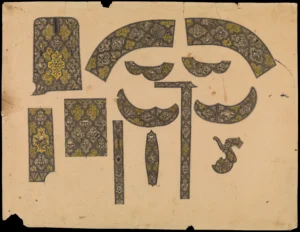
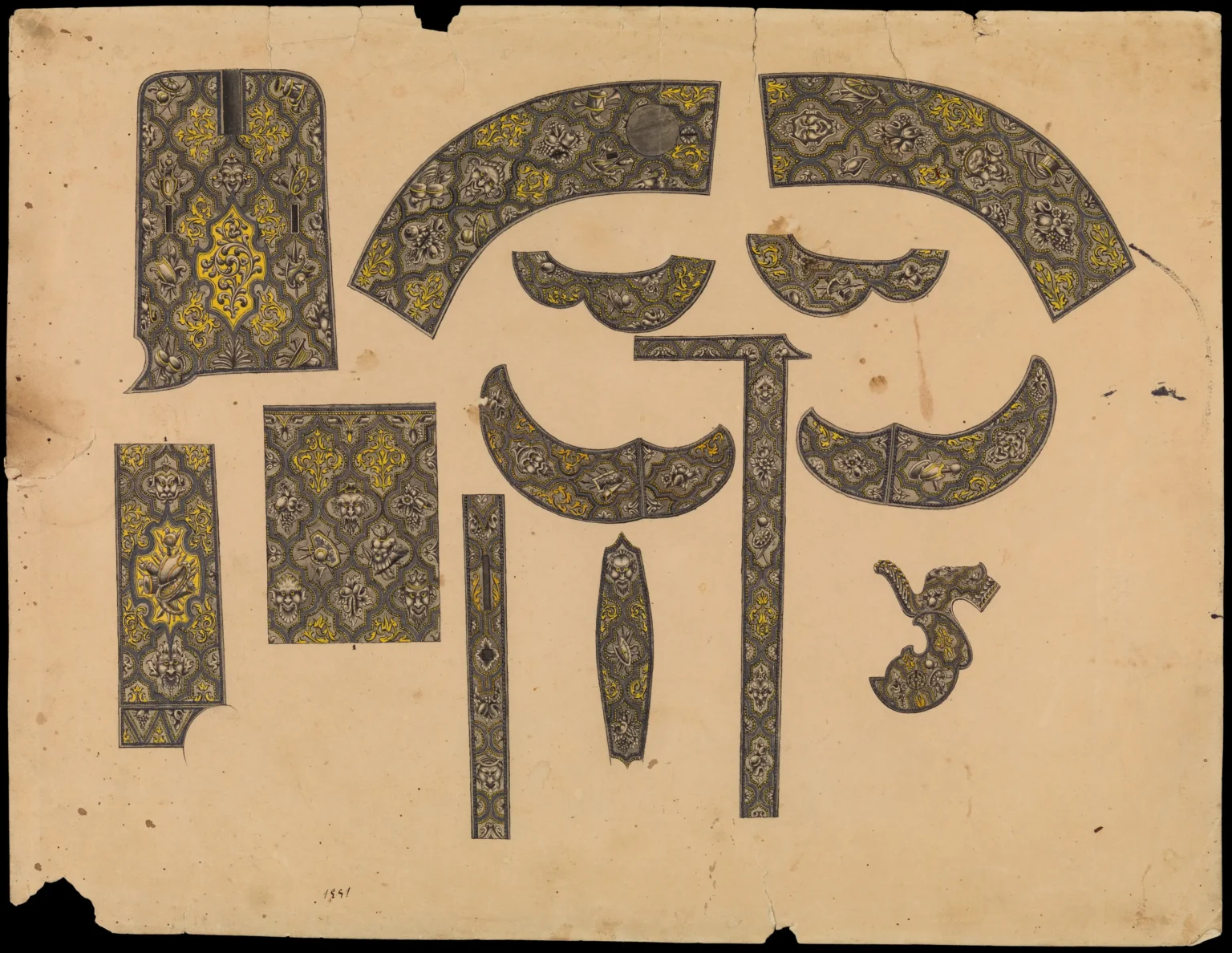
The workshop’s design process survives on paper. The Metropolitan Museum of Art holds three finished design drawings for the decoration of firearms and edged weapons from Eusebio’s workshop. One, dated about 1847 and executed in pen, ink, colored wash, and silver, records the decoration of a cased pair of all-steel percussion pistols made in Madrid or Eibar. The pistols were stolen from the Higgins Armory Museum in Worcester, Massachusetts, in 1978 and have not been recovered, so the drawing is the surviving record of their color scheme. [6]
Plácido Zuloaga and Alfred Morrison
Plácido learned from the Renaissance armor he helped restore in Madrid and from several years in Paris with Lepage and the designer and sculptor Michel Liénard. Neo-Renaissance and Spanish Moresque ornament became his principal design sources. At the 1862 International Exhibition in London he met Alfred Morrison, whose patronage secured the success of his new workshop. [4] His work had already drawn praise at the Paris exhibition of 1855. [5]
The Fonthill Casket, now in the Khalili Collection (ZUL 102), is an iron cassone measuring 121 x 201 x 86 cm. It combines forged iron, chiseled and engraved repoussé, silver with niello, and gold and silver damascening. Its four sides and lid carry high-relief putti among animal and vegetal grotesques in 17th-century baroque style. The plates were blued before gold leaf was applied to the stippled background, and small gold damascene details tie the relief figures to the gold ground. The interior is painted in white enamel with black ornament repeating the exterior design. [7]
A cartouche on the rear panel carries the inscription, in capitals: “ENCARGO DE EL S.D. ALFRED MORRISON Y EJECUTADO POR PLACIDO ZULOAGA EN EIBAR AÑO 1870 Y 1871” (“commissioned by Señor Don Alfred Morrison and executed by Plácido Zuloaga in Eibar, 1870 and 1871”). The inscription names the commissioner, the maker, the town, and two years of work. The Khalili catalogue identifies the casket as apparently Plácido’s first commission for Morrison. An 1879 article in the Magazine of Art recorded it in the drawing room of Morrison’s London house at Carlton House Terrace; its name comes from Fonthill, the estate Morrison inherited on his father’s death in 1857. [7]
Morrison’s commissions changed the scale of Plácido’s work. The catalogue attributes the casket to a team of forgers, filers, chiselers, damasceners, and engravers working across the two years named in the inscription, and places it before Plácido’s later large pieces, the Prim mausoleum and the Loiola altar. [7] Morrison also commissioned a pair of iron urns, 108 cm high, modeled on the Nasrid “Alhambra” vases of southern Spain and covered in gold and silver damascene over a stippled ground. They were exhibited in Paris in 1878, delivered to Morrison in London in 1879, and recorded that year in the dining room at Carlton House Terrace. [8] Between them, the casket and the urns represent both of Plácido’s design idioms, baroque and Moresque. [4]
As the era of great patrons ended, the damasceners turned from monumental team projects requiring several years to smaller objects, jewelry, and everyday items for a broader clientele. The Khalili Collection holds more than 100 pieces of Spanish damascene, 22 of them signed by Plácido. [9]
The Workshop Tradition in Eibar
The Arms Industry Museum in Eibar presents both halves of the story. Its Decorative Techniques room shows the decoration of luxury arms and includes a recreated damascene workshop. [2] Its 19th-century room treats damascening as both arms decoration and an art in its own right, and represents Plácido through examples of his work and his sketches. [10]
Frequently Asked Questions
Damascening is the mechanical inlay of a soft metal, usually gold or silver, into iron or steel without heat or solder. The soft metal is either hammered into recesses or pressed onto cross-hatched steel, and the steel is often patinated black for contrast.
On top of the barrel, a gold inscription reads “Eusebio Zuloaga Arcab. De S.M. Año 1864 en Eibar.” It gives the maker, his title as royal arquebusier, the year, and his Eibar workshop.
It is an iron cassone, 121 x 201 x 86 cm, that Plácido Zuloaga made in Eibar in 1870 and 1871 for Alfred Morrison, and it is now in the Khalili Collection. The inscription on its rear panel names Morrison as the client, Plácido as the maker, Eibar, and both years.
The two met at the 1862 International Exhibition in London, and Morrison’s patronage secured the success of Plácido’s new workshop. Morrison’s commissions included the Fonthill Casket and a pair of damascened iron urns, 108 cm high, delivered to him in 1879.
The Arms Industry Museum in Eibar holds Eusebio’s 1864 shotgun and has a recreated damascene workshop. Its 19th-century room shows examples of Plácido’s work and his sketches.
Sources
[1] The Metropolitan Museum of Art. “Damascening.” The Metropolitan Museum of Art, August 24, 2022.
[2] Arms Industry Museum, Eibar. “Decorative Techniques.” Arms Industry Museum, n.d.
[3] Arms Industry Museum, Eibar. “Damascene Shotgun by Eusebio Zuloaga (1864).” Arms Industry Museum, n.d.
[4] Moncrieff, Elspeth. “Masterpieces of the Zuloaga Family Courtesy of a Middle-Eastern Millionaire.” The Art Newspaper, August 31, 1997.
[5] Victoria and Albert Museum. “Casket, Eusebio Zuloaga or Plácido Zuloaga, about 1866, Museum No. 324-1866.” Victoria and Albert Museum, n.d.
[6] The Metropolitan Museum of Art. “Designs for the Decoration of a Percussion Pistol, Eusebio Zuloaga, ca. 1847, 2015.101.” The Metropolitan Museum of Art, n.d.
[7] Khalili Collections. “Iron Cassone, ZUL 102.” The Nasser D. Khalili Collection of Spanish Damascene Metalwork, n.d. Catalogue text after Lavin, J. D., ed. The Art and Tradition of the Zuloagas: Spanish Damascene from the Khalili Collection. Oxford, 1997, cat. 1, pp. 70–81.
[8] Khalili Collections. “Pair of Iron Urns, ZUL 104.” The Nasser D. Khalili Collection of Spanish Damascene Metalwork, n.d. Catalogue text after Lavin, J. D., ed. The Art and Tradition of the Zuloagas: Spanish Damascene from the Khalili Collection. Oxford, 1997, cat. 2, pp. 82–87.
[9] Khalili Collections. “Spanish Damascene Metalwork (1850–1900).” Khalili Collections, n.d.
[10] Arms Industry Museum, Eibar. “The End of the Guilds. The 19th Century.” Arms Industry Museum, n.d.