
Key Takeaways:
- Firearms engraving developed from a much older tradition of decorating arms and armor.
- Gustave Young became Colt’s principal engraving contractor during part of the 1850s and helped adapt European decorative traditions to American firearms.
- Reliable attribution requires documentary evidence, such as factory records, contemporary correspondence, or surviving workshop impressions, not stylistic similarity alone.
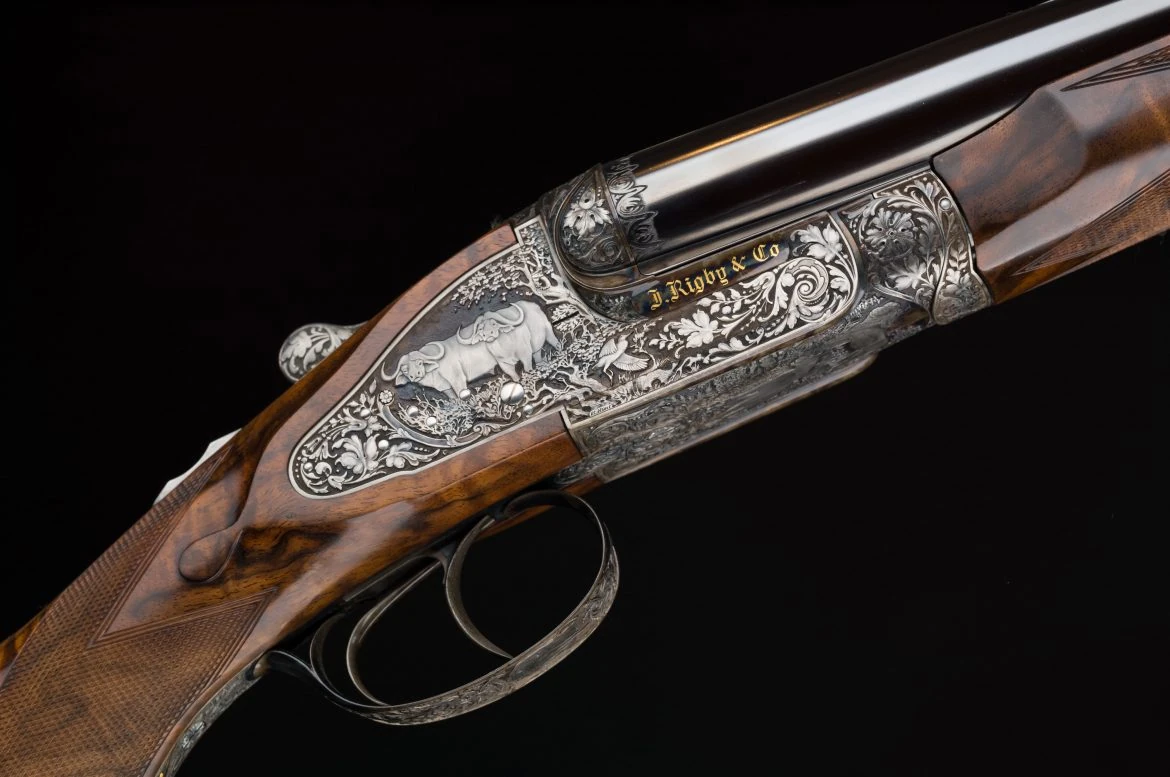
Firearms engraving belongs to a much older tradition of decorating arms and armor. Engraving, cutting a pattern or inscription into metal with a hardened tool, appears on weapons from antiquity and became a common method of decorating firearms from the 15th century onward. Craftsmen also employed etching, bluing, gilding, relief carving, and precious-metal inlay.[1]
Decoration served several purposes. Some embellished arms remained practical weapons, while exceptionally ornate examples were made for ceremonies, exhibitions, or presentation. Arms and armor could communicate rank, authority, military identity, and wealth. They also functioned as diplomatic gifts and public demonstrations of a maker’s technical abilities.[2]
The American Tradition
During the 19th century, American manufacturers used hand engraving to distinguish presentation arms and special-order firearms from ordinary production. Samuel Colt was particularly successful in combining industrial manufacture with individually executed decoration.
Around 1853, Colt directed the production of a small group of percussion revolvers ornamented with extensive engraving or relief carving, gold inlay, and carved grips. These firearms were intended for international exhibitions and presentation to officials and heads of state. Rather than functioning solely as luxury objects, they promoted Colt’s manufacturing capabilities to influential audiences.[3]
The Metropolitan Museum of Art’s gold-inlaid Colt Model 1849 Pocket Revolver, serial number 63306, belongs to this group. Its scrollwork is carved in relief so that the design rises above the surrounding surface. This treatment, together with its gold ornament and carved grip, distinguishes it from the larger number of conventionally engraved presentation firearms produced by Colt.[3]
Gustave Young and Colt Engraving
Gustave Young was one of the most important engravers associated with Colt during the mid-19th century. Born in Prussia in 1827, Young immigrated to the United States in 1852. He engraved for Colt between 1853 and 1858 and became the company’s principal engraving contractor during the latter part of that period. After returning temporarily to Germany, he resumed work for Colt in the early 1860s. He also engraved firearms for Smith & Wesson, the New Haven Arms Company, and other manufacturers.[4]
Young’s engraving reflected his German training. His surviving designs feature scrollwork, animal heads, human figures, and hunting scenes arranged around the mechanical forms of a firearm. Pattern books published by European engravers provided additional sources of ornament, demonstrating that American firearms engraving developed through the adaptation of established European decorative traditions.[4]
A Colt Model 1851 Navy revolver in the Metropolitan Museum of Art provides a documented example of Young’s work. Manufactured around 1853–54, the cased .36-caliber revolver bears intricate engraving attributed directly to him. Its importance extends beyond its appearance: because many firearms have been attributed to Young without conclusive evidence, a documented example provides a dependable standard for evaluating his style and technique.[5]
Young also preserved records of completed work by taking ink impressions, known as pulls, from engraved metal surfaces. Twenty-five surviving impressions in the Metropolitan Museum’s collection record ornament applied to lockplates, receivers, hammers, barrel tangs, and other components. These impressions reveal how designs were adapted to the irregular shapes and mechanical divisions of different firearms.[4]
Decoration and Historical Evidence
An engraved firearm can preserve several overlapping histories. Its mechanical form documents firearms manufacture. Its ornament records the work of a designer or engraver. Its inscriptions may identify a recipient or commemorate an event. Factory records, correspondence, presentation inscriptions, engravers’ pulls, and established ownership records can connect these elements.
Decoration alone, however, does not prove authorship or historical association. An engraved name establishes the content of an inscription, but it does not necessarily establish ownership. Stylistic similarity can support an attribution, but it is weaker than a factory record, contemporary document, or surviving workshop impression.
Condition must also be considered carefully. Refinishing, polishing, replaced components, and recut engraving can alter both the appearance and the historical integrity of a firearm. Wear may be consistent with genuine use, but it does not independently prove a particular history.
For collectors and researchers, the most significant engraved firearms combine artistic quality with reliable documentation. When the firearm, engraving, and surviving records support one another, the object becomes more than a decorated weapon. It becomes a documented work of decorative art and a primary source for the history of craftsmanship, manufacture, presentation, and ownership.
Frequently Asked Questions
Engraving became a frequent method of decorating firearms from the 15th century onward. The technique developed from earlier traditions of decorating weapons and armor.
Engraved firearms were produced as presentation pieces, diplomatic gifts, exhibition objects, and expressions of rank or wealth. Some remained functional, while others were intended primarily for ceremony or display.
Gustave Young was a Prussian-born engraver who worked for Colt and other American firearms manufacturers during the 19th century. He served as Colt’s principal engraving contractor from 1855 to 1858.
Strong evidence may include factory records, contemporary correspondence, documented provenance, or workshop impressions taken from completed engraving. A signature or stylistic resemblance alone is not conclusive.
No. Collectibility also depends on documented authorship, originality, condition, provenance, historical importance, and the quality of the engraving.
Sources
- Dirk H. Breiding, “Techniques of Decoration on Arms and Armor,” The Metropolitan Museum of Art, October 2003.
- Dirk H. Breiding, “Arms and Armor in Renaissance Europe,” The Metropolitan Museum of Art, October 2002.
- The Metropolitan Museum of Art, “Gold-inlaid Colt Model 1849 Pocket Revolver, Serial No. 63306,” collection record.
- The Metropolitan Museum of Art, “Twenty-Five Inked Impressions (or ‘Pulls’) of Engraved Firearms Ornament,” collection record.
- The Metropolitan Museum of Art, “Colt Model 1851 Navy Percussion Revolver, Serial Number 29705, with Case and Accessories,” collection record.