
Key Takeaways:
- Engraving, etching, pointillé, inlay, and relief carving are distinct decorative techniques.
- Pattern books helped circulate firearm designs between European and American workshops.
- Serial numbers, factory records, provenance, and securely attributed examples provide stronger evidence than stylistic resemblance.
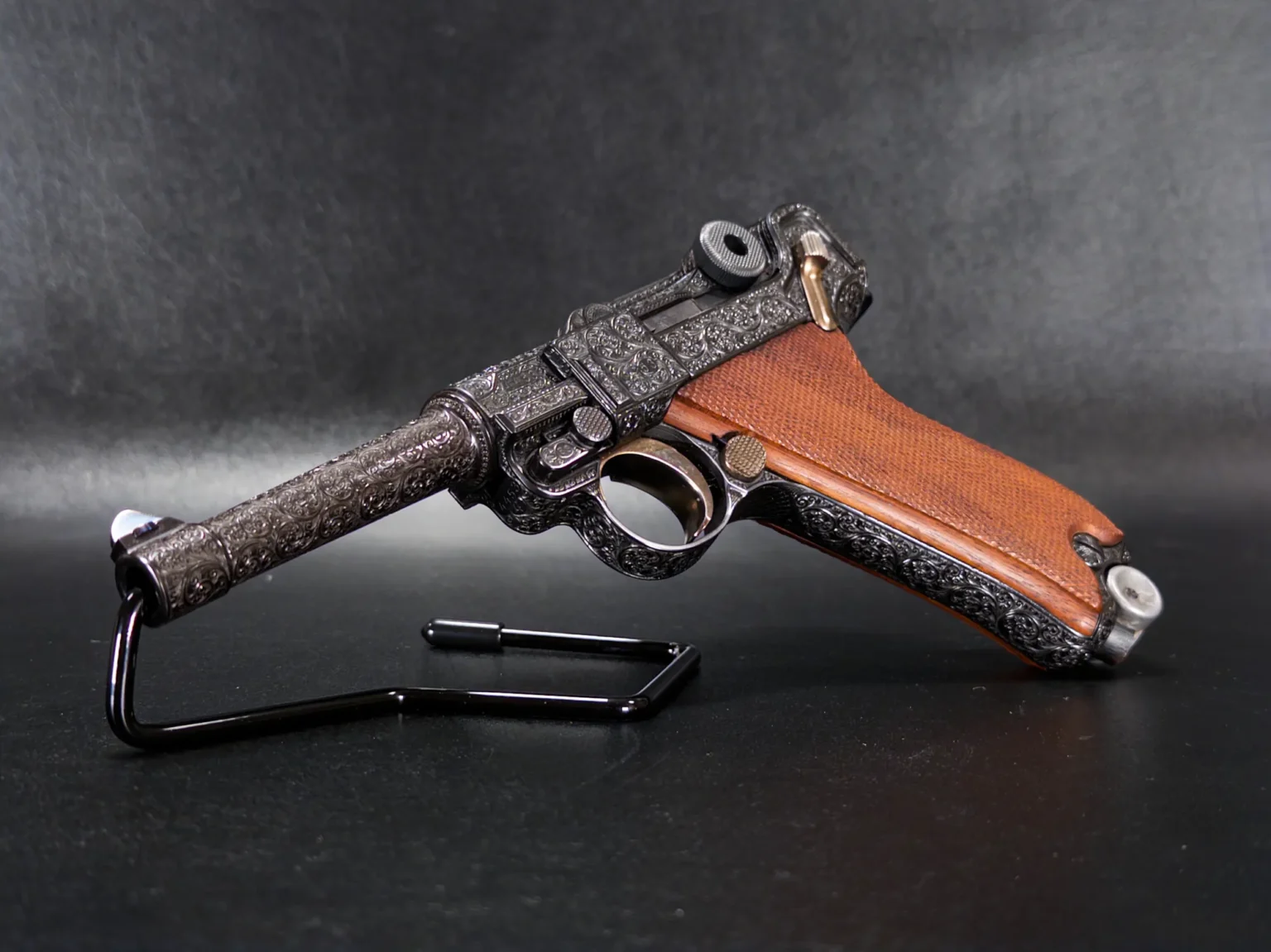
Engraved firearms belong to the histories of both gunmaking and decorative art. Decorated arms have served as expressions of rank, ceremonial objects, and diplomatic gifts. On working firearms, ornament was generally arranged so that it did not interfere with function. Firearms intended for presentation or display could support much more elaborate treatment.[1]
Understanding the Techniques
Engraving is the direct cutting of a pattern or inscription into metal with a hardened pointed tool called a burin. Pointillé creates an image with punched dots rather than continuous cut lines. Etching is a different process in which acid cuts a design through openings in a protective coating.[2]
Inlay also differs from engraving, although the techniques frequently appear together. The artisan cuts or carves a recess, undercuts its sides, and hammers in a softer metal such as gold or silver. Wooden stocks may be inlaid with bone, horn, mother-of-pearl, or precious-metal wire. Relief decoration can be carved or chiseled into a surface, while repoussé raises a design from the reverse and chasing adds detail from the front.[2]
These distinctions are important when cataloging a firearm. Engraved scrollwork, acid-etched scenes, punched backgrounds, relief carving, and precious-metal inlay require different methods. Several techniques may appear on the same firearm, but their presence alone does not establish authorship or date.
The Development of Firearm Ornament
Firearm ornament became particularly elaborate in Europe from the 15th century onward. By the 16th century, printed designs were circulating among armorers, gunsmiths, engravers, and other metalworkers. These prints helped transmit decorative ideas between workshops and continued to influence arms design into the 19th century.[3]
A French print of about 1750 in The Metropolitan Museum of Art shows a standard musket and an elaborate hunting gun together with individual components, labels, and decorative details. Other surviving pattern sheets placed ornament directly on locks, stocks, and related parts. Craftsmen could adapt and rearrange these designs to suit particular commissions.[3]
Decoration also communicated ownership, status, and intended use. It could incorporate initials, coats of arms, hunting scenes, animals, mythological subjects, or other imagery selected for a patron. The result was not necessarily a separate work of art imposed on a firearm. In accomplished examples, the ornament responded to the firearm’s contours, materials, and mechanical components.[1][3]
American Firearms Engraving
As firearms production became increasingly industrialized in the United States during the 1850s, customers could commission independent artisans to embellish machine-made guns. Manufacturers later established more organized factory-decoration programs.[4]
Louis Daniel Nimschke was among the leading independent engravers working in this period. Born in Germany in 1832, he immigrated to the United States in 1853 and spent most of his working life in New York. His career extended from about 1850 to about 1900 and included firearms produced by Colt, Winchester, Smith & Wesson, Remington, Marlin, and other manufacturers.[4]
Nimschke’s surviving equipment illustrates the range of tools used in his workshop. The Metropolitan Museum of Art holds a set of 62 hammers, gravers, punches, files, planishers, calipers, and related implements associated with his work.[4]
Gustave Young followed a related path. A documented Colt Model 1851 Navy revolver, serial number 29705, was engraved by Young around 1853 or 1854. The Metropolitan Museum of Art identifies it as one of the few documented examples that can serve as a reference for his style and technique. Young’s later reputation caused the decoration on many firearms to be attributed to him without sufficient evidence.[5]
Attribution Requires Documentation
A familiar scroll pattern is not proof of authorship. Engravers drew from shared pattern books, worked for several manufacturers, and did not always sign their work. Later artisans could also imitate established styles.
Nimschke’s surviving workbook demonstrates the value of direct comparison. Compiled from about 1850 to 1900, it contains hundreds of ink impressions, known as pulls, taken from engraved surfaces. Nimschke indexed the volume and marked impressions that were not his work. Because he signed only some of his firearms, the workbook provides reference material for evaluating unsigned examples.[6]
A sound attribution should combine several forms of evidence whenever possible: a signature or inscription, records tied to the serial number, period correspondence, documented provenance, and comparison with securely attributed work. Stylistic resemblance may support an attribution, but it should not replace documentation.
Decoration and Historical Identity
Decorative coverage alone does not establish the significance of an engraved firearm. The underlying model, date, configuration, authorship, materials, condition, completeness, and provenance must be considered separately.
The Metropolitan Museum of Art’s gold-inlaid Colt Model 1849 Pocket revolver, serial number 63306, demonstrates the distinction between craftsmanship and provenance. Made around 1853, it belongs to a group of Colt percussion firearms decorated with extensive engraving, relief carving, and gold inlay. About 20 examples of this broader type are known to survive, including six Model 1849 revolvers.[7]
The group was produced under Samuel Colt’s direction for international exhibitions and presentations to public officials and heads of state. Serial number 63306, however, has no documented original presentation history. Its decoration establishes its relationship to Colt’s exhibition and presentation firearms, but it does not identify a particular recipient.[7]
Careful evaluation therefore begins with the firearm rather than its reputation. Serial numbers, markings, inscriptions, materials, decorative methods, surviving finish, and accessories should be recorded and compared with factory records, period catalogs, archival documents, and securely attributed examples. Craftsmanship creates visual interest, but documentation establishes historical identity.
Frequently Asked Questions
Firearm engraving is the direct cutting of patterns or inscriptions into metal with a hardened pointed tool called a burin.
Engraving mechanically cuts the metal. Etching uses acid to create a design through openings in a protective coating.
Nimschke and Young were German-born engravers whose work influenced American firearm decoration during the 19th century.
A sound attribution may combine signatures, serial-number records, period correspondence, provenance, and comparison with securely documented work. Visual similarity alone is not conclusive.
No. Presentation history should be supported by inscriptions, factory records, correspondence, or other reliable documentation.
Sources
[1] Breiding, Dirk H. “The Decoration of Arms and Armor.” Heilbrunn Timeline of Art History, The Metropolitan Museum of Art, October 1, 2003.
[2] Breiding, Dirk H. “Techniques of Decoration on Arms and Armor.” Heilbrunn Timeline of Art History, The Metropolitan Museum of Art, October 1, 2003.
[3] Rossman, Sasha, and Femke Speelberg. “The ‘Cutting Edge’ of Fashion: Designs for the Decoration of Arms and Armor on Paper.” The Metropolitan Museum of Art, April 16, 2015.
[4] The Metropolitan Museum of Art. “Set of Sixty-Two Engraving Tools of Louis D. Nimschke (1832–1904).” The Metropolitan Museum of Art, n.d.
[5] The Metropolitan Museum of Art. “Colt Model 1851 Navy Percussion Revolver, Serial Number 29705, with Case and Accessories.” The Metropolitan Museum of Art, n.d.
[6] The Metropolitan Museum of Art. “Workbook Recording the Engraved Firearms Ornament of Louis D. Nimschke (1832–1904).” The Metropolitan Museum of Art, n.d.
[7] The Metropolitan Museum of Art. “Gold-Inlaid Colt Model 1849 Pocket Revolver (Serial No. 63306).” The Metropolitan Museum of Art, n.d.