
Key Takeaways:
- A presentation firearm requires evidence connecting it to a specific recipient, occasion, or institutional purpose.
- A commemorative firearm honors a subject or event but does not necessarily have a direct historical connection to it.
- Factory records can confirm original configuration, while provenance must be established through documentation tied to the specific firearm.
The terms “presentation,” “commemorative,” and “limited edition” describe different attributes of a collectible firearm.
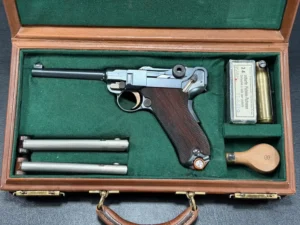
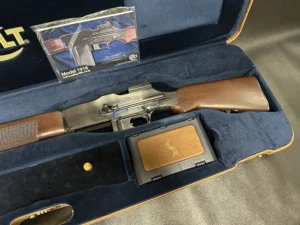
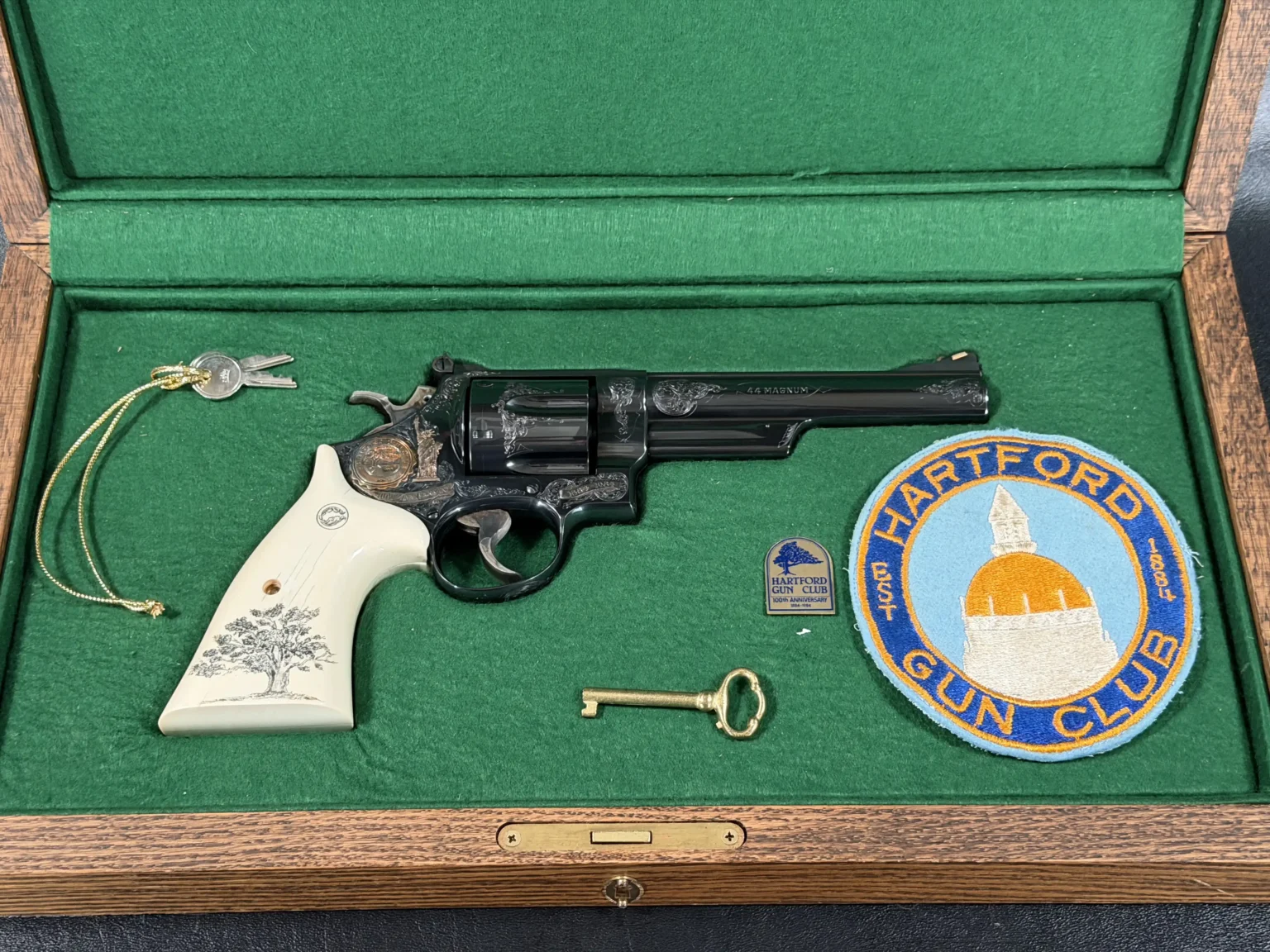
A presentation firearm is associated with an identifiable recipient, occasion, or institutional purpose. A commemorative firearm marks a person, organization, anniversary, or event. A limited edition has a stated production limit. A firearm can fit more than one category, but decoration, special packaging, or a numbered certificate does not establish presentation history.
Samuel Colt’s Presentation Firearms
Samuel Colt used highly decorated revolvers as diplomatic gifts and demonstrations of his company’s manufacturing and artistic capabilities. The Metropolitan Museum of Art identifies approximately twenty surviving gold-inlaid Colt percussion firearms from this group. They were produced for international exhibitions and presentations to officials and heads of state, including the kings of Sweden and Denmark and Czar Nicholas I of Russia.[1]
On October 30, 1854, Colt presented three gold-inlaid revolvers to Nicholas I at Gatchina Palace: a Third Model Dragoon, a Model 1851 Navy, and a Model 1849 Pocket revolver. All three are preserved in the State Hermitage Museum.[1][2]
The Metropolitan Museum owns closely numbered revolvers traditionally associated with the same series, but it distinguishes documented presentations from firearms whose original purposes remain uncertain. Its gold-inlaid Model 1851 Navy, serial number 20133, closely resembles the Hermitage revolver numbered 20131. The museum nevertheless states that the original use of its revolver is not recorded.[2]
The engraver responsible for these gold-inlaid Colts has not been conclusively identified. The Metropolitan Museum lists Gustave Young, Herman Bodenstein, and John Marr among the possible engravers. Young worked for Colt from 1853 to 1858, Bodenstein during portions of the period from 1852 to 1865, and Marr from 1853 to 1855.[2]
These distinctions matter because physical similarity is not the same as documented provenance. Sequential serial numbers, comparable engraving, and period manufacture may associate a firearm with a recognized group. They do not independently prove that the firearm was presented to a particular recipient.
Many more modest Colt presentation revolvers were inscribed with the recipient’s name on the backstrap.[1] An inscription can be important evidence, but it must be evaluated with factory records, correspondence, period accounts, or a documented ownership history. An inscription applied after the firearm left the factory does not establish a factory presentation.
Winchester Exhibition and Special-Order Arms
Winchester produced decorated firearms for exhibitions, presentations, and individual customers. One documented example in the Cody Firearms Museum is a Winchester Model 1866 engraved by Conrad F. Ulrich around 1873. The rifle was displayed at the Centennial Exposition in Philadelphia in 1876. Its engraving includes game animals, a representation of Diana, and a Grecian-key border at the wrist.[3]
This rifle was not a commemorative in the later commercial sense. It was an individually embellished exhibition firearm. Its identity rests on the particular rifle, its documented engraver, and its exhibition history.
Winchester’s “One of One Thousand” and “One of One Hundred” Model 1873 rifles form another distinct category. Winchester selected rifles through factory accuracy testing and equipped qualifying examples with features that could include set triggers, figured walnut, checkering, and metal engraving.[4] The designation described a grade selected for accuracy rather than a consecutively numbered edition of 1,000 firearms.
That difference separates the Winchester accuracy grades from later commemorative production. The distinguishing feature was not simply a decorative inscription or an announced production ceiling. It was the rifle’s factory-selected configuration and documented place within a specialized production program.
The Factory Commemorative
Winchester identifies the 1964 Wyoming Diamond Jubilee Model 1894 as its first factory commemorative. The company followed it in 1966 with the Model 66 Centennial, a gold-tone Model 1894 produced for the 100th anniversary of Winchester Repeating Arms.[5] A professionally published history of the Model 94 likewise identifies the Wyoming Diamond Jubilee as the beginning of Winchester’s commemorative series.[6]
The format became familiar: a standard-production model received inscriptions, special finishes, medallions, engraving, packaging, or accessories connected to a historical subject. These features can be entirely factory original without creating a direct connection to a particular person or event.
A Wyoming Diamond Jubilee rifle commemorates Wyoming’s anniversary. It does not follow that a particular example belonged to a Wyoming official or appeared in an anniversary ceremony. Those claims require documentation specific to that firearm.
The same principle applies to the word “presentation.” A presentation case or presentation-grade finish describes packaging or decoration unless evidence identifies an actual recipient and occasion. The word alone does not establish provenance.
Documentation and Collector Identification
The firearm itself should be examined before its packaging or sales description. Relevant evidence includes:
- Serial number
- Factory and proof markings
- Caliber
- Barrel configuration
- Trigger type
- Finish
- Engraving
- Stock or grip material
- Assembly numbers
- Evidence of refinishing or later alteration
Those details should be compared with factory records and contemporary literature whenever such records survive.
The Cody Firearms Records Office holds Winchester factory information covering production from 1873 into the mid-20th century. For many Winchester firearms manufactured between 1873 and approximately 1906, surviving records may identify caliber, barrel type, trigger type, special-order features, and serial-number application dates. Customer information is rarely present.[7]
A factory letter documents only the information preserved in the corresponding record. If a ledger confirms caliber, barrel, trigger, and shipping information but does not identify a purchaser, it cannot establish the firearm’s original owner.
Provenance requires a separate chain of evidence. Relevant records can include:
- Contemporary correspondence
- Presentation documents
- Exhibition catalogs
- Period photographs
- Institutional records
- Estate inventories
- Earlier catalog entries
- Ownership records that identify the firearm by serial number
Engraver attribution also requires evidence. A signature, factory notation, engraver’s pull, contemporary document, or comparison with authenticated work can support an attribution. Similar scrollwork or subject matter alone is not conclusive, particularly when several engravers worked within the same factory tradition.
Production quantity and surviving rarity are separate questions. An announced limit establishes a proposed maximum. Factory records may establish how many examples were completed. Neither figure establishes how many survive or how many retain their original finish, components, cases, and papers.
Presentation history, commemorative purpose, factory originality, production quantity, and provenance are distinct facts. Each should be stated only to the extent supported by the firearm and its documentation.
Frequently Asked Questions
A presentation firearm has a documented association with a recipient, occasion, or institutional purpose. An inscription can support that history but is not conclusive by itself.
A commemorative firearm is produced to honor a person, organization, anniversary, or event. It does not necessarily have a direct historical connection to its subject.
No. It establishes an announced production limit, not the number actually completed or the number surviving in original condition.
Examine the serial number, markings, configuration, finish, and other physical features against surviving factory records and contemporary literature. Later modifications must be identified separately.
No. “Presentation case” may describe packaging rather than documented history, so the recipient and occasion require independent evidence.
Sources
[1] Metropolitan Museum of Art. “Gold-inlaid Colt Model 1849 Pocket Revolver, Serial No. 63306.” Metropolitan Museum of Art, n.d.
[2] Metropolitan Museum of Art. “Gold-inlaid Colt Model 1851 Navy Revolver, Serial No. 20133, with Case and Accessories.” Metropolitan Museum of Art, n.d.
[3] Buffalo Bill Center of the West. Points West. Spring 2017, pp. 26–27.
[4] Campbell, Dave. “A Look Back (And Forward) at the 1873 Winchester.” American Rifleman, October 1, 2013.
[5] Winchester Repeating Arms. “Legendary Innovation.” Winchester Repeating Arms, n.d.
[6] Hacker, Rick. “The Immortal Winchester Model 94: From the 19th into the 21st Century.” American Rifleman, July 29, 2021.
[7] Buffalo Bill Center of the West. “Winchester Factory Records.” Cody Firearms Records Office, n.d.