
Star Bonifacio Echeverría, S.A., of Eibar in Gipuzkoa, made firearms from 1905 until 1997. In the postwar decades, its submachine guns were adopted by Spain’s military and police forces, which made the company the main supplier of light arms to the country’s official forces [1]. The firm’s last three decades were shaped by its dependence on the American market, a 1980s product-line renewal, and a decline that ended in July 1997, when Star closed its doors. Its Basque competitor Astra-Unceta y Cía. declared bankruptcy in 1998 [2][3].
The American Market
In 1947, Star signed an agreement with the American importer Firearms International Corporation. Through it, large quantities of pistols went to the United States in the 1950s and 1960s, and the United States became the main destination for the company’s production [1]. FIC remained Star’s U.S. importer until 1970 [3].
The Gun Control Act of 1968 introduced a points-based test for imported handguns. That test barred many of Star’s smaller pistols, especially those in .25 ACP and .22 LR [3]. The new import restrictions dealt the company a severe blow, and its sales to the United States fell significantly from 1969 [1][2]. Export data for 1960 to 1989, which Igor Goñi Mendizabal drew from L. M. Antaris’s reference work Star Firearms (2001), show total exports declining over that period and the U.S. share shrinking with them [2].
Interarms of Alexandria, Virginia, obtained the U.S. distributorship in 1978 and remained Star’s American representative for nearly 20 years. Pete Dickey, who had worked at FIC, had proposed the lightweight .45 caliber PD model, which was named after him. Star ended PD production in 1990 after making 62,295 of them [3].
Renewal in the 1980s
Isaac Irusta, who had run the factory’s administration since the 1920s, died in 1971, and Valentín Suinaga, the firm’s design and production manager, retired in the same decade. By the early 1980s, Iñaki de Subiñas and Eduardo Iraegi were running the company. They began renewing the model range, and the new pistols were successful enough to keep the company stable through the decade, when it employed 260 workers [1].
Iraegi also began work on a submachine gun prototype modeled on the Israeli Uzi. The project was shelved and then revived in 1983 as the Z83, which was refined into the Z84. Spain’s Policía Nacional and Guardia Civil acquired the Z84, and it was exported to Iran, Angola, and Peru. From 1960 to 1985, Star produced 221,787 submachine guns [4]. On the pistol side, Star followed the industry shift to plastics with the Ultrastar, which featured a polymer frame [2].
Decline and Closure
Goñi Mendizabal attributes Star’s decline from the end of the 1980s to several causes: repeated changes in its administrative and technical management, the failure of new manufacturing projects, and a firearms market shrinking under increasingly restrictive international rules on sales and use. An attempted merger with Astra was one of several rescue efforts that failed [1].
The American channel narrowed at the same time. In 1995, Star offered Interarms Firestar Plus pistols in .45 ACP and .40 S&W. Interarms declined, and it also turned down a later proposal for modified Felk pistols that existed only as drawings. Interarms still held about 30,000 unsold Star pistols. Star then named European American Armory of Naples, Florida, as its new distributor [3].
By July 1997, Star’s workforce had fallen to fewer than 40 employees. The factory closed that month [1][3].
What Survives
The Eibar factory building was demolished in 2003, and the manufacturer ALFA’s new headquarters now stands on the site [1]. A 2023 monograph on Star’s submachine guns, by authors including Guardia Civil armament specialist Jesús Acosta and Manuel Estirado, was reviewed in El Debate. According to the review, when the plant was dismantled, a scrap dealer took its metal shelving, still full of parts, and found a large quantity of company documentation inside [4].
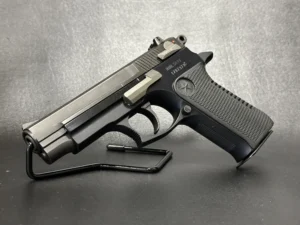
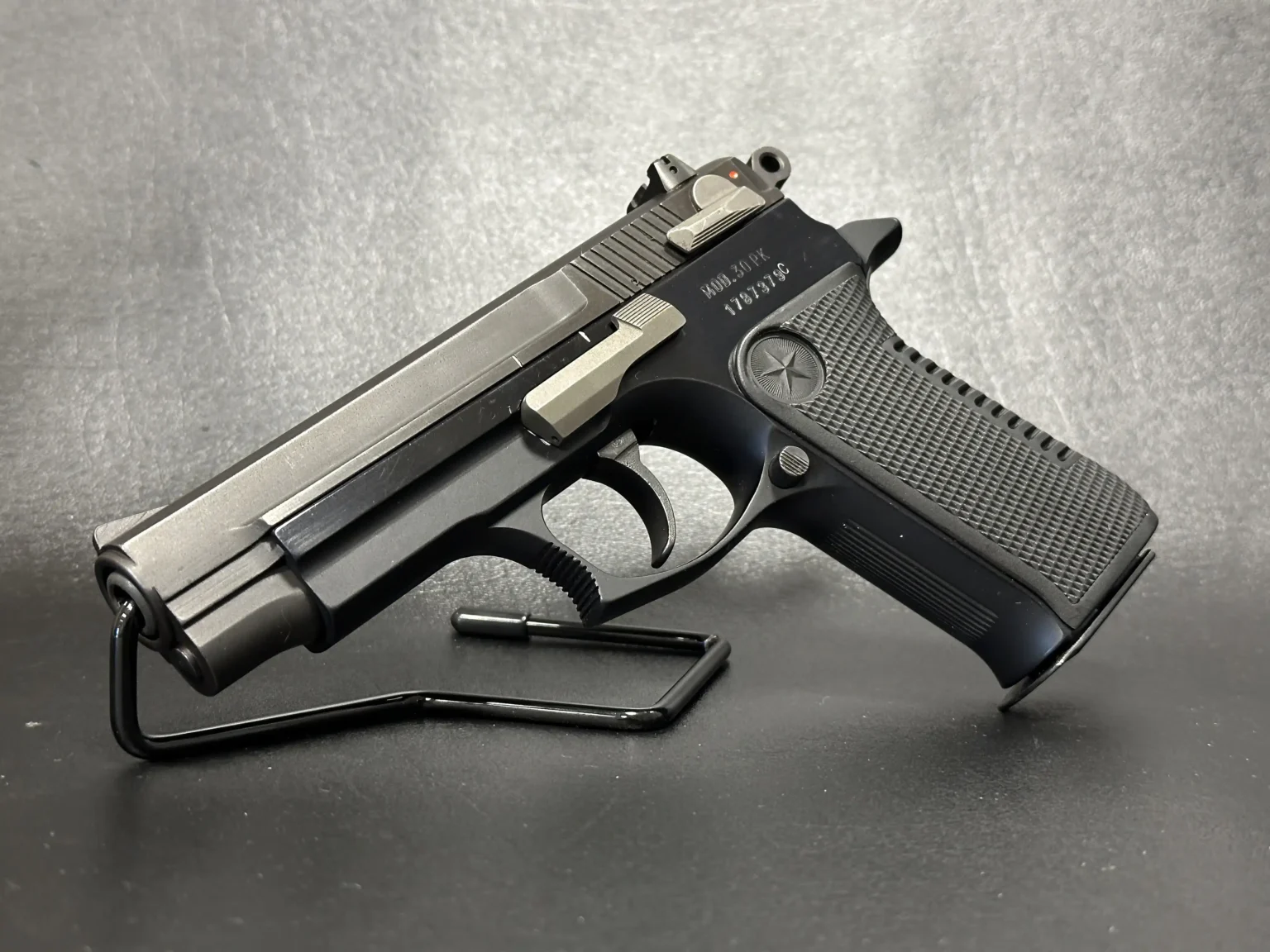
Eibar’s Museo de la Industria Armera holds examples from Star’s last product lines:
- Firestar M43: The museum holds an example with serial number 1977951, made in 1992. It is proof-marked with the Eibar year letter L2 and has a special engraved finish. Star offered that finish only by special order and commissioned the Eibar engraver Vicente Alberdi to do the work. The museum’s record says the model received two U.S. firearms-trade awards in 1993 [5].
- High-grade shotgun: In 2024, the museum acquired number 3 of a series of 10 automatic-opening shotguns that Star built at the end of the 1980s. The gun is damascened throughout by the Eibar artist Lucas Alberdi Aranzabal, whose signature dates the work to 1983. The Basque Government’s Department of Culture funded its purchase from a private owner, and it was presented publicly on January 31, 2024 [6].
Frequently Asked Questions
Star closed in July 1997, when its workforce had fallen below 40 employees. Its Basque competitor Astra-Unceta y Cía. declared bankruptcy the following year.
The Gun Control Act of 1968 introduced a points-based test for imported handguns that barred many of Star’s smaller pistols, especially in .25 ACP and .22 LR. The company’s sales to the United States fell significantly from 1969.
Firearms International Corporation was Star’s U.S. importer until 1970, and Interarms of Alexandria, Virginia, held the distributorship from 1978 for nearly 20 years. In its final years, Star named European American Armory of Naples, Florida, as its new distributor.
Star produced 221,787 submachine guns between 1960 and 1985. Spain’s Policía Nacional and Guardia Civil acquired its last design, the Z84, and exported it to Iran, Angola, and Peru.
The factory building was demolished in 2003, and the manufacturer ALFA’s headquarters now stands on the site. When the plant was dismantled, its shelving was given to a scrap dealer, who found a large quantity of company documentation inside.
Sources
[1] Goñi Mendizabal, Igor. “Star Bonifacio Echeverría.” Auñamendi Eusko Entziklopedia, Eusko Ikaskuntza, n.d.
[2] Goñi Mendizabal, Igor. “Evolución de la industria armera vasca entre 1876 y 1969. Un enfoque a largo plazo.” VIII Congreso de la Asociación Española de Historia Económica, Santiago de Compostela, 2005, pp. 37-38.
[3] Kokalis, Peter G. “The Fallen Star: This Spanish Pistol Maker Had a Long and Productive Run, but Ultimately Couldn’t Prevail Against Market Conditions and Changing Tastes.” Shotgun News, November 20, 2012.
[4] Morales, Gustavo. “Star, la empresa vasca que alcanzó la cima de la industria armamentística española.” El Debate, December 10, 2023.
[5] Armia, Museo de la Industria Armera de Eibar. “Pistola semiautomática Star Mod. M43 – Firestar.” Armia, Museo de la Industria Armera de Eibar, n.d.
[6] Ayuntamiento de Eibar. “El Ayuntamiento de Eibar, gracias a la financiación del Gobierno Vasco, adquiere una escopeta de alta gama fabricada por la STAR para el Museo de la Industria Armera.” Ayuntamiento de Eibar, January 31, 2024.