
Key Takeaways
- In 1905 Elizabeth Hart Jarvis Colt left the Wadsworth Atheneum almost 1,000 works, including paintings, porcelain, documents, and firearms. She also funded the Elizabeth Hart Jarvis Colt Memorial Wing, which was completed in 1910.
- On March 7, 1957, the Pratt & Whitney Company Foundation transferred Colt’s factory gun collection and business records to the Connecticut State Library. The guns became the Factory Collection at the Museum of Connecticut History, and the papers became Record Group 103.
- Record Group 103 holds correspondence, orders for arms, test reports, production records, and accounting records, but no shipping records. Colt’s kept its shipping records, and Colt archive letters are based on them.
Hartford holds two Colt collections that reached public hands by separate routes. The first came from Armsmear, the Colt family home, and passed to the Wadsworth Atheneum on Elizabeth Hart Jarvis Colt’s death in 1905. [1][2] The second came from the company in 1957, when the Connecticut State Library received the Colt factory firearms collection and a large manuscript collection. [3] One preserves a household and Samuel Colt’s personal arms. The other preserves the factory’s own models and business papers.
Armsmear
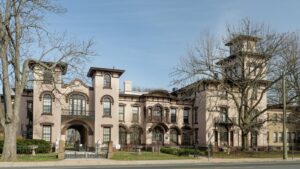
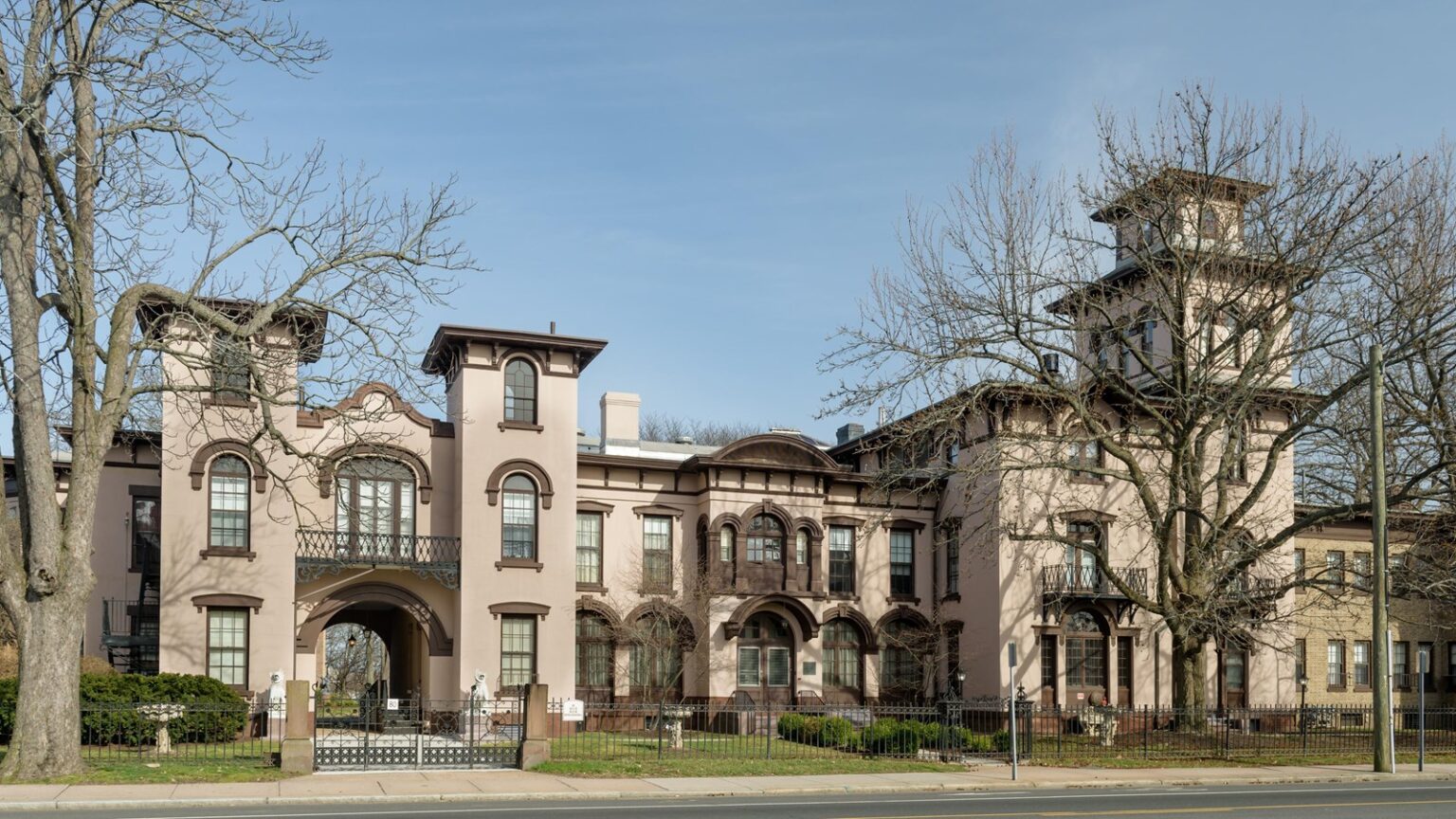
Samuel Colt commissioned Armsmear on Wethersfield Avenue, overlooking his armory. Local architect Octavius Jordan built it between 1856 and 1857, and Ringuet-LePrince & Marcotte, a decorating firm with offices in New York and Paris, furnished the interior. The house remained the Colt family home until Elizabeth’s death in 1905. [1]
Samuel Colt died in 1862. Elizabeth, his widow, became the largest stockholder in the Colt arms manufactory. She commissioned or bought paintings by Hudson River School artists including Frederic E. Church, Sanford Robinson Gifford, William Bradford, John F. Kensett, and Albert Bierstadt, and she collected decorative arts from America, Europe, and Asia. [4]
At Armsmear she reworked the public rooms. The ballroom became a private art gallery, and a reception room replaced the music room. She kept adding to the collection until her death, and the house became a memorial to the couple, with his gifts to her, his prized possessions, and purchases from her travels on display. [1]
The 1905 Bequest to the Wadsworth
Elizabeth Colt bequeathed almost 1,000 works to the Wadsworth Atheneum: paintings, ceramics, porcelain, objects, documents, and firearms. She also funded a new addition to the museum, the Elizabeth Hart Jarvis Colt Memorial Wing, completed in 1910. [4] It was the first wing in an American municipal museum to be named for a woman. [1]
The Wadsworth describes the Elizabeth Hart Jarvis Colt Collection as American and European paintings and sculpture, the furnishings and contents of Armsmear, and Samuel Colt’s personal collection of firearms, edged weapons, and armor from around the world. The arms include prototype weapons from his company and pieces presented to Colt as gifts by foreign rulers. Highlights named by the museum include the wooden model that, by the museum’s account, Colt carved aboard ship in his youth and that led to his revolver design; Moorish swords; Italian armor; and a Walker-Texas holster pistol. [2] Objects from the bequest carry 1905 accession numbers. Edward Sheffield Bartholomew’s marble bust of Elizabeth, made about 1857, is number 1905.1122. [4]
The house and grounds followed other paths. Elizabeth left the grounds of Armsmear, apart from the area immediately around the house, to the City of Hartford for public recreation, and they became Colt Park. [5] Armsmear itself was converted into apartments and opened in 1911 as a residence for senior women of faith with limited income. [1]
The 1957 Factory Gift
After the Penn-Texas Corporation took over Colt’s in 1955, its new president and chairman gave the collection of Colt guns then in the armory museum to the people of Connecticut. The Pratt & Whitney Company Foundation transferred the gun collection and the company’s business records to the State Library on March 7, 1957. [6]
The firearms form the Colt’s Patent Fire Arms Manufacturing Company Factory Collection at the Museum of Connecticut History. It centers on early Colt prototypes, factory models, and experimental firearms, and it also holds Colt-made Gatling guns, shotguns, and automatic weapons. The original “Rampant Colt” statue from the Hartford factory joined the collection in 1995 as a separate museum acquisition. [7]
The papers became Record Group 103 in the State Archives. They run from about 1810 to 1980, with most dating from 1840 to 1890, and they cover gun manufacturing at the armory, the company’s subsidiaries, and its outside contracting activities, including the Gatling Gun Company, the London Armory and Agency, and the Union Ferry Company. Staff first arranged them as a record group in 1971. [6] Photographs that came with the 1957 transfer, later enlarged by other donors, form Picture Group 460. It holds portraits of administrators and employees, factory views from the 1864 fire and the 1936 and 1938 floods, and views of Armsmear and Colt Park. [8]
What the Records Contain
The State Library identifies incoming correspondence and orders for arms as the strongest parts of the company’s business file. [6] The incoming letters run from 1836 to 1970, with most written before 1890. They are mainly orders and routine requests for catalogs, price lists, and parts, but they also include reports from company agents in Europe and the United States, early applications for work at the new armory, and personal letters from Samuel Colt’s brother James. [9]
The orders series holds dealer orders sent on Colt-supplied postcards from 1873 to 1897, U.S. Army and Navy orders from the Civil War period, War Department orders from World War I, and orders from foreign governments. A separate series of tests and reports, 1857 to 1921, documents government trials of Colt arms and military officers’ assessments of them. [9]
The accounting records survive in part. They include bills and receipts from 1840 to 1889, with gaps; Samuel Colt’s bank account book for 1857 to 1859; cash and rent books for 1863 to 1890; accounts for the “Allies,” a select group of Colt distributors, for 1883 and 1884; and contractors’ accounts. Some thirty contractors worked inside the armory, and their accounts record what they produced under contract and what Colt paid them. Production records from 1856 to 1928 add production logs, contractor logs, and time books. [9] A later accession added sales books, account ledgers, and cash books covering 1871 to 1934. [10] The record group does not include board minutes, personnel records, internal office memoranda, annual reports, or printed financial statements. [6]
Samuel Colt’s papers are divided among Hartford institutions. In 1982 Richard Mellon funded a project to reorganize and microfilm the Colt company records and Samuel Colt’s personal papers held by the Connecticut State Library, the Connecticut Historical Society, and the Wadsworth Atheneum. [6]
Shipping Records
Record Group 103 documents how the company operated, but it does not contain the records needed to trace an individual firearm. That information is in the company’s shipping records, which were not part of the 1957 donation and which Colt’s retained. [3][6] Colt’s refers requests for research letters drawn from those records to Colt Archive Properties. [11]
A Colt archive letter reports the original configuration, shipping date, and shipping destination of a firearm, usually with its caliber, barrel length, finish, stocks, and any custom features original to it. It does not trace later owners. Individual names appear only sparsely in the shipping ledgers, and assembler, inspector, military, and government markings were not recorded in the shipping records. [12]
Frequently Asked Questions
She left almost 1,000 works, including paintings, sculpture, ceramics, porcelain, documents, the furnishings and contents of Armsmear, and Samuel Colt’s personal collection of firearms, edged weapons, and armor. She also funded the Colt Memorial Wing, which was completed in 1910.
Armsmear was the Colt family home on Wethersfield Avenue in Hartford, built between 1856 and 1857 by architect Octavius Jordan. After Samuel Colt died, Elizabeth turned its ballroom into a private art gallery.
It gave the factory firearms collection from the armory museum and a large collection of business records. The Pratt & Whitney Company Foundation completed the transfer on March 7, 1957.
Record Group 103 covers about 1810 to 1980, with most records dating from 1840 to 1890. It includes incoming correspondence, orders for arms, tests and reports, production logs, and surviving accounts, including contractors’ accounts.
No. Tracing a specific firearm requires the company’s shipping records, which were not part of the 1957 donation and which Colt’s retained.
Sources
[1] National Park Service. “Armsmear (Samuel and Elizabeth Colt House).” Coltsville National Historical Park, n.d.
[2] Wadsworth Atheneum Museum of Art. “Colt Firearms.” Wadsworth Atheneum Museum of Art, n.d.
[3] Connecticut State Library. “Colt Patent Fire Arms Manufacturing Company.” Connecticut State Library, n.d.
[4] Wadsworth Atheneum Museum of Art. “Bust of Elizabeth Hart Jarvis Colt.” Object 1905.1122, Google Arts & Culture, n.d.
[5] National Park Service. “Colt Park.” Coltsville National Historical Park, n.d.
[6] Connecticut State Library. “Colt’s Patent Fire Arms Manufacturing Company Records, RG 103.” Finding aid, Connecticut State Archives, n.d.
[7] Museum of Connecticut History. “Colt Collection FAQs.” Connecticut State Library, May 7, 2026.
[8] Connecticut State Library. “Colt’s Patent Fire Arms Manufacturing Company Collection, PG 460.” Finding aid, Connecticut State Archives, n.d.
[9] Connecticut State Library. “RG 103, Colt’s Patent Fire Arms Manufacturing Company.” Series-level finding aid, Connecticut State Library, 2007. Archived copy, Internet Archive.
[10] Connecticut State Library. “Research Guide to Materials Relating to Colt’s Patent Fire Arms Manufacturing Company in the Connecticut State Library, State Archives, and Museum of Connecticut History.” Museum of Connecticut History, n.d. Archived copy, Internet Archive.
[11] Colt’s Manufacturing Company. “Archive Services.” Colt’s Manufacturing Company, n.d.
[12] Colt Archive Properties. “About The Archive Letter.” Colt Archive Properties, n.d.