
Key Takeaways:
- Paul Liebenberg opened Pistol Dynamics in Los Angeles in 1986 after managing Pachmayr Gun Works’ handgun division.
- His career connects Pistol Dynamics with experimental competition pistols, the development of the .40 S&W cartridge, and Smith & Wesson’s Performance Center.
- Pistol Dynamics has ended its traditional bespoke-order model and now offers hand-built, controlled-feature pistols after completion.
The M1911’s longevity rests on a proven military design and an unusual capacity for refinement. John M. Browning’s recoil-operated, single-action pistol was formally adopted by the U.S. Army on March 29, 1911. The original .45-caliber model used a detachable magazine and incorporated both manual and grip safeties. After serving as the standard American military sidearm for more than seven decades, it was succeeded by the 9mm M9 in 1985.[1][2]
Military service established the pistol’s reputation, but competition and custom gunsmithing expanded its possibilities. Barrel fit, sights, controls, grip geometry, trigger characteristics, and external contours could all be adapted without abandoning the underlying Browning system. Pistol Dynamics emerged from that tradition under gunsmith and competitive shooter Paul Liebenberg.
From Pachmayr to Pistol Dynamics
Liebenberg began his career in South Africa and immigrated to the United States in 1983. By 1986, American Handgunner identified him as the master gunsmith managing the handgun division of Pachmayr Gun Works in Los Angeles. The magazine documented his work on a modular competition pistol built around the Colt Government Model, with interchangeable configurations for .45 ACP, .38 Super, and 9mm competition.[3]
According to Pistol Dynamics’ company history, Liebenberg opened the original Pistol Dynamics shop in Los Angeles in 1986, initially producing competition pistols and completing contract work for Pachmayr. He joined Smith & Wesson in 1989, where he helped establish the company’s Performance Center, and returned to independent work in Florida in 2001.[4]
His influence also extended to the development of high-performance .40-caliber competition pistols. During the 1980s, Liebenberg worked with Whit Collins, barrel maker Irv Stone, and Bud Watson on the Centimeter cartridge and compatible 1911-pattern pistols. That work formed part of the development path that eventually led Liebenberg to Smith & Wesson and contributed to the company’s introduction of the .40 S&W cartridge and Model 4006 pistol.[5][6]
Documented Pistol Dynamics Features
Period reporting provides a clearer picture of Liebenberg’s work than broad claims about “custom” quality. A 1988 American Handgunner feature examined the Pistol Dynamics Carry Comp, a modified Springfield Armory Government Model in .45 ACP. Its documented features included a Bar-Sto barrel, compensator, adjustable cone bushing, handmade beavertail grip safety, fixed sights, interchangeable front sight, full-length guide rod, ambidextrous safety, and extensive internal fitting.[7]
The Carry Comp illustrates Liebenberg’s design-led approach. Components were not added solely for appearance; the pistol’s contours, controls, sighting system, barrel arrangement, and recoil-management features were treated as an integrated package.
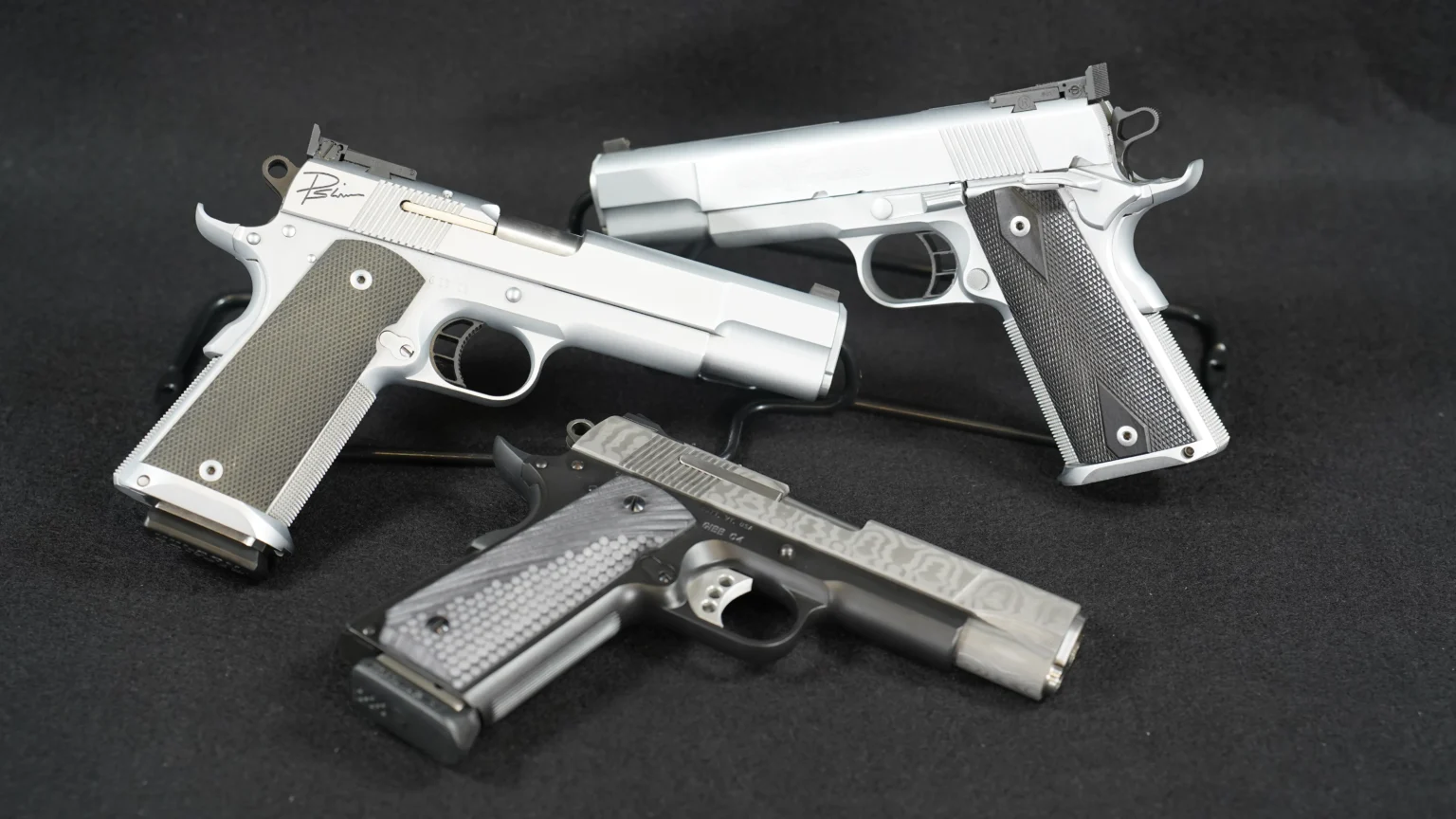
Competition pistols allowed for more extensive experimentation. Pistol Dynamics’ archive identifies IPSC and Bianchi pistols as an important part of Liebenberg’s early work and describes them as a proving ground for features that could later migrate into other designs.[8] Signature pistols occupied a different category, combining functional preparation with individually executed metalwork and aesthetic detailing. The company states that these pistols were handmade and tested to its performance requirements before delivery.[9]
These categories matter to collectors because “Pistol Dynamics 1911” does not describe a single standardized model. The name can encompass practical pistols, specialized competition builds, signature-grade arms, and pistols produced from customer-supplied or commercial foundations. Configuration, markings, date, base firearm, and accompanying records must therefore be evaluated individually.
A Changed Business Model
The traditional Pistol Dynamics business was built around one-off commissions, but that model has ended. The company’s current website states that it no longer accepts bespoke handgun orders. Instead, it focuses on hand-built pistols with predetermined features, offering them for sale after completion.[10]
That distinction is important. Historic Pistol Dynamics pistols may reflect direct consultation with an original customer, while current production follows a more controlled specification determined by the maker. Both can embody Liebenberg’s design philosophy, but they represent different periods in the company’s history.
For collectors, attribution should rest on documentary and physical evidence rather than reputation alone. Relevant evidence may include invoices, work orders, correspondence, test targets, authenticity documents, distinctive markings, and features consistent with documented Pistol Dynamics work. A period magazine appearance or company record can strengthen the history of a particular pistol, but it does not establish the originality or configuration of another example.
Pistol Dynamics occupies a distinct place in modern 1911 history because Liebenberg’s work connects several important strands of the custom-pistol trade: Pachmayr’s competition shop, the experimental handguns of the 1980s, Smith & Wesson’s Performance Center, and the continuation of individually built 1911-pattern pistols. The strongest examples are not merely elaborately finished firearms. They are documented expressions of a particular gunsmith’s evolving approach to mechanical design, competitive shooting, and traditional hand fitting.
Frequently Asked Questions
Paul Liebenberg is a gunsmith, firearm designer, and former competitive shooter whose career includes work at Pachmayr Gun Works, Smith & Wesson, and Pistol Dynamics.
According to the company’s published history, Liebenberg opened Pistol Dynamics in Los Angeles in 1986.
Documented examples combine functional modifications, hand fitting, and firearm-specific design work. Configurations vary because Pistol Dynamics produced practical, competition, signature, and commissioned pistols.
No. The company currently builds pistols with predetermined features and offers them for sale after completion.
Collectors should verify the firearm’s markings, configuration, condition, and documentary provenance. Useful records may include invoices, work orders, correspondence, test targets, and authenticity documents.
Sources
- U.S. Army Military History Institute, “Arming the Army: John M. Browning,” U.S. Army, January 12, 2009.
- Scott Engen, “The History of the 1911 Pistol,” Browning, January 24, 2011.
- Dave Arnold, “Pachmayr Modular Pistol,” American Handgunner, January/February 1986, p. 35.
- Pistol Dynamics, “About Paul,” company history.
- American Handgunner, “The Centimeter,” July/August 1987.
- Mike Wood, “The .40 Story,” American Handgunner, 2019.
- American Handgunner, “Pistol Dynamics Carry Comp,” July/August 1988, p. 56.
- Pistol Dynamics, “Competition Pistols,” company archive.
- Pistol Dynamics, “Signature Pistols,” company archive.
- Pistol Dynamics, “About Pistol Dynamics,” current company information.