
Key Takeaways
- The Model 1900 was Colt’s first production automatic pistol and used John M. Browning’s locked-breech, recoil-operated design.
- Early pistols featured a rear sight that doubled as a firing-pin safety, a system Colt later replaced with a fixed sight.
- The U.S. Army tested the pistol, while the Navy adopted it in limited numbers for boarding and shore duties.
Colt introduced the Model 1900 in 1900 as its first production automatic pistol. Designed by John M. Browning, it established the recoil-operated, locked-breech system from which Colt and Browning developed a succession of service-size automatic pistols.[1][2]
Design and Operation
The Model 1900 was chambered for the .38 Automatic Colt Pistol cartridge and fitted with a 6-inch barrel and seven-round detachable magazine.[3] It was a single-action, recoil-operated pistol in which the barrel and slide initially moved together after firing.
Browning’s patent described a magazine pistol that used recoil energy to unlock and open the breech, extract and eject the fired case, cock the hammer, chamber another cartridge, and close and lock the action.[2] The production pistol employed a full-length slide moving on rails in the frame. Front and rear links connected the barrel to the frame, allowing the barrel to move rearward and downward while remaining nearly parallel to the slide.[2][3]
This arrangement differs from the later M1911 system, which eliminated the forward link and used a barrel bushing at the muzzle. The underlying principle remained the same: the barrel and slide stayed locked together during the initial stage of recoil, then separated after pressure had fallen.[3]
The Sight Safety
Early Model 1900 pistols combined the rear sight with a firing-pin safety. Pressing the pivoting sight downward blocked the firing pin; raising it returned the sight to its firing position. The mechanism provided a positive mechanical block, but its location made it difficult to operate with the shooting hand.[3]
The pistol also lacked a device to hold the slide open after the final cartridge had been fired. Colt subsequently replaced the sight safety with a fixed rear sight. Browning addressed the absence of a hold-open mechanism in the Model 1902 Military, which incorporated a slide-locking lever, a longer grip, an eight-round magazine, and a lanyard ring.[3]
Army and Navy Evaluation
A U.S. Army board tested a Colt .38 automatic pistol between January and April 1900. The board reported advantages that included simple construction, ease of operation, rapid fire, convenient loading, a comparatively flat trajectory, and greater accuracy than a revolver. It recommended the purchase of pistols for field testing.[3][4]
The Navy also adopted the Colt M1900 in limited numbers for boarding and shore duties. The Naval History and Heritage Command identifies it as the Navy’s first adopted semi-automatic handgun and as part of the developmental line leading to the M1911.[5]
The Model 1900 did not become a universal U.S. service pistol. That distinction went to the .45-caliber M1911, which the Army adopted in 1911 after further development and competitive testing. The Library of Congress describes the M1911 as the first semi-automatic service pistol adopted across the United States military.[1][6]
Development into Later Colt Automatics
The Model 1900 established several features that continued through Colt’s early locked-breech automatics. Its full-length reciprocating slide enclosed the barrel, carried the breech face and firing pin, and stripped cartridges from the magazine as it returned forward. Its recoil spring was positioned beneath the barrel.[2][3]
Colt followed the original pistol with the Model 1902 Sporting and Model 1902 Military. The Model 1903 Pocket Hammer used the same general locked-breech system in a shorter configuration. Browning and Colt then adapted the system to .45 caliber, producing the Model 1905 and subsequent military-test pistols before reaching the M1911 configuration.[3][6]
Collector Identification
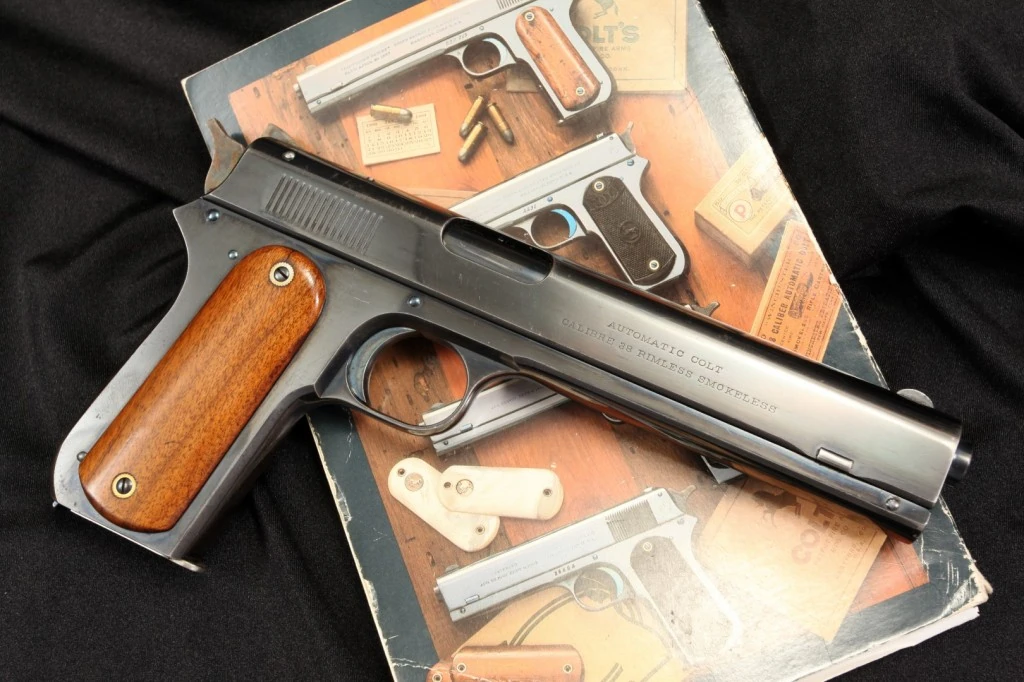
Original Model 1900 pistols are marked “AUTOMATIC COLT CALIBRE .38 RIMLESS SMOKELESS” on the right side of the slide. Standard early examples were fitted with smooth walnut stocks, although some Army pistols received roughly checkered wooden stocks.[3]
Slide-serration placement is another identification point. Early pistols had 16 vertical grooves at the rear of the slide. Colt later moved the serrations toward the front, and that arrangement continued through the remainder of Model 1900 production.[3] Surviving pistols may retain the original sight safety, have a fixed-sight factory alteration, or display other period changes. Those distinctions make the sight assembly, slide machining, grips, markings, and documented configuration central to evaluating an individual example.
The Model 1900’s significance rests on specific achievements. It was Colt’s first production automatic pistol, introduced Browning’s locked-breech slide system into Colt manufacture, underwent formal Army evaluation, entered limited Navy service, and provided a mechanical foundation for the automatic pistols that culminated in the M1911.[1][2][3][5][6]
Frequently Asked Questions
John M. Browning designed the recoil-operated system used in the Colt Model 1900.
The pistol was chambered for the .38 Automatic Colt Pistol cartridge, commonly called .38 ACP.
Its detachable magazine held seven cartridges.
Pressing the pivoting rear sight downward blocked the firing pin. Raising it returned the sight to its firing position.
The Army evaluated the pistol but did not adopt it as a universal service sidearm. The Navy adopted it in limited numbers for boarding and shore duties.
Sources
[1] Colt’s Manufacturing Company. “The Colt Story.” Colt’s Manufacturing Company, n.d.
[2] Browning, John M. “Firearm.” U.S. Patent No. 580,924, filed October 31, 1896, issued April 20, 1897.
[3] Rogers, Patrick F. “Colt’s Early Automatic Pistols.” American Rifleman, December 1984, republished November 10, 2024.
[4] U.S. Army Ordnance Department. “Report of Board on Tests of Automatic Pistols.” Appendix 15 in Annual Report of the Chief of Ordnance, 1900. U.S. Government Printing Office, 1901, pp. 177–194.
[5] Naval History and Heritage Command. “The U.S. Navy and World War I, Exhibition Panels 35–39.” Naval History and Heritage Command, n.d.
[6] Library of Congress. “Introduction: Military Sidearms, from Revolvers to Semi-Automatic Pistols.” Library of Congress, February 26, 2026.