
Key Takeaways:
- Innovative Engineering & Design: The Luger P08 stands out for its revolutionary toggle-lock action, ergonomic grip, and precision-focused design. These engineering innovations distinguished it from contemporaries and influenced future firearm developments.
- Historical and Military Significance: Adopted by the German Navy and Army in the early 20th century, the Luger P08 served in both World Wars, making it iconic as a symbol of German military might. Its presence on the battlefield and in the hands of various nations solidified its place in firearms history.
- Enduring Collectibility and Cultural Impact: Valued for its rarity, variant types (e.g., Navy, Artillery, Krieghoff), and historical provenance, the Luger P08 remains a highly prized collector’s item. Its continued relevance in modern shooting sports and popular culture highlights its timeless appeal.
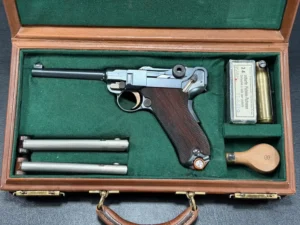
The Luger is best understood as a family of Parabellum pistols rather than a single model. Its development spanned several configurations before the German Army adopted the 9 mm Pistole 08, or P08, in 1908. That distinction matters: not every Luger is a P08, and the model name alone cannot establish a pistol’s date, manufacturer, or service history.
From Borchardt to Luger
Georg Luger developed his pistol from Hugo Borchardt’s earlier toggle-action design. He retained the rising-toggle operating principle and detachable magazine while substantially revising the pistol’s spring, extractor, safety system, grip, and overall proportions. The resulting handgun was lighter and easier to handle than the Borchardt.[1][2]
The first Luger produced in quantity was the Model 1900, chambered in 7.65 mm. Switzerland adopted that model as a service arm in 1901. The following year, Deutsche Waffen- und Munitionsfabriken, or DWM, introduced a Model 1902 chambered for the new 9 mm Parabellum cartridge.[1]
The German Navy adopted a 9 mm version in 1904. The German Army followed in 1908 with the Pistole 08. This model used a coiled mainspring, was chambered in 9 mm Parabellum, and omitted the grip safety found on some earlier Lugers. Early P08 pistols also lacked the hold-open device incorporated into subsequent production.[1]
The Toggle Mechanism
The Luger’s defining mechanical feature is its recoil-operated toggle action. Georg Luger’s 1906 United States patent describes a breech bolt actuated by toggle links and connected through a lever system to a compression spring. When the firearm discharges, the breech bolt moves rearward and the toggle links rise against spring tension. During the return movement, the spring and linkage drive the breech bolt back into its closed position.[3]
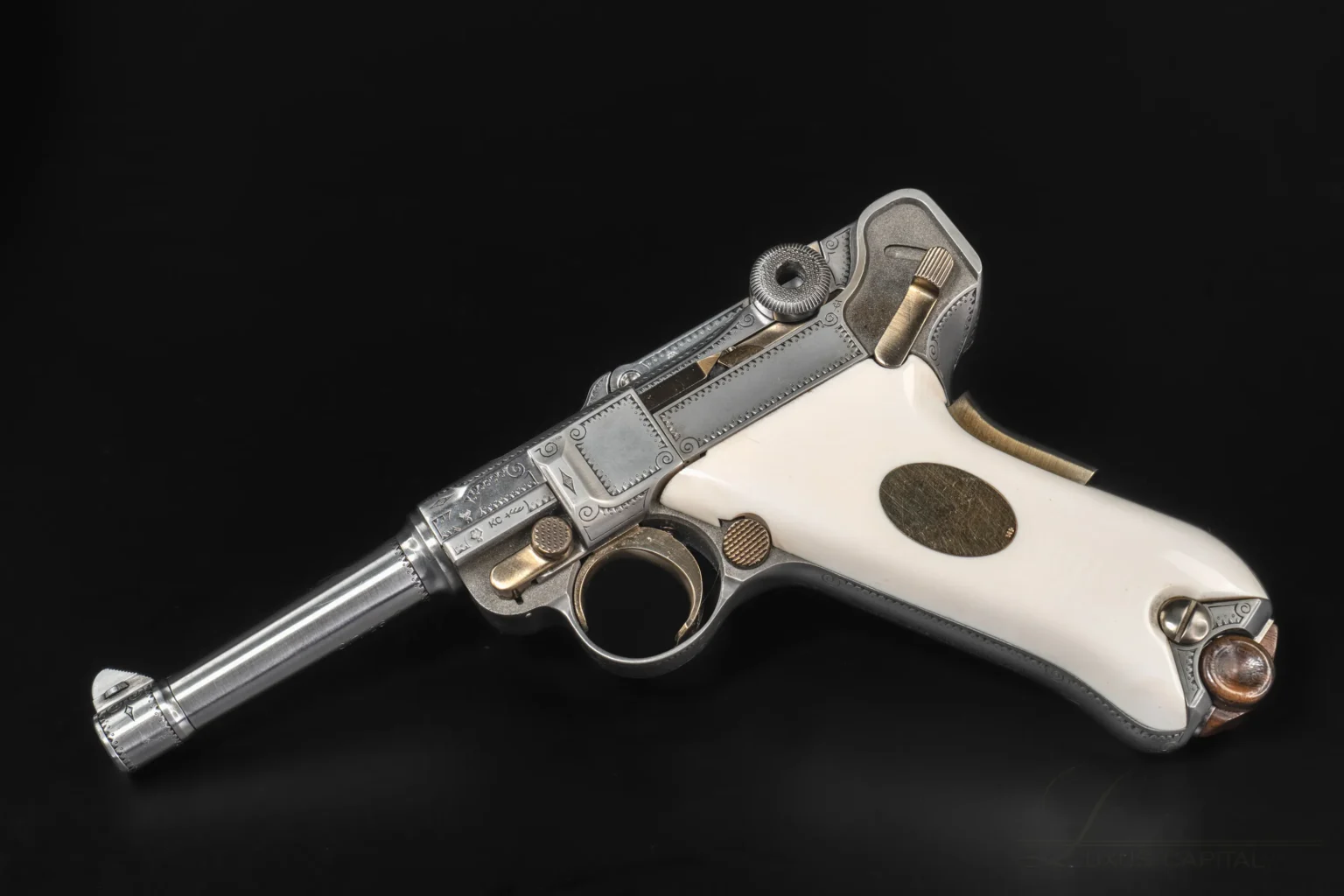
Although the mechanism was derived from the Borchardt system, Luger reorganized it into a more compact pistol. The exposed toggle and forward-raked grip gave the Parabellum its characteristic profile while the internal spring and linkage arrangements changed as the design evolved.
Military Production and Service
After the German Army adopted the P08, production expanded beyond DWM. The Royal Arsenal at Erfurt became an additional manufacturing center, and DWM and Erfurt supplied German forces during the First World War.[1]
Large numbers of Lugers subsequently reached the United States as war souvenirs or commercial imports. American Rifleman records that some imported pistols had been assembled from parts or rebuilt, occasionally with their original proof, manufacturer, or service markings removed. That history remains important to collectors because a functional Luger is not necessarily an original or correctly configured example.[1]
Mauser resumed Luger production at Oberndorf in 1930 and continued producing the pistol during the Second World War. The P08 remained the standard German military sidearm until the adoption of the Walther P38 before the war, although Lugers continued in production and service.[1][2]
Lugers were not limited to German Army issue. They were manufactured for naval, air-force, police, civilian, and foreign-contract use. These different production histories resulted in numerous combinations of calibers, barrel lengths, safety systems, markings, and other features.[1][2]
The Lange Pistole 08
One of the most distinctive military variants was the Lange Pistole 08, or LP08, commonly known as the Artillery Luger. DWM developed the model to provide greater effective reach than a standard pistol while remaining more compact than a conventional service rifle.[4]
The German Army adopted the LP08 in June 1913, with issue beginning the following year. DWM was its principal manufacturer, although Erfurt produced a limited number in 1914. The pistol included a mounting point for a wooden shoulder stock. Its extended configuration made it suitable for roles beyond ordinary sidearm service.[4]
The LP08 was initially issued to artillery units and later used by members of the German air service and assault troops. The Australian War Memorial estimates that approximately 155,000 were produced between 1914 and 1918. Its collection includes a DWM example dated 1917 whose serialized components match except for the magazine—a useful illustration of the detailed component examination required when documenting a collectible Luger.[4]
Krieghoff Luftwaffe Pistols
Heinrich Krieghoff produced another notable P08 variation. In 1935, the company received a contract for 10,000 pistols for the German Luftsportverband, a contract later associated with the Luftwaffe. Most were delivered during 1936 and 1937. The National Firearms Museum records that another 2,200 pistols were subsequently delivered in smaller batches as remaining parts were used.[5]
These pistols were produced in limited numbers and were primarily issued to Luftwaffe officers. Their distinct manufacturing history separates them from the much larger bodies of DWM, Erfurt, and Mauser production.[5]
Understanding a Collectible Luger
A collectible Luger must be evaluated through its physical evidence. The manufacturer’s mark, date or production code, proof and service markings, serial numbers, safety system, barrel configuration, and other mechanical features should form a consistent pattern.
Matching serial numbers can help establish that components have remained together, but they do not independently prove originality. Wartime use, arsenal work, commercial rebuilding, parts assembly, and deliberate alteration all affected surviving pistols. Removed or modified markings may also prevent a conclusive identification.[1]
The Luger’s historical importance lies partly in this complexity. It developed from the Borchardt system, introduced the Parabellum pistol in several successive forms, served across two world wars, and appeared in specialized Army, naval, air-service, police, civilian, and foreign-contract configurations. For collectors, the strongest examples are those whose markings, components, and documented history support one another.
Frequently Asked Questions
Georg Luger designed the Luger P08 in 1898 as an improvement on the Borchardt C-93. It introduced the innovative toggle-lock action.
While chambered initially in 7.65mm, the Luger P08 is most famously associated with the 9mm Parabellum (also known as 9mm Luger).
The Luger P08 uses a toggle-lock mechanism instead of a traditional, mechanically distinctive, and historically significant slide.
The Luger P08 served as a standard sidearm for German forces in World War I and II.
Navy Lugers feature longer barrels and adjustable sights, while Artillery Lugers include tangent rear sights and attachable shoulder stocks—both are rare and highly collectible variants.
Collectors prize the Luger P08 for its historical significance, unique engineering, variant rarity, and provenance. Original condition and manufacturer also significantly influence its value.
Sources
- James M. Triggs, “Exploded View: Luger P08,” American Rifleman, August 21, 2023.
- National Firearms Museum, “Mauser P08 Luger Semi-Automatic Pistol.”
- Georg Luger, “Recoil-Operated Firearm, U.S. Patent No. 839,778,” United States Patent Office, December 25, 1906.
- Australian War Memorial, “Luger LP08 Artillery Model Pistol: German Army,” Accession No. REL/07430.001.
- National Firearms Museum, “Krieghoff P08 Luger Semi-Automatic Pistol.”