
Key Takeaways:
- The Korth uses a recoil-operated, locked-breech action with a large locking wedge beneath the barrel casing.
- Its DA/SA mechanism was designed to give the hammer equal travel whether cocked manually, by the slide, or through the trigger.
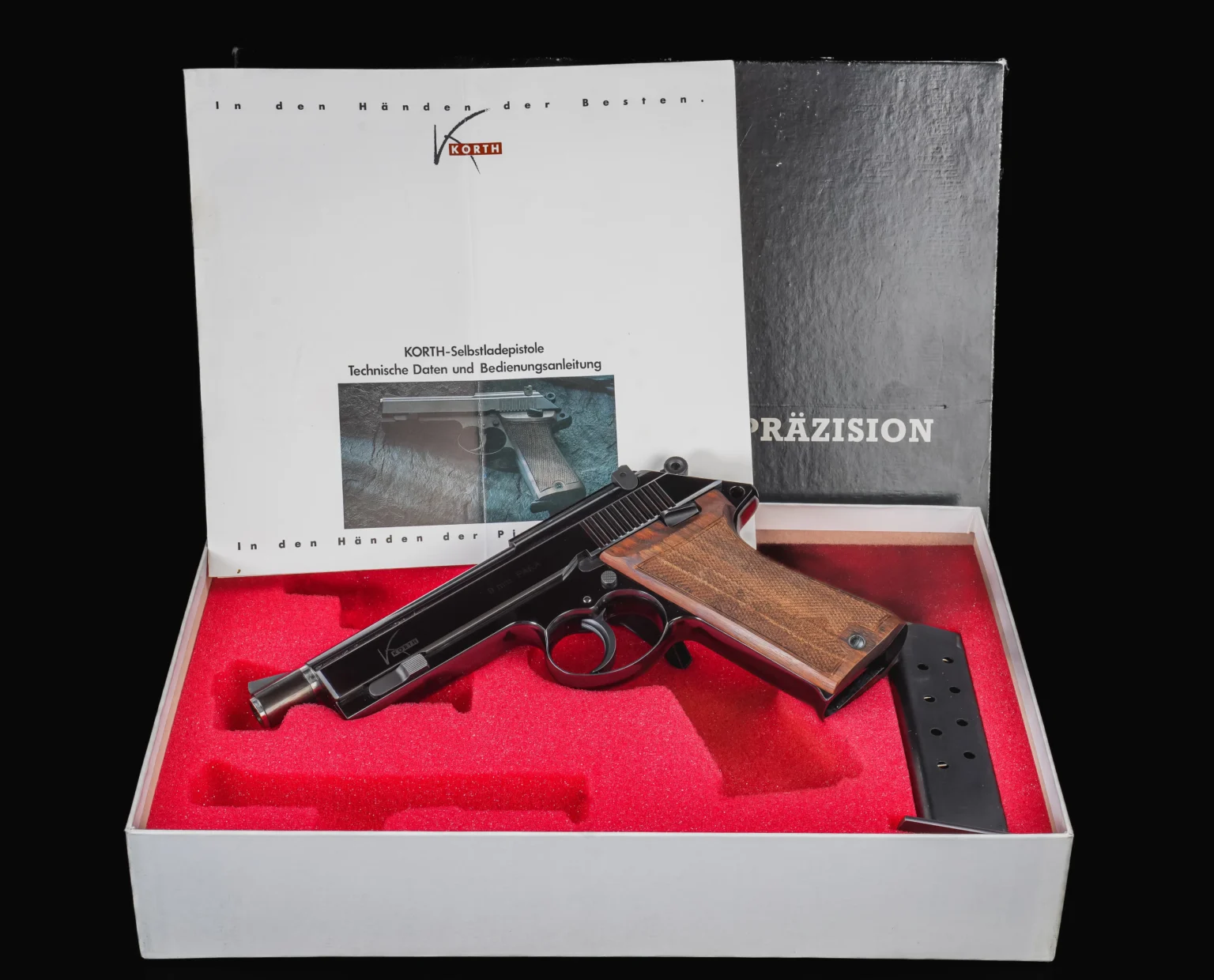
- The factory manual lists four chamberings, a 4-inch barrel, and magazine capacities of nine or 10 cartridges, depending on caliber.
Korth announced its 9mm Luger semi-automatic pistol in March 1982. A limited-production single-action version became available in 1985, followed by a double-action model marketed in France in 1987. Firearms writer Raymond Caranta reported that the first numbered batch ran from 1 through 100.[1]
The Patented Action
Alexander Kuckens and Willi Korth received U.S. Patent 4,589,326 for the pistol’s operating system on May 20, 1986. The patent describes a recoil-operated, mechanically locked pistol in which a large locking member connects the barrel casing and breech member during the first stage of recoil.[2]
When fired, the barrel casing and breech member begin moving rearward together. Control surfaces in the frame then move the locking member into its release position. The barrel casing stops after this limited travel, while the breech member continues rearward to extract and eject the fired case, compress the return spring, and cock the hammer. On the forward stroke, the pistol chambers a new cartridge and returns the locking member to engagement.[2]
The locking member is mounted in the breech member and engages a recess beneath the barrel casing. It also bears directly against the return-spring guide. This arrangement allowed the designers to use a comparatively large locking surface while keeping the operating components on the barrel’s longitudinal axis.[2] The later factory manual identifies the production mechanism as a locked-breech, recoil-operated system using a locking wedge with a stated locking area of 54 square millimeters.[3]
Trigger and Hammer Mechanism
The Korth is hammer-fired and operates in both double-action and single-action modes. The patented trigger mechanism uses a crank-like coupling between the trigger arm and hammer. Control surfaces on the trigger arm, slide, and frame regulate this coupling so that the hammer travels the same distance whether cocked manually, cocked by slide movement, or cocked and released through a double-action trigger pull.[2]
According to the patent, equalizing the hammer’s travel permitted the use of a lighter mainspring while retaining sufficient striking energy. The factory manual specifies a single-action pull of approximately 15 newtons, or 3.3 pounds, and a double-action pull of approximately 50 newtons, or 11 pounds. Listed trigger travel is 2.3 millimeters in single action and 13.3 millimeters in double action.[2][3]
The manual also describes a disconnector incorporated into the trigger bar. Its purpose is to interrupt the firing mechanism during cycling and prevent uncontrolled automatic fire.[3]
Safety and Readiness
The patented design places a safety control on the hammer near the pistol’s centerline, where it can be reached from either side and its position can be seen from the rear.[2] The later factory manual lists an external firing-pin safety as optional and identifies a loaded-chamber indicator among the pistol’s standard features.[3]
With a loaded chamber and the hammer lowered into its safety notch, the pistol can be fired through a double-action trigger pull. After the first shot, slide movement cocks the hammer, and subsequent shots are fired single-action unless the hammer is lowered again. With the chamber empty and the hammer in the safety notch, the pistol cannot fire.[3]
Production Specifications
The factory manual lists four chamberings: 9mm Parabellum, 9×21mm IMI, .357 SIG, and .40 S&W. Magazine capacity is 10 cartridges in the two 9mm chamberings and nine cartridges in .357 SIG or .40 S&W.[3]
The standard barrel measures 102 millimeters, or 4 inches. Overall length is 206 millimeters, height is 148 millimeters, and width is 33 millimeters. Unloaded weight is approximately 1,240 grams, or 2.73 pounds. The grip angle is 70 degrees, and the factory specified walnut grip panels.[3]
The manual counts 65 components and identifies the principal field-stripped assemblies as the frame and firing mechanism, barrel and barrel-shroud assembly, locking wedge, disassembly lever, recoil spring and guide, and slide with firing pin and safety lever. Routine field stripping requires no tools.[3]
Caranta’s 2003 account recorded the pistol in the same four chamberings listed in the manual. He also documented an early long-barreled 9mm example and a single-action-only version introduced in March 2001 with a shorter trigger movement and lighter pull.[1] These variations, together with the early numbered batch and the patented locking system, distinguish the Korth semi-automatic pistol from the company’s better-known revolver production.
Frequently Asked Questions
Korth announced the 9mm Luger pistol in March 1982. A limited-production single-action version became available in 1985, followed by a double-action model marketed in France in 1987.
The barrel casing and breech member initially recoil together. A locking wedge then disengages, allowing the breech member to continue rearward and cycle the action.
No. The documented production pistol is hammer-fired and operates in both double-action and single-action modes.
The factory manual lists 9mm Parabellum, 9×21mm IMI, .357 SIG, and .40 S&W. Capacity is 10 cartridges for the 9mm chamberings and nine for .357 SIG and .40 S&W.
Yes. The factory manual states that the pistol separates into its principal assemblies for routine cleaning and maintenance without tools.
Sources
[1] Caranta, Raymond. “The Guns of Europe.” Gun Digest, 57th ed., 2003, pp. 165–167.
[2] Kuckens, Alexander, and Willi Korth. “Self-Loading Pistol in the Form of a Mechanically Locked Recoil Loader.” U.S. Patent 4,589,326, issued May 20, 1986.
[3] Korth. KORTH Semi-Automatic Pistol: Technical Data and Operating Instructions. n.d., pp. 2–9.