
Key Takeaways:
- The P9S uses a stationary polygonal barrel and recoil-operated, roller-locked action.
- Hermann Historica reported that 239 early PSP pistols were manufactured.
- A documented P7 M13 Training Program Weapon sold for a net hammer price of €8,000 in November 2024.
Heckler & Koch was founded in Germany in 1949 and is headquartered in Oberndorf am Neckar.[1] Among its discontinued handguns, the P9S and early members of the P7 family remain particularly interesting because their mechanical designs differ substantially from those of conventional service pistols.
The P9S
The P9S combines a stationary polygonal barrel with a recoil-operated, roller-locked action. Its concealed hammer is controlled through a lateral cocking and decocking lever, while a molded synthetic covering surrounds the steel receiver.[2]
These features make the P9S mechanically distinctive. The roller system reduces the rearward velocity of the slide, while the stationary barrel eliminates the movement associated with conventional short-recoil pistol designs.[2]
Collectors should distinguish the documented P9S from alleged experimental derivatives. A model name or auction description is not sufficient to authenticate a prototype or factory-development pistol. Such a firearm requires physical examination and documentation connecting its markings, serial number, proof marks, and configuration to Heckler & Koch.
The Early PSP
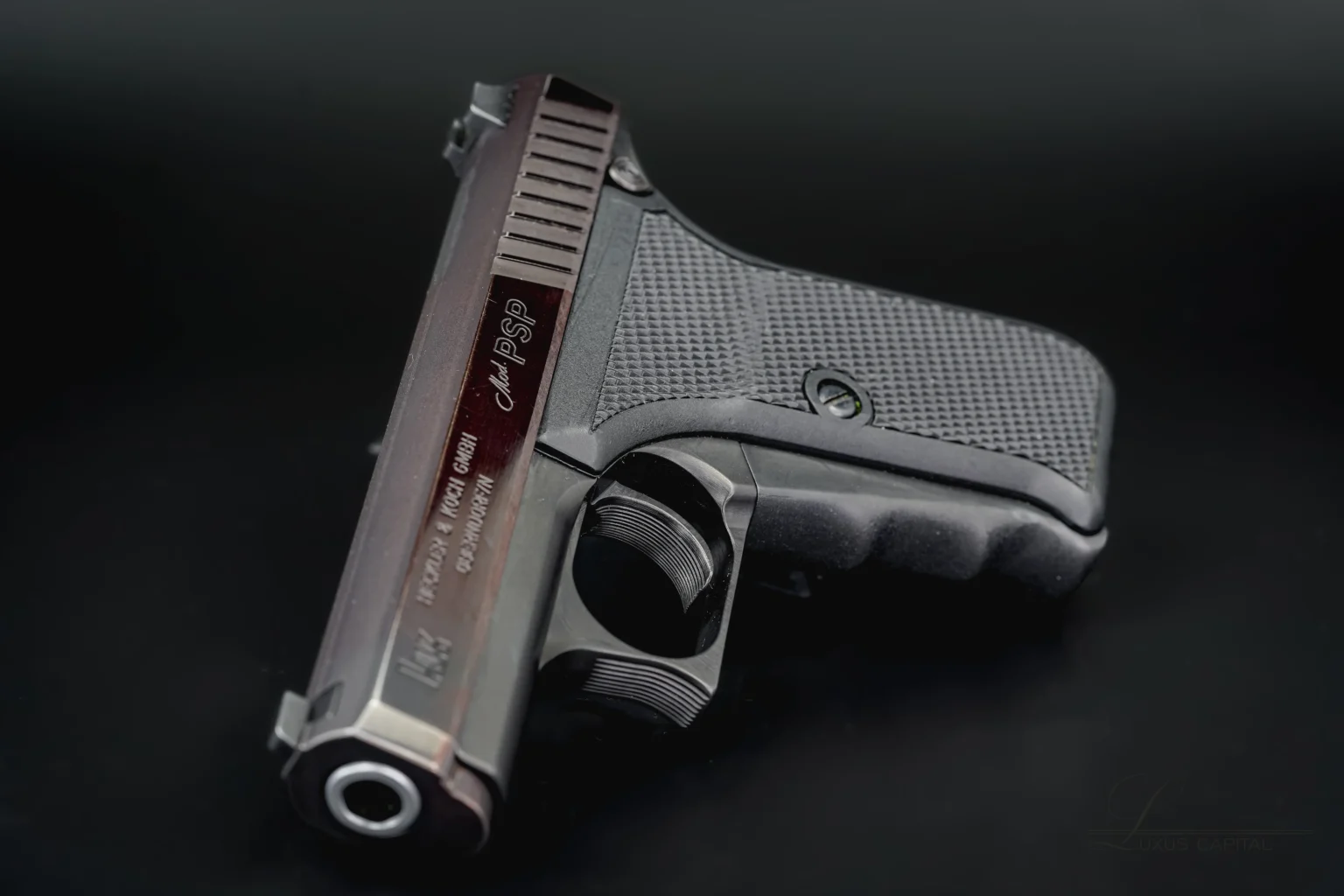
The early PSP, Polizei-Selbstlade-Pistole, or police self-loading pistol, preceded the standardized P7.
Its fixed polygonal barrel works with a gas-retarded operating system. When the pistol is fired, propellant gas enters a cylinder beneath the barrel and acts against a piston attached to the slide. This temporarily retards the slide’s rearward movement.[3]
The pistol’s most recognizable feature is its squeeze-cocking lever. Depressing the lever on the front of the grip cocks the pistol; releasing it decocks the mechanism. The lever also functions as a safety device and can release the slide when it is locked open.[3]
The PSP uses an eight-round, single-column 9×19mm magazine and a magazine catch at the base of the grip. Later P7M8 and P7M13 pistols relocated the magazine release to the frame behind the trigger guard.[3]
Hermann Historica reported that 239 early PSP pistols were manufactured and that changes were introduced during production and testing. At its November 2024 auction, two nearly new examples sold for net hammer prices of €10,500 and €9,500.[4]
Because the PSP evolved during its limited production, differences among surviving pistols may be historically significant. Authentication should therefore focus on the individual firearm rather than a generalized list of model features.
The P7 M13 Training Program Weapon
The production P7M13 retained the P7 family’s fixed barrel, gas-retarded action, and squeeze-cocking system. Its principal distinction was a wider, double-row magazine holding 13 rounds of 9×19mm ammunition. With one additional cartridge in the chamber, the pistol’s total loaded capacity was 14 rounds.[3]
A specialized example identified as a P7 M13 “Training Program Weapon” appeared in Hermann Historica’s November 2024 auction. The auction house described it as the eleventh series-produced pistol and reported that it remained in nearly new condition. It sold for a net hammer price of €8,000 against a €5,000 starting price.[4]
The available documentation establishes the identity and sale of that specific firearm. It does not establish that every unusually marked or modified P7M13 belongs to the same program. A claimed Training Program Weapon should be supported by its original markings, correct physical configuration, serial number, and documentary provenance.
Collecting Rare HK Pistols
Rare Heckler & Koch pistols should be evaluated firearm by firearm. Important evidence includes:
- Model and caliber markings
- Serial number and proof marks
- Factory finish
- Correct controls and internal components
- Matching magazines and accessories
- Original box, manual, tools, and test target
- Factory, institutional, or other documented provenance
Auction prices provide evidence of what particular examples achieved on a particular date. They do not establish a universal market value. Condition, originality, documentation, and the credibility of the firearm’s provenance remain decisive.
The P9S demonstrates Heckler & Koch’s use of a roller-operated pistol action. Early PSP records document the development of the P7 before its configuration became standardized. The documented P7 M13 Training Program Weapon represents a specialized variation of the higher-capacity P7. Their significance rests not on promotional claims, but on identifiable engineering and verifiable history.
Frequently Asked Questions
The P9S combines a stationary polygonal barrel with a recoil-operated, roller-locked action. It also has a concealed hammer and a lateral cocking and decocking lever.
The early PSP was a developmental predecessor to the standardized P7. Hermann Historica reported that 239 examples were manufactured.
The PSP uses an eight-round, single-column magazine with a release at the base of the grip. The later P7M8 and P7M13 place their magazine-release controls behind the trigger guard.
Its double-row magazine holds 13 rounds of 9×19mm ammunition. Its total loaded capacity is 14 rounds when one cartridge is chambered.
Hermann Historica documented a specialized example identified by that name and described it as the eleventh series-produced pistol. Authentication of another example requires matching physical features and credible provenance.
Sources
- Heckler & Koch, “75th Anniversary,” May 16, 2025.
- Heckler & Koch, “P9S Automatic Pistol, Caliber .45 ACP: Instruction Manual.”
- Heckler & Koch, “Operator’s Manual for P7 Series Pistols,” revised March 2007.
- Hermann Historica, “November 2024 Auction Report,” December 2024.