
Key Takeaways:
- The G11 was developed as a potential replacement for the Bundeswehr’s G3 rifle and MP2 submachine gun, but it never entered series production or service.
- Its 4.73×33mm DM11 cartridge used specialized high-ignition-temperature propellant to reduce the cook-off risk associated with caseless ammunition.
- Germany suspended procurement after requirements and budgets changed, while an official audit found that development and testing remained incomplete.
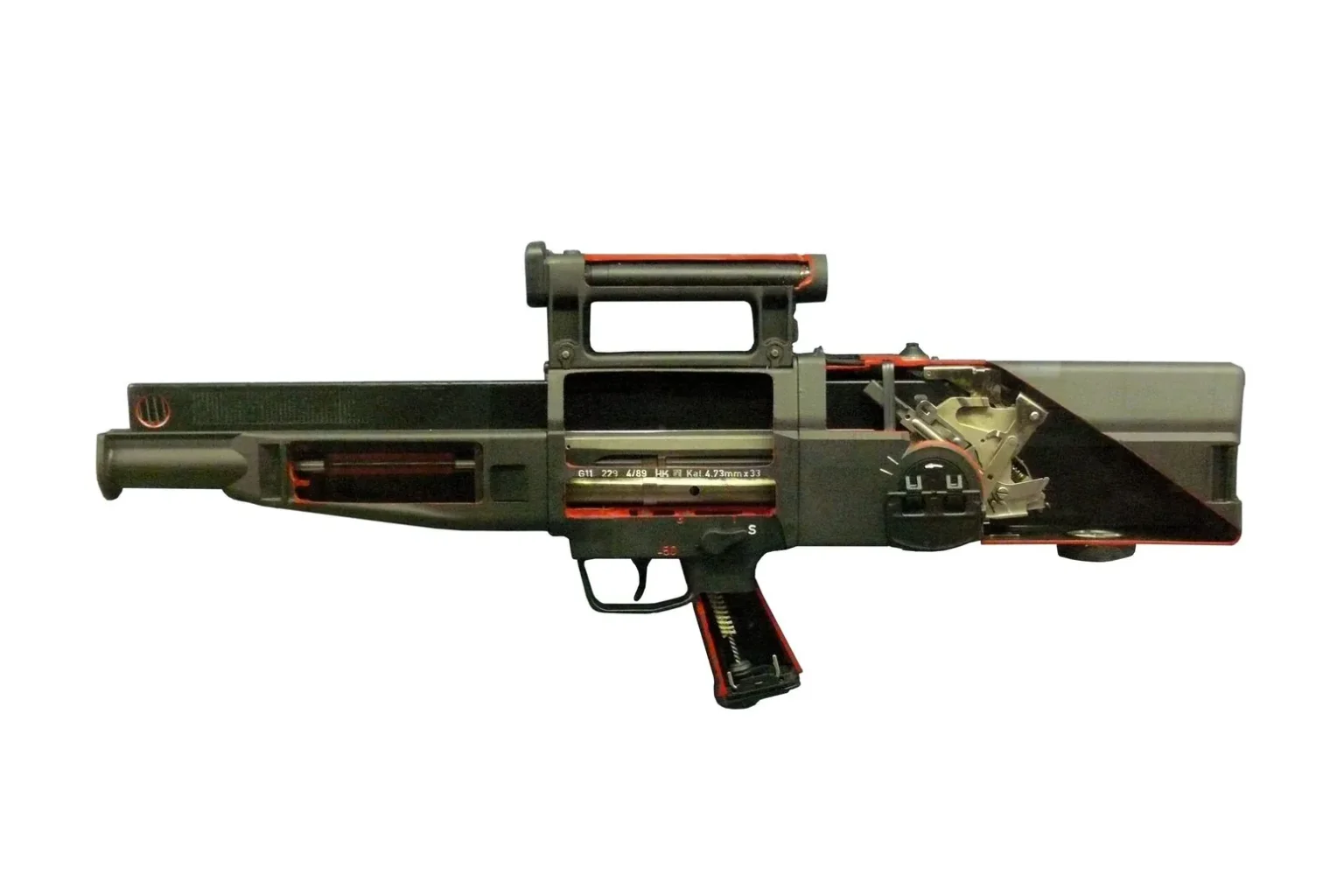
The Heckler & Koch G11 was more than an experimental rifle. It was an attempt to replace the conventional relationship between firearm and cartridge with an integrated weapon-and-ammunition system. Developed for West Germany during the Cold War, it combined caseless ammunition, a rotating chamber, an integrated optical sight, and a rapid three-round burst. The design reached advanced government trials but never entered series production or Bundeswehr service.
Origins of the Program
The G11 originated in a 1970 Bundeswehr requirement for a weapon capable of replacing the 7.62×51mm G3 rifle and the 9×19mm MP2 submachine gun. The German Ministry of Defense authorized development of the new rifle in 1974. Initial planning envisioned adoption beginning in 1979, but the project’s technical demands extended development for nearly two decades.[1]
Three German companies supplied the system’s principal components. Heckler & Koch developed the rifle, Dynamit Nobel developed the caseless ammunition, and Hensoldt produced the integrated optical sight.[2] This arrangement reflected the project’s central premise: the firearm, ammunition, and sighting equipment had to be engineered as a complete system.
The Caseless DM11 Cartridge
The mature German cartridge was designated 4.73×33mm DM11. Its 3.25-gram projectile was enclosed within a rectangular propellant body rather than seated in a metallic cartridge case. The propellant body also held the projectile and ignition components together.[3]
Eliminating the case offered clear advantages. The ammunition could be lighter and more compact, and the rifle did not require a conventional extraction-and-ejection cycle. However, the missing case also created significant technical problems.
In a conventional firearm, the cartridge case helps seal the chamber when pressure rises. Once ejected, it also carries some heat out of the weapon. A caseless rifle must provide its own mechanical gas seal while retaining more heat in the chamber. That heat can cause a cartridge to ignite without a trigger pull—a dangerous malfunction known as a cook-off.[4]
Dynamit Nobel addressed the heat problem by developing a high-ignition-temperature propellant based on HMX, known in German as Oktogen. Patent documentation states that the new composition raised the ammunition’s ignition threshold by approximately 100 degrees Celsius compared with earlier nitrocellulose propellant, which could ignite at about 180 degrees Celsius.[3]
Later technical analysis found that the G11 cartridge achieved cook-off resistance comparable to conventional brass-cased ammunition, but doing so required both specialized propellant and a heat-resistant surface coating. The propellant body also had to be strong enough to survive transportation, handling, and the weapon’s feeding cycle while remaining capable of breaking up and burning correctly when fired.[4]
An Unconventional Mechanism
The G11’s magazine was positioned horizontally above the barrel, with its cartridges oriented across the bore. A cartridge entered a cylindrical chamber, which rotated 90 degrees to align the round with the barrel for firing. Heckler & Koch’s patents document the swiveling breech arrangement and the specialized sealing mechanisms required to contain high-pressure gas when firing caseless ammunition.[5]
The barrel and operating mechanism were mounted together inside the rifle’s external housing. In three-round-burst mode, the internal assembly could move rearward while the rifle discharged the burst at a very high cyclic rate. The purpose was to send the three projectiles toward the target before the full recoil impulse significantly displaced the shooter’s point of aim.
This operating principle distinguished the G11 from conventional service rifles, in which feeding, chambering, locking, extraction, and ejection generally occur along the bore axis. The absence of a fired case removed the extraction and ejection stages, but the resulting rotating chamber and sealing system introduced a different kind of mechanical complexity.
The rifle’s optical sight was integrated into its carrying handle, another unusual feature for a service-rifle design of the period.[2] Late configurations also provided mounting positions for reserve magazines alongside the magazine feeding the rifle.
The Advanced Combat Rifle Program
The United States Army selected the G11 as one of the candidates in its Advanced Combat Rifle program. The program examined new technologies intended to improve the soldier’s probability of hitting a target, including flechette ammunition, multiple-projectile cartridges, and the G11’s caseless system.
The ammunition nomenclature can cause confusion. The original cartridge was identified as 4.73×33mm when the U.S. Army awarded an early contract to Heckler & Koch. When the G11 entered the Advanced Combat Rifle program in 1984, American documentation used the designation 4.92×34mm. The German military designation remained DM11.[4]
The G11’s participation in the program demonstrated that it had advanced beyond a laboratory experiment. It did not, however, result in an American production order or military adoption.
Planned German Procurement
By 1990, the G11 also appeared close to German procurement. The federal defense budget included funds to begin purchasing the rifle and its associated ammunition. In response to parliamentary questions, the German government confirmed that procurement initiation was included in the 1990 budget.[6]
The subsequent Federal Court of Auditors report presents a more cautious assessment of the weapon’s readiness. Approximately DM100 million had been spent on development, compared with an original estimate of DM13 million. Only five rifles representing the final design standard, together with 26,401 rounds, had been available for technical evaluation and troop trials.[1]
The auditors concluded that this limited test material was insufficient to establish the rifle’s technical readiness and suitability for service. They also identified incomplete ammunition development and inadequate capability under twilight conditions. An estimated additional DM80 million would have been required to finish development and prepare the system for series production.[1]
On March 8, 1992, the Ministry of Defense formally ended the program at its existing development and testing stage. Although an introduction authorization was issued, procurement was suspended indefinitely because the Bundeswehr no longer had an established requirement for the weapon.[1]
German reunification had substantially changed the country’s defense requirements and budget priorities. In May 1991, the federal government stated that reductions to the defense budget and the resulting reprioritization of procurement programs meant that G11 acquisition could not proceed.[7]
The rifle therefore did not receive a series-production contract, was not adopted as the Bundeswehr’s standard service rifle, and was never fielded in combat.
Historical and Collectible Significance
The G11 occupies an unusual place in firearms history. It advanced well beyond an early concept and demonstrated that a shoulder-fired military rifle could operate with durable caseless ammunition, a mechanically sealed rotating chamber, and a rapid controlled burst. At the same time, Germany’s official audit found that the system had not completed every development requirement when procurement was suspended.
For collectors and museums, surviving G11s should be understood as development, trial, or demonstration arms rather than examples from a standardized production run. Configuration and documented provenance are particularly important because the rifle and its ammunition changed repeatedly during development.
Claims that approximately 1,000 G11 rifles were produced are frequently repeated, but the official records cited here do not establish a total production quantity. The German audit confirms only that five final-configuration rifles were available for the principal technical and troop evaluations.[1] That figure should not be interpreted as the total number of prototypes, experimental variants, or demonstration weapons manufactured during the program.
The G11 remains historically important because of the scope of its engineering ambition. It addressed ammunition weight, recoil management, sight integration, chamber sealing, and automatic-fire dispersion as parts of one system. Its failure to enter service was not proof that caseless ammunition could not work. It demonstrated that technical feasibility alone does not guarantee military adoption, particularly when a weapon requires new ammunition production, specialized logistics, prolonged development, and substantial additional investment.
Frequently Asked Questions
The G11 was an experimental West German military rifle built around caseless ammunition. Heckler & Koch developed the firearm with ammunition from Dynamit Nobel and an optical sight from Hensoldt.
The mature German design used the 4.73×33mm DM11 caseless cartridge. Its 3.25-gram projectile and ignition components were contained within a rectangular propellant body.
Cartridges entered a cylindrical chamber from a magazine positioned above the barrel. The chamber rotated 90 degrees to align each cartridge with the bore for firing.
German reunification changed the Bundeswehr’s requirements and defense-spending priorities. An official audit also found that testing was limited and parts of the system remained incomplete.
The reviewed official records do not establish a total production quantity. They confirm that five final-configuration rifles were available for the principal technical and troop evaluations, but that figure excludes earlier prototypes and other development arms.
Sources
- German Federal Parliament (1992), Comments of the German Federal Court of Auditors on Federal Financial and Administrative Management, 1992, Parliamentary Paper 12/3250, sections 20–21. Original publication in German. https://dserver.bundestag.de/btd/12/032/1203250.pdf
- Kurtenbach, J. (2020), “Heckler & Koch: The Gray Room, Part I,” American Rifleman. https://www.americanrifleman.org/content/heckler-koch-the-gray-room-part-i/
- German Patent Office (1990), Caseless Ammunition, Especially for Assault Rifles, Machine Guns, and Sniper Rifles of the Same Caliber, Patent DE3834925A1. Original patent in German; English translation available through Google Patents. https://patents.google.com/patent/DE3834925A1/en
- Jenzen-Jones, N.R. (2016), Chambering the Next Round: Emerging Small-Caliber Cartridge Technologies, Small Arms Survey Working Paper 23. https://www.smallarmssurvey.org/sites/default/files/resources/SAS-WP23-cartridge-technologies.pdf
- Heckler & Koch GmbH (1976), Shoulder Arm with Swiveling Breech Member, U.S. Patent 3,997,994; Heckler & Koch GmbH (1983), Firearm for Caseless Ammunition, German Patent DE3325605C1. https://patents.google.com/patent/US3997994A/en; https://patents.google.com/patent/DE3325605C1/en
- German Federal Parliament (1990), Federal Government Response Concerning Caseless Rifle Systems for the Bundeswehr and Federal Police, Parliamentary Paper 11/7055. Original publication in German. https://dserver.bundestag.de/btd/11/070/1107055.pdf
- German Federal Parliament (1991), Plenary Record 12/25, response by Parliamentary State Secretary Willy Wimmer, May 14, 1991. Original publication in German. https://dserver.bundestag.de/btp/12/12025.pdf