
Key Takeaways
- The Korth Combat evolved from Willi Korth’s early work in Ratzeburg and entered conventional revolver production during the 1960s.
- Documented features include a distinctive rear-mounted cylinder release, removable cylinder assembly, and adjustable double-action trigger system.
- Chambering, capacity, barrel length, finish, and mechanical details vary by production period, so each revolver must be evaluated individually.
Willi Korth established his workshop in Ratzeburg, West Germany, after designing an alarm revolver in 1953. Between 1954 and 1964, the business reportedly produced approximately 20,000 alarm revolvers. Revenue and manufacturing experience from those arms supported Korth’s move into conventional sporting revolvers in 1964.[1]
The Combat emerged from this early production as Korth’s practical, double-action revolver. Although often discussed as a single model, it has appeared in several configurations and chamberings over its long history. A 2003 Gun Digest account described the basic four-inch Combat as a six-shot revolver weighing 36 ounces and listed versions in .22 Long Rifle, .22 Winchester Magnum Rimfire, .32 S&W Long, .38 Special, and .357 Magnum. The same source recorded five-shot .38 Special and .357 Magnum variants made from 1966 through 1968.[1]
A Distinctive Mechanical Design
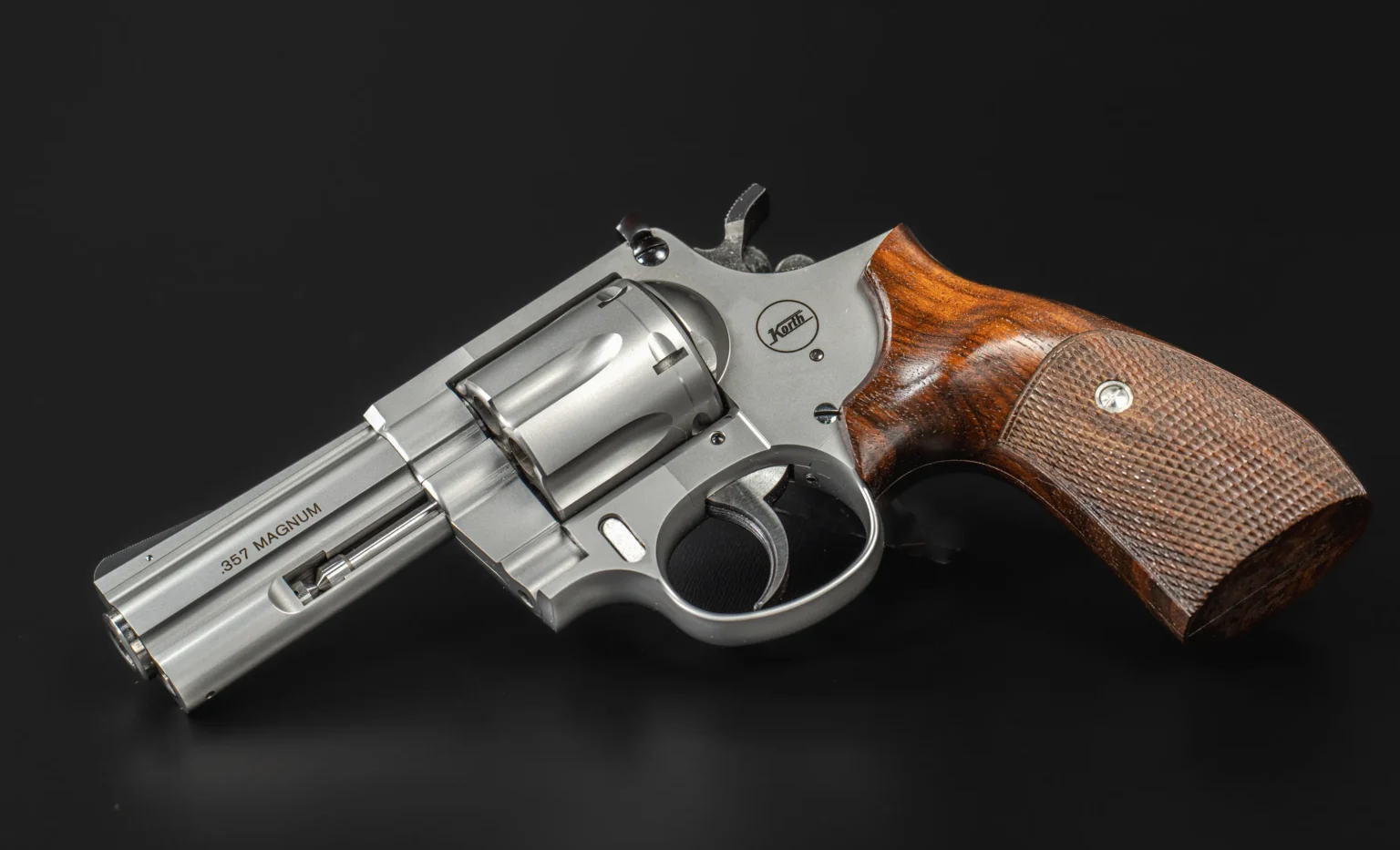
Korth revolvers are recognizable for more than their finish. Traditional examples employ a cylinder release positioned beside the hammer, rather than the frame-mounted latch familiar from many American revolvers. Their cylinders can also be removed without conventional disassembly tools, allowing a properly fitted alternate cylinder to be installed.[1][3]
Willi Korth’s attention to the trigger mechanism is documented in German patent application DE1904675A1, filed on January 31, 1969, and published on August 20, 1970. The application describes a double-action system employing a rotating wheel in the trigger cam. Interchangeable wheels of different diameters could alter the trigger’s pressure-point characteristics.[2] This arrangement remains part of the modern Combat NSC specification, for which Korth supplies three wheel sizes to modify the character of the double-action pull.[4]
Published accounts also describe an unusually labor-intensive production process. In the early 2000s, Korth stated that approximately 70 percent of revolver manufacture consisted of manual operations, including component shaping, fitting, inspection, and final assembly.[1][3] That figure belongs to a particular production period and should not be treated as a verified description of every Korth revolver made before or since.
Documented Performance
A 2002 Gun Tests evaluation examined a four-inch, six-shot Combat Magnum chambered for .357 Magnum and compatible with .38 Special ammunition. The test revolver measured 9.4 inches overall and was fired for accuracy at 25 yards.[3]
Across four commercial loads, its five-shot groups averaged between 1.3 and 1.9 inches. The smallest reported group measured 0.7 inch with Winchester’s 110-grain .357 Magnum load. These results document the performance of one revolver with specific ammunition under the magazine’s test conditions; they do not establish an accuracy guarantee for every Combat.[3]
The tested revolver also displayed characteristics associated with traditional Korth production: conventional rifling, a fully lugged barrel shroud, an adjustable rear sight, closely fitted exterior components, and a removable cylinder assembly.[3]
The Modern Combat NSC
The current model designation is Combat NSC, not “Combat NCS.” Korth lists six-shot .357 Magnum versions with three-, four-, 5¼-, and six-inch barrels.[5] The manufacturer’s specifications for the four-inch model give a weight of 2.42 pounds, an overall length of 8.86 inches, a height of 6.1 inches, and a width of 1.54 inches.[4]
Standard features include a cold-forged barrel, double- and single-action operation, an adjustable rear sight, a replaceable front sight, an externally adjustable mainspring, a DLC-coated finish, and the traditional rear-mounted cylinder release. Korth also offers fitted cylinder-and-crane assemblies in .38 Special and 9 mm Luger, including a 9 mm version cut for moon clips.[4]
These specifications describe the present Combat NSC and should not be projected backward onto vintage Combat revolvers. Earlier guns vary in chambering, capacity, barrel length, sights, grips, finish, and mechanical details.
The Combat as a Collectible
For collectors, “Korth Combat” is a family name rather than a complete identification. A sound evaluation begins with the individual revolver: its serial number, proof marks, chambering, barrel length, cylinder configuration, finish, grips, accessories, and accompanying records. Claims about production date, originality, or rarity require evidence specific to that firearm.
Condition is equally important, but cosmetic appearance alone is insufficient. Cylinder timing, lockup, bore condition, forcing-cone wear, mechanical alterations, and the fit of any interchangeable cylinder all warrant examination by a qualified specialist. Original packaging, test targets, manuals, tools, alternate cylinders, and documented ownership can further distinguish a complete collector’s set from an otherwise similar revolver.
The Korth Combat’s significance rests on a documented combination of distinctive engineering, extensive hand fitting, and continuity across several generations of German manufacture. Its variations are part of its appeal, and the reason precise identification matters.
Frequently Asked Questions
Who developed the Korth Combat revolver?
The Combat originated with German gunmaker Willi Korth, whose company began producing conventional sporting revolvers in 1964.
What distinguishes the Korth Combat mechanically?
Traditional examples feature a cylinder release beside the hammer and a removable cylinder assembly. Willi Korth also patented a trigger system using interchangeable wheels to alter the double-action pressure point.
Which calibers were offered in historical Korth Combat revolvers?
Published records identify versions in .22 Long Rifle, .22 Winchester Magnum Rimfire, .32 S&W Long, .38 Special, and .357 Magnum. Chamberings and cylinder capacities varied by production period.
How accurate is the Korth Combat?
In a 2002 Gun Tests evaluation, one four-inch Combat produced five-shot groups averaging between 1.3 and 1.9 inches at 25 yards. Those results apply only to the tested revolver, ammunition, and conditions.
What should collectors examine before buying a Korth Combat?
Collectors should verify the serial number, proof marks, chambering, barrel length, cylinder configuration, finish, grips, mechanical condition, and accompanying documentation. Claims of rarity, originality, or production date require evidence specific to the individual revolver.
Sources
- Raymond Caranta, “Korth: Workmanship Supreme,” Gun Digest, 57th Edition, 2003, pp. 164–167.
- Willi Korth, “DE1904675A1: Vorrichtung zum Erzeugen eines Druckpunktes bei einem Revolver,” German patent application, filed January 31, 1969; published August 20, 1970.
- Gun Tests, “Korth Combat Revolver, $4,700: The Ultimate Conditional Buy,” July 2002.
- PTW KORTH Technologies GmbH, “KORTH Combat Revolver NSC 4 Inch .357 MAG,” official manufacturer specifications.
- PTW KORTH Technologies GmbH, “Revolver Product Catalog,” official manufacturer model listings.