
Key Takeaways
- The Coonan is a distinct 1911-inspired pistol, not a conventional M1911 rechambered for .357 Magnum.
- The Model A used a linked barrel, while the Model B introduced a linkless barrel system.
- Collectors should distinguish the early Cadet from the later Compact and verify markings, configuration, and provenance.
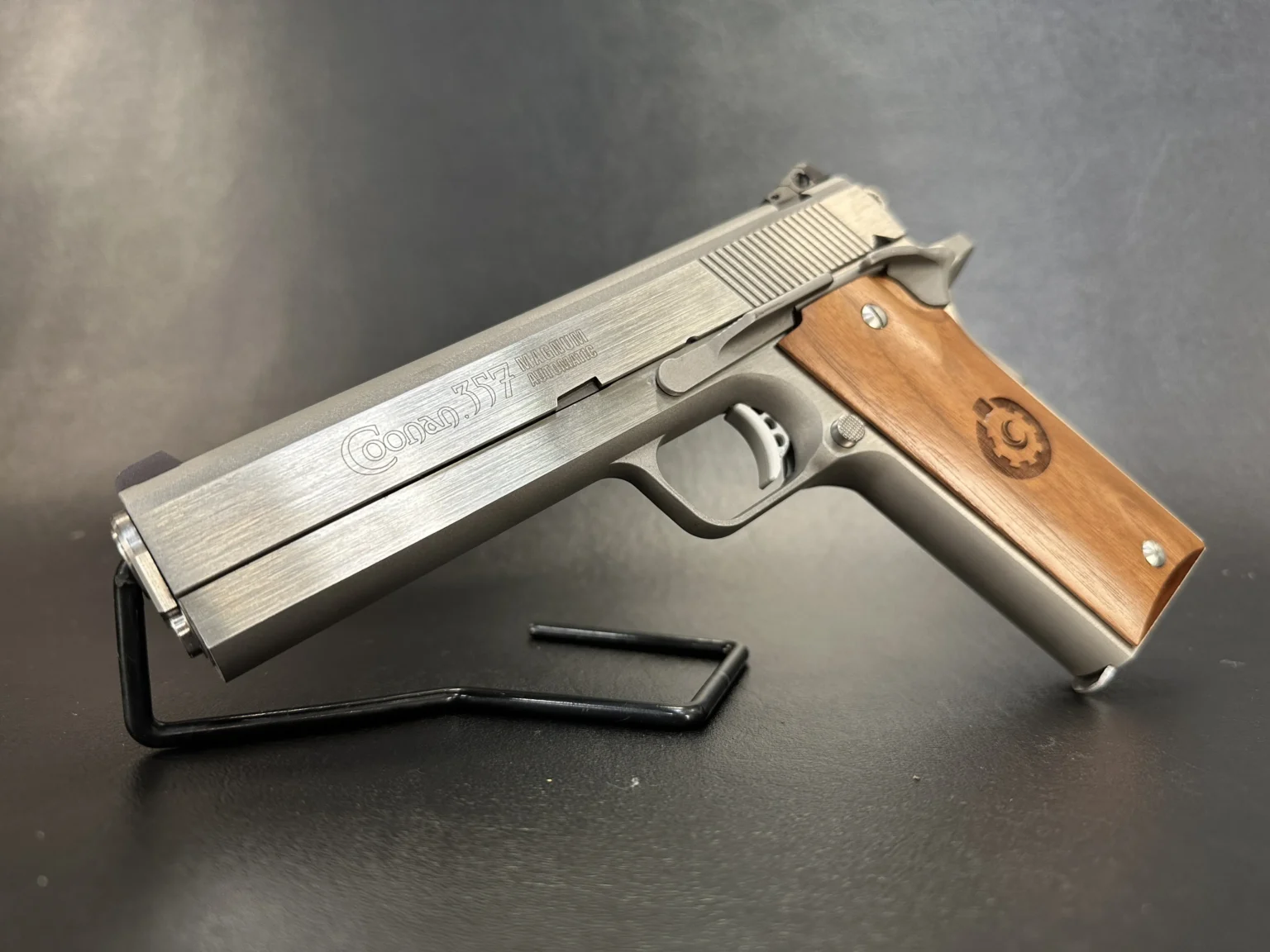
The Coonan .357 Magnum Automatic occupies an unusual place in American firearms history. Designed by Dan Coonan, it combined the familiar controls and operating principles of the M1911 with a purpose-built platform chambered for the long, rimmed .357 Magnum cartridge.
It was not simply a conventional 1911 rechambered for another cartridge. The Coonan required a longer grip frame, slide, and proprietary magazine to accommodate .357 Magnum ammunition. Although some components were interchangeable with M1911 parts, much of the pistol was unique to the Coonan design.[1]
From Model A to Model B
Dan Coonan began developing the pistol while studying engineering in the late 1970s. His early work included designing a magazine that could reliably present rimmed .357 Magnum cartridges in a semiautomatic pistol. Commercial examples reportedly reached the market in 1981.[2]
The Model A was the first production version. It retained a swinging barrel link broadly comparable to the M1911 system. The upgraded Model B replaced that arrangement with a cam-controlled, linkless barrel system.[2][3]
The Model B preserved the M1911’s recognizable single-action operation, exposed hammer, grip safety, and frame-mounted thumb safety. Its trigger, however, pivoted from the top rather than moving straight rearward like a traditional M1911 trigger. Later versions also used an external extractor.[1]
Feeding a rimmed cartridge from a box magazine was one of the design’s central engineering challenges. The Coonan magazine arranged each cartridge so that its rim remained ahead of the rim below it, reducing the potential for the cartridges to lock together during feeding. Later descriptions identify an articulated follower that helped maintain the proper cartridge angle as each round moved toward the chamber.[1][2]
A Complicated Manufacturing History
Dan Coonan sold Coonan Arms to Bill Davis in 1985 and left the company in 1990. Coonan Arms entered Chapter 11 bankruptcy in 1994 and was subsequently incorporated into JS Worldwide Distribution. Both companies were dissolved in 1998.[1]
In 2009, Dan Coonan joined Dave Neville and Gordy Davis to establish Coonan, Inc. The new company returned the five-inch .357 Magnum pistol to production under the commercial name Coonan Classic.[1]
Some contemporary reporting referred to this revived design as the Model C. That designation did not identify a compact pistol: the Model C became the full-size Classic. The company’s compact models were the earlier Cadet and the later Coonan Compact.[2]
Cadet, Classic and Compact
The Cadet belonged to the earlier production period. A published evaluation from 2000 described it as a shortened Model B with a 3¾-inch barrel, six-round magazine, fixed locking lug and no separate barrel bushing. It was approximately one inch shorter and seven ounces lighter than the Model B examined in the same test.[4]
The revived company’s Coonan Compact was a separate design introduced years later. It used a four-inch barrel and shortened grip frame. Published specifications list an overall length of 7.7 inches, an unloaded weight of 39.3 ounces, and a six-round magazine, producing a total capacity of six plus one.[5]
The full-size Classic used a five-inch barrel and seven-round magazine. A 2012 production example measured 8.3 inches overall and weighed 42 ounces unloaded. It incorporated a linkless barrel with a removable muzzle bushing, an external extractor, a pivoting trigger, and walnut grip panels.[1]
The Classic’s longer magazine held seven cartridges, for a total capacity of seven plus one. An examination published by American Rifleman found that 18 components were directly interchangeable with M1911 parts, six could be adapted, and the remainder were proprietary to the Coonan.[1]
These distinctions are important to collectors. The Model A, Model B, Cadet, revived Classic and later Compact represent different configurations and manufacturing periods. They should not be treated as interchangeable versions of the same pistol.
Ammunition and Performance
The Coonan’s operation depends on ammunition generating sufficient recoil impulse to cycle its slide. In a 2012 evaluation, a Classic functioned reliably with full-power .357 Magnum ammunition loaded with bullets ranging from 125 to 180 grains but did not operate consistently with reduced-power defensive loads.[1]
The full-size Classic was supplied with a lighter recoil spring for use with .38 Special ammunition.[1] The later Compact was different. It was configured specifically for .357 Magnum and used a 24-pound recoil spring. Although the tested Compact could chamber and fire .38 Special, the shorter cartridge did not produce enough recoil energy to cycle its action reliably.[5]
Recoil and accuracy claims must be tied to specific test pistols. In a 2015 evaluation, a Coonan Compact completed testing without a malfunction. Its smallest five-shot group measured 2.43 inches at 25 yards, while three tested loads averaged between 2.80 and 3.00 inches.[5]
An earlier Cadet produced materially different results. A 2000 evaluation reported a malfunctioning magazine follower, a front sight that loosened during testing, and average five-shot groups exceeding five inches at 25 yards.[4] These contrasting results show why the production period, mechanical condition, and individual configuration matter when evaluating a collectible Coonan.
Collector Considerations
The Coonan’s collector appeal rests on its unusual engineering and discontinuous manufacturing history. It preserves the recognizable profile and controls of the M1911 while incorporating a longer frame, proprietary magazine, pivoting trigger and modified locking system developed around the .357 Magnum cartridge.
A prospective collector should identify an example through its actual frame and slide markings, serial number, manufacturing address, barrel system and magazine capacity. The term “Coonan 1911” is convenient but imprecise, and seller descriptions sometimes confuse the Model C with the Cadet or later Compact.
Original magazines are particularly relevant because the magazine was fundamental to the pistol’s design. Period-correct sights, grips, recoil springs, cases and paperwork also help establish whether an example retains its original configuration. Claims about rarity, production quantity or factory originality should be supported by records specific to the firearm rather than by general statements about the Coonan brand.
The Coonan .357 Magnum Automatic is best understood as a distinct American pistol influenced by the M1911, not as a conventional 1911 variant. Its progression from the linked-barrel Model A to the linkless Model B, early Cadet, revived Classic, and later Compact created a small but mechanically significant family of semiautomatic pistols built around a cartridge developed primarily for revolvers.
Is the Coonan .357 Magnum a true 1911?
No. It uses several 1911-style controls and operating principles, but its larger frame, proprietary magazine, pivoting trigger, and other components make it a distinct design.
What is the difference between the Coonan Model A and Model B?
The Model A used a swinging barrel link similar to the M1911 system. The Model B replaced it with a cam-controlled, linkless barrel.
Was the Coonan Model C a compact pistol?
No. Contemporary reporting used Model C for the revived full-size pistol marketed as the Coonan Classic.
How do the Cadet and Compact differ?
The earlier Cadet had a 3¾-inch barrel and six-round magazine. The later Compact had a four-inch barrel, six-round magazine, and a different production history.
Can a Coonan fire .38 Special ammunition?
The full-size Classic was supplied with a lighter recoil spring for .38 Special ammunition. The Compact could chamber and fire .38 Special, but published testing found that it would not cycle the action reliably.
Sources
- NRA Staff. “Coonan Classic .357 Magnum Automatic.” American Rifleman, October 16, 2012.
- Bahde, Dave. “2 Coonan .357 Magnum Pistols for Full-Size and Compact Carry.” Ballistic Magazine, Spring 2018.
- American Rifleman Staff. “NRA Gun of the Week: Coonan Compact Pistol.” American Rifleman, January 16, 2016.
- Gun Tests Editorial Staff. “Coonan Cadet Not Worth Its High Price.” Gun Tests, October 26, 2000.
- Horman, B. Gil. “Review: Coonan Compact .357 Mag. Pistol.” American Rifleman, June 5, 2015.