

Key Takeaways
- Martz began specializing in custom Luger and P38 work in the late 1960s after a 26-year career as a U.S. Air Force tool-and-die maker.
- His patented Martz Safe Toggle Release allowed a Luger’s open toggle to close when the safety was moved to the “safe” position.
- Martz firearms are individually constructed custom arms whose authentication depends on markings, configuration, provenance, and supporting records.
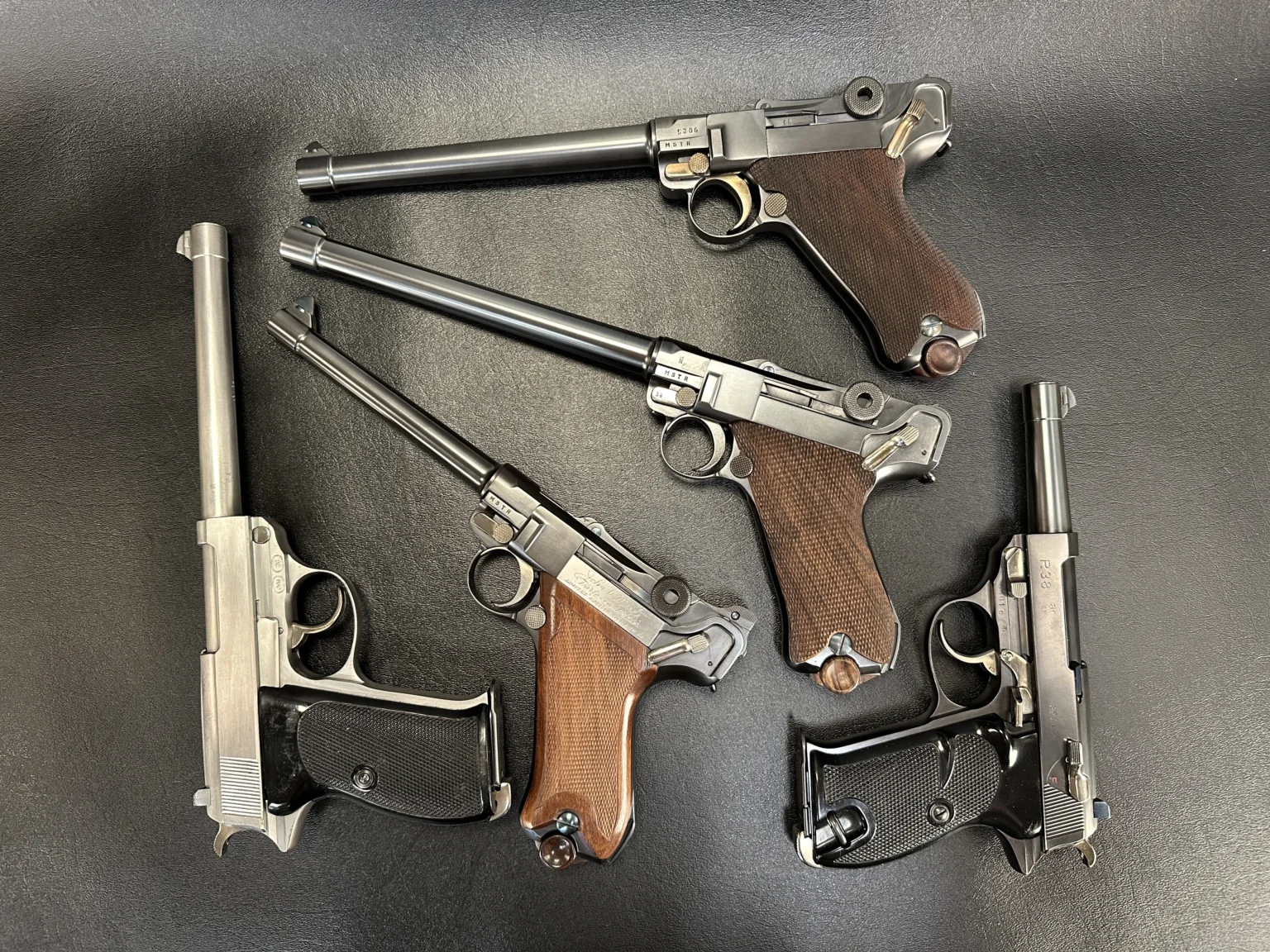
John V. Martz was an American custom gunsmith best known for transforming Luger and Walther P38 pistols into configurations their original manufacturers never offered. His work included compact “Baby” pistols, stocked carbines, unusual caliber conversions, and a patented modification known as the Martz Safe Toggle Release.
Martz’s firearms were not factory variants or reproductions. They were individually built custom arms, generally incorporating original pistols, newly made components, extensive machining, and distinctive workshop markings. Their significance rests on the quality and complexity of that work rather than on military provenance or factory originality.
From Toolmaker to Custom Gunsmith
A 1988 American Handgunner profile reported that Martz had completed a 26-year career as a tool-and-die maker for the U.S. Air Force before concentrating on Luger and P38 mechanisms. His professional background helps explain the unusually ambitious nature of his later projects, many of which required the redesign and manufacture of interconnected components rather than ordinary refinishing or parts replacement.[1]
The Buffalo Bill Center of the West dates his conversion work to 1968. By 1982, American Handgunner listed his Lincoln, California, shop as specializing in Luger and P38 customization. The services advertised at the time included Baby Lugers, Luger and P38 carbines, .45 ACP conversions, repairs, and replacement Luger parts.[2][3]
Martz worked from a historically important platform. Georg Luger developed the Parabellum by making Hugo Borchardt’s earlier toggle-action pistol smaller and more practical. Switzerland adopted a 7.65×21mm version in 1900, while the German Army adopted the 9×19mm Pistole 08 in 1908. The pistol’s characteristic toggle action, close mechanical tolerances, and instantly recognizable profile later made it a particularly demanding subject for custom work.[4]
The Martz Safe Toggle Release
Martz’s most clearly documented mechanical invention was his toggle-release system for the Luger P08. He filed his application on January 31, 1975, and received U.S. Patent No. 3,956,967 on May 18, 1976.[5]
On a standard P08, the toggle remains open after the last cartridge has been fired. Closing it ordinarily requires removing or replacing the magazine and manually retracting and releasing the toggle. Martz’s system linked the hold-open mechanism to the pistol’s existing thumb safety.
Moving the safety from “fire” to “safe” operated an internal lever that lowered the hold-open latch and allowed the toggle to close. At the same time, the movement of the safety locked the firing mechanism. Martz designed the modification to remain within the pistol’s existing contours, preserving its external profile.[5]
The patented system required a new internal release lever, a modified sear-bar slide, alterations to the hold-open latch, and limited machining of the frame rail. Completed pistols were commonly marked “MSTR,” meaning Martz Safe Toggle Release.[1][5]
The patent establishes Martz as more than a skilled restorer. He developed a specific mechanical solution to a characteristic feature of the Luger action and formally protected that invention.
Baby Lugers and Carbines
Martz’s Baby Lugers were shortened conversions with reduced barrels and grip frames. The work was mechanically more involved than simply cutting down an existing pistol. Changes to the frame dimensions required corresponding alterations to the magazine, mainspring system, grips, and other components if the pistol was to retain both its proportions and its function.[1]
His carbines moved in the opposite direction. Martz fitted Lugers with longer barrels, fore-ends, and detachable shoulder stocks, recalling the commercial Luger carbines and stocked military LP08 pistols of the early 20th century. The 1988 profile documented Martz carbines with barrels ranging from approximately 12 to 16 inches or more.[1]
At least one Martz-converted First World War artillery Luger is held by the Cody Firearms Museum at the Buffalo Bill Center of the West. The museum describes it as a carbine conversion with a detachable stock and drum magazine.[2]
Martz also produced Lugers chambered for cartridges outside the most familiar 7.65mm and 9mm offerings. Period reporting documented, among other variations, custom pistols in .22 Winchester Magnum Rimfire.[1]
The .45 ACP Luger
The .45 ACP conversion was among Martz’s most technically demanding projects. A conventional Luger frame and action were dimensioned for substantially smaller cartridges. Accommodating the .45 ACP required a wider frame and extensive changes to the barrel, receiver, breech mechanism, magazine, and related operating parts.
Published examinations describe Martz constructing the enlarged frame from carefully joined sections of donor Lugers and manufacturing or substantially reworking the remaining components. The resulting firearm preserved the recognizable Luger form while being dimensionally and mechanically altered for the larger cartridge.[6]
These pistols must be distinguished from the original .45-caliber Lugers associated with early U.S. military testing. Martz’s examples were later American custom constructions. Their value as historical objects comes from their documented maker, workmanship, configuration, and provenance—not from any connection to the original military trials.
Martz reportedly avoided using high-grade, matching-number collector pistols as donor guns. The 1988 profile stated that he selected serviceable “shooter” examples and restored their exterior surfaces as part of the conversion process. His standard finish was a fine matte bare-steel surface he called “satin-white,” although traditional rust-blue finishing could be ordered.[1]
Martz and the Walther P38
Martz applied comparable methods to the Walther P38. Adopted by Germany in 1938, the P38 combined a locked-breech action with a double-action/single-action trigger system and became one of the most influential service-pistol designs of the 20th century.[7]
His documented P38 work included shortened Baby conversions, carbines, and pistols chambered in .38 Super and .45 ACP. The large-caliber versions required especially extensive reconstruction. Published accounts describe the widened frames as being formed with material from two standard pistols, much as Martz enlarged Luger frames for the .45 ACP cartridge.[3][7]
The P38 conversions confirm that Martz’s work was not confined to one mechanism. He was prepared to reconstruct two fundamentally different German pistol designs while retaining their recognizable appearance.
Understanding Martz Collectibility
A Martz firearm should be evaluated as an individual custom object. Relevant evidence includes JVM or Martz markings, an MSTR marking where applicable, the workshop or assembly number, caliber, donor-arm markings, magazines, stocks, display equipment, correspondence, invoices, and prior published documentation.
Exact production claims require caution. In a 2015 overview, John Eckert identified Martz and fellow California custom maker Mike Krause as significant postwar Luger builders and estimated their combined production at approximately 300 firearms. That figure applies to both makers together and should not be presented as a Martz production total or divided among particular Martz configurations without additional records.[8]
Martz’s reputation ultimately rests on verifiable work: a patented Luger mechanism, documented specialization beginning in the late 1960s, contemporary coverage of his machining methods, and surviving firearms held and studied as examples of American custom gunsmithing. His best work did not merely decorate the Luger and P38. It reconstructed them.
Frequently Asked Questions
Who was John V. Martz?
John V. Martz was an American custom gunsmith and former U.S. Air Force tool-and-die maker. He specialized in extensive modifications of Luger and Walther P38 pistols.
What is the Martz Safe Toggle Release?
The Martz Safe Toggle Release is a patented mechanism that connects a Luger’s hold-open system to its thumb safety. Moving the safety to “safe” releases the open toggle while locking the firing mechanism.
What types of firearms did Martz create?
His documented work included Baby Lugers, Luger and P38 carbines, and pistols converted to cartridges such as .22 Winchester Magnum Rimfire, .38 Super, and .45 ACP. These were custom conversions rather than factory-produced models.
Are Martz .45 ACP Lugers original military-test Lugers?
No. Martz .45 ACP Lugers were later American custom constructions and should not be confused with the original .45-caliber Lugers associated with early U.S. military testing.
How can a Martz firearm be authenticated?
Authentication should consider JVM or Martz markings, MSTR markings, workshop numbers, caliber, construction details, accessories, and documented provenance. A general resemblance to Martz’s work is not sufficient by itself.
Sources
- J. B. Wood, “The Martz Luger,” American Handgunner, May/June 1988, pp. 44–48.
- Buffalo Bill Center of the West, “World War One Luger,” Points West, Fall 2011, p. 28.
- American Handgunner, “Pistolsmith Directory,” January/February 1982, p. 51.
- Royal Armouries, “Arms of the First World War: Pistole 08 Parabellum.”
- John V. Martz, “Toggle Release for Luger Pistol,” U.S. Patent No. 3,956,967, filed January 31, 1975; issued May 18, 1976.
- Ian McCollum, “John Martz Custom Luger Pistols—Babies, Carbines, and .45 ACP Conversions,” Forgotten Weapons, November 9, 2017.
- Jeremiah McCarthy, “Walther P38: The Most Influential Pistol You Don’t Think About,” American Handgunner, 2021.
- John Eckert, “A Luger Short Story,” American Society of Arms Collectors Bulletin, no. 111, 2015, pp. 56–74.

One Response
Fascinating work on the Luger restoration, the engraving detail in your gallery is on another level. Do you take on P38 builds with full custom finishes, or mainly stock refurbishments ?