
Key Takeaways
- Walther introduced the PP in 1929 and the smaller PPK in 1931, creating an influential family of double-action/single-action pistols.
- Adopted by Germany in 1939, the P38 was produced during the Second World War by Walther, Mauser and Spreewerk.
- Correct markings, matching components, original condition and verifiable provenance are essential when evaluating a collectible Walther.
Carl Walther’s most collectible pistols document an important period in handgun development. The PP and PPK brought double-action operation and an integrated decocking safety to compact semiautomatic pistols, while the P38 applied similar principles to a locked-breech military sidearm. For collectors, however, a model name is only the starting point. Production period, manufacturer, markings, originality, and documentation determine what a particular Walther represents.
From Rifles to Semiautomatic Pistols
Carl Wilhelm Freund Walther established his rifle-making business in Zella-Mehlis, Germany, in 1886. The company initially manufactured hunting and target rifles. Carl’s son Fritz subsequently encouraged its move into semiautomatic pistols, leading to a Model 1 prototype in 1908. The design was patented in 1911 and entered production in 6.35 mm. [1]
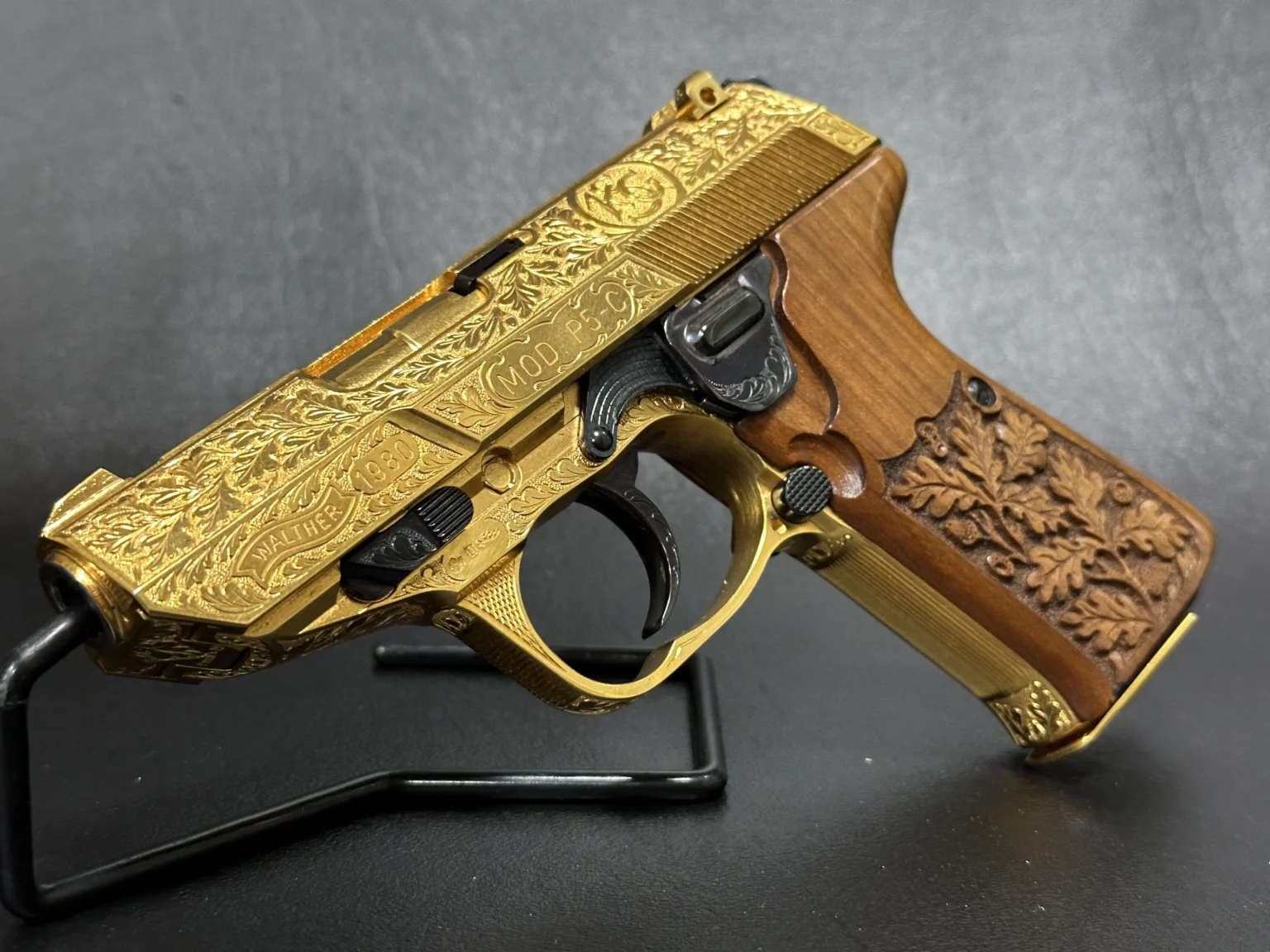
The double-action Walther PP, an abbreviation of Polizeipistole, or police pistol, appeared in 1929. The more compact PPK followed in 1931. [1] The smaller pistol retained the PP’s basic operating system but used a shorter barrel, slide, frame, and grip.
Both were fixed-barrel, blowback-operated pistols with exposed hammers and double-action/single-action triggers. The first shot could be fired with a long double-action trigger pull; slide movement then cocked the hammer for subsequent single-action fire. Their slide-mounted safety systems also allowed the hammer to be lowered without intentionally firing the pistol. [2]
The fixed barrel doubled as a guide for the recoil spring. Other notable PP-series features included a frame-mounted magazine release, a last-round slide hold-open, and, on many examples, a loaded-chamber indicator. [2] These details helped distinguish the PP family from many contemporary European pocket pistols.
The PPK: More Than a Bond Pistol
The PPK’s compact dimensions made it better suited than the PP to discreet or plainclothes carry. Prewar examples were produced in several chamberings, including 7.65 mm Browning, known in the United States as .32 ACP—and 9 mm Kurz, or .380 ACP. [2]
Its later association with James Bond gave the PPK cultural recognition far beyond the firearms community. In the official Ian Fleming chronology, Bond receives a Walther PPK before his assignment in Dr. No. [3] That connection became an enduring part of the pistol’s identity, but it should not obscure the PPK’s earlier importance as a compact police and commercial design.
Collectors must distinguish carefully among prewar, wartime, and postwar examples. Following the Second World War, Walther rebuilt its operations near Ulm, West Germany. Postwar PP-series production also involved the French firm Manurhin, and later PPK and PPK/S pistols were manufactured in the United States. [1] [2] The Walther banner alone therefore does not establish where or when a pistol was manufactured.
The PPK/S was developed for the American market after the Gun Control Act of 1968 changed handgun-import requirements. It combined the longer PP frame with the shorter PPK slide and barrel, creating a pistol that was taller and heavier than the original PPK and carried one additional cartridge. [2]
For collectors, the PPK and PPK/S should be treated as distinct configurations. Frame dimensions, chambering, country and importer markings, proof marks, grips and magazine capacity must be examined together.
The P38 and the Modern Service-Pistol Format
Walther developed the P38 during the 1930s as a military pistol intended to replace the costly and labor-intensive Luger P08. Germany formally adopted the P38 in 1939, and deliveries to the German Army began that year. [4]
Unlike the blowback-operated PP and PPK, the 9 mm P38 used a locked-breech operating system. Its design incorporated an exposed hammer, twin recoil springs, and a slide-mounted safety and decocking lever. The pistol could be carried with the hammer lowered and fired initially in double-action mode, after which slide movement cocked the hammer for single-action fire. [4]
Walther could not meet wartime demand by itself. Mauser and Spreewerk joined P38 production, and more than 1.2 million pistols were manufactured before the war ended. Walther produced approximately 580,000, with the balance supplied by the other factories. [1] [4]
This multi-factory production created the markings that now define much of P38 collecting. Walther used the code “ac,” Mauser used “byf” during much of its production, and Spreewerk used “cyq.” Mauser- and Walther-produced pistols commonly included a two-digit year code, while Spreewerk did not normally mark the year in the same manner. [4]
Wartime serial numbers were issued in recurring blocks. After a sequence reached 9999, numbering restarted with a lowercase letter suffix. A pistol bearing a low numerical serial is therefore not necessarily an early-production example. The serial number, suffix, maker code and year must be interpreted together. [4]
After the war, Walther resumed P38 production in West Germany. The design continued in German service, while the related P1 became a sidearm of the postwar German armed forces. [1] Wartime P38s and postwar P38/P1 pistols belong to different historical and collecting categories even when their external appearance is similar.
Evaluating a Collectible Walther
A responsible evaluation should establish:
- The exact model and variant
- Manufacturer and place of production
- Production period
- Chambering
- Complete serial number, including prefixes or suffixes
- Proof, inspection and military-acceptance marks
- Whether numbered components match
- Whether the finish, grips, magazine and small parts are period-correct
- Evidence of refinishing, polishing or replaced components
- The quality of any accompanying documentation
Originality cannot be determined from appearance alone. Refinishing may alter surface texture, soften edges or partially obscure markings. Grips and magazines are readily replaced, and apparently correct components may belong to another period or manufacturer.
Provenance also requires evidence. A military document, factory record or dated sales record is meaningful only when it can be connected to the firearm through a serial number or another specific identifier. An undocumented family account may provide a useful lead, but it is not proof of military use, notable ownership or participation in a historical event.
For wartime P38s, authentic capture paperwork identifying the firearm by make, model and serial number can materially strengthen provenance. [4] The same standard should apply to any claimed association: the document and the pistol must be demonstrably connected.
Condition matters, but it is only one part of collectibility. A cosmetically attractive pistol assembled from mismatched or restored components may be less historically significant than a worn but substantially original example. Rarity, originality, and provenance should be evaluated separately before they are combined into an assessment of importance or value.
Walther’s historic pistols do not need exaggerated claims to justify serious attention. The PP and PPK represent a major stage in compact semiautomatic-pistol development, while the P38 helped establish the double-action service-pistol format that remained influential after the Second World War. Their collectibility rests on documented history, and on the evidence preserved in each individual firearm.
Frequently Asked Questions
The PPK is a more compact version of the PP, with a shorter barrel, slide, frame, and grip. Walther introduced the PP in 1929 and the PPK in 1931.
The PPK/S combines the longer PP frame with the shorter PPK slide and barrel. It was developed for the American market following changes to handgun-import requirements under the Gun Control Act of 1968.
The P38 combined a locked-breech system with double-action/single-action operation and a decocking safety. Germany adopted it in 1939 as a replacement for the Luger P08.
Walther, Mauser and Spreewerk manufactured the P38 during the Second World War. Their principal wartime codes were “ac,” “byf” and “cyq,” respectively.
Collectors should examine the exact variant, maker and date codes, complete serial number, matching components, finish and period-correct parts. Any claimed provenance should be supported by documentation that can be connected directly to the firearm.
Sources
[1] Carl Walther GmbH, “The First Century,” company historical record.
[2] Joe Coogan, “Walther’s PPK,” American Rifleman, August 22, 2019.
[3] Ian Fleming Publications, “James Bond Timeline,” official literary chronology.
[4] Philip Schreier, “The Classics: The Walther P38,” Shooting Illustrated, December 1, 2024.