

Key Takeaways:
- Browning model names can cover different manufacturers, production periods, and mechanical designs.
- Serial numbers are valuable research tools, but incomplete factory records can make exact production dates uncertain.
- Documented provenance, original condition, correct markings, and careful preservation are fundamental to responsible collecting.
Few designers have influenced modern firearms as broadly as John Moses Browning. The National Museum of the United States Air Force credits him with 128 patents and more than 100 firearm designs spanning sporting arms, semiautomatic pistols, automatic rifles, and machine guns.[1]
For collectors, however, “Browning” does not identify a single manufacturer, factory, or period. Browning designs were produced in the United States, Belgium, Canada, Japan, and elsewhere. Some were manufactured under other companies’ names, while certain Browning model names were later applied to mechanically different firearms. Accurate identification must therefore come before assumptions about rarity, originality, or value.
The Auto-5
The Browning Auto-5 was the first commercially successful semiautomatic shotgun. Fabrique Nationale began production in Belgium in 1902 after Browning contracted with the company to manufacture the design.[2]
Its squared receiver profile, commonly called the “humpback,” is immediately recognizable. The original Auto-5 operates by long recoil: the locked barrel and bolt travel rearward together after firing. The bolt then remains to the rear momentarily while the barrel moves forward, ejecting the fired shell. The bolt subsequently returns forward and chambers another shell.[3]
Production history is essential to evaluating an Auto-5. FN manufactured the early guns in Belgium. Remington produced Browning-marked American versions during interruptions in Belgian production associated with the Second World War. Regular Auto-5 production moved from Belgium to Miroku in Japan in 1976, and Browning ended the original series after a 1999 Final Tribute edition.[4]
An early serial number does not always establish an exact production year. Browning reports that few prewar Auto-5 records survive and cautions that dates attributed to many examples from that period are estimates.[4] Collectors should examine the serial number together with the receiver and barrel markings, gauge, proof marks, operating components, and physical configuration.
The modern Browning A5 is a different firearm. Browning revived the A5 name in 2012, but the new shotgun does not use the original Auto-5’s long-recoil mechanism.[5]
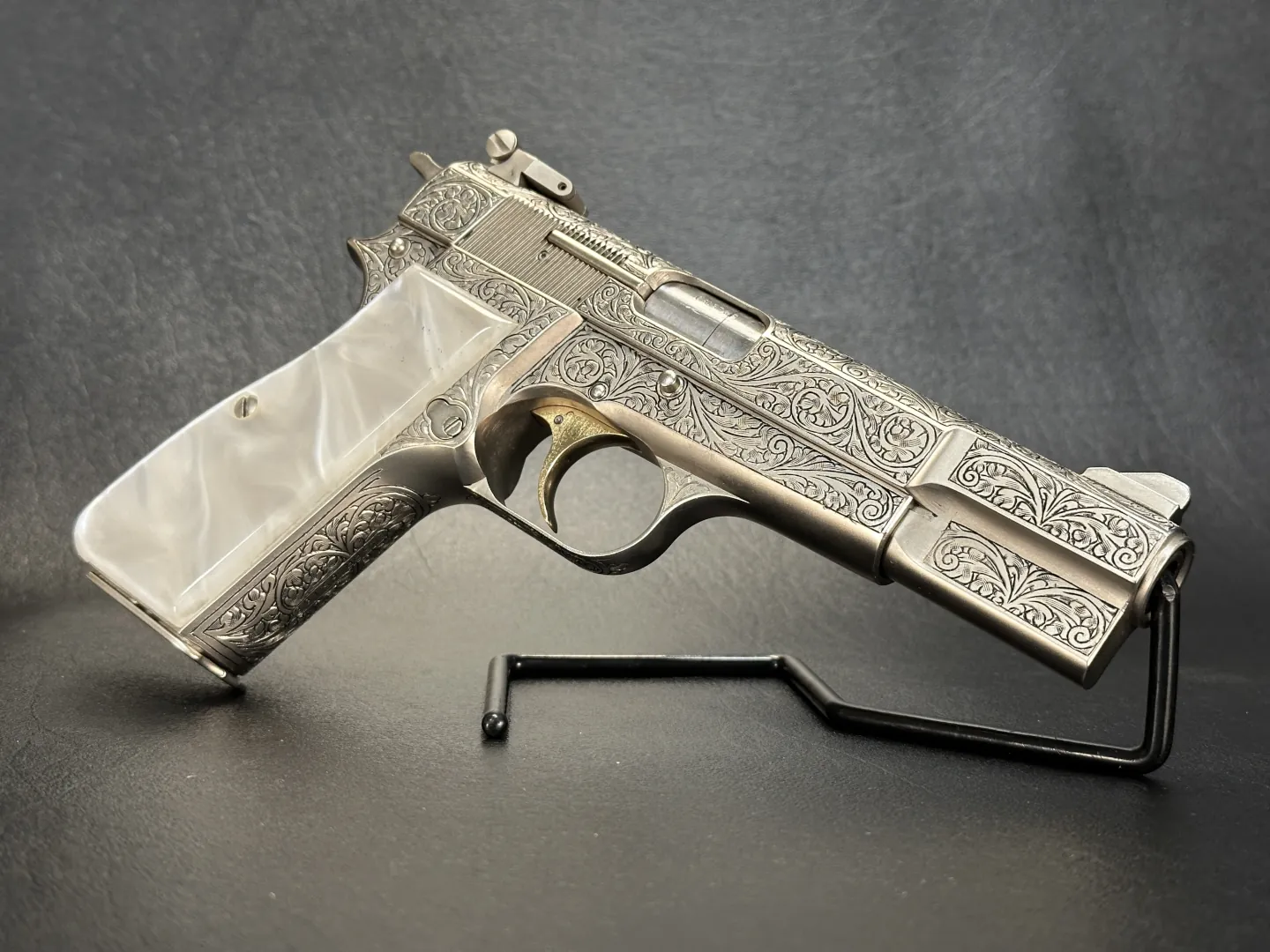
The Browning Hi-Power
The Hi-Power developed from a pistol project begun by John Browning and completed at Fabrique Nationale by Belgian designer Dieudonné Saive after Browning’s death in 1926. FN records that Saive completed the design in 1934, preceding the pistol’s 1935 military introduction.[6]
The original service pistol was chambered in 9×19 mm and combined a recoil-operated, single-action mechanism with a 13-round detachable magazine. That capacity was unusually high for a service pistol of the period and became one of the model’s defining features.[6]
The Hi-Power’s manufacturing history created several distinct collecting categories. Imperial War Museums documents an FN-manufactured 9×19 mm example associated with the German Army during the Second World War and cataloged under the German designation Pistole 640(b).[7] The Canadian War Museum records a No. 2 Mk I variant manufactured by the John Inglis Company in 1944.[8]
Markings matter. A tangent sight, shoulder-stock slot, military-style finish, or wartime-pattern component does not independently establish a particular contract or period. Serial numbers, manufacturer inscriptions, proof and acceptance marks, and the consistency of major components must be evaluated together.
Browning’s published serial-number tables also require caution. The company states that its figures for Hi-Power pistols sold in the United States from 1954 through 1957 are estimates; more accurate company records begin in 1958.[9]
The Superposed
The Superposed was John Browning’s final firearm design. He filed the first two related patent applications in 1923 but died before the over-and-under shotgun reached the market. Browning introduced the Superposed commercially in 1931.[10]
Manufactured by FN in Belgium, the Superposed combined an over-and-under action with the materials, finishing, and decoration expected of a premium sporting shotgun. Surviving examples range from relatively restrained field guns to extensively engraved pieces. Browning’s historical records identify established grades including Grade I, Diana, and Midas, which were discontinued from the regular product line in 1977.[10]
Belgian production was interrupted during the Second World War and resumed after the war. Over its long history, the model appeared in different gauges, grades, barrel configurations, and engraving patterns.[10] Factory-grade engraving should not be assumed merely because a gun is elaborately decorated. Post-production engraving, replacement barrels, restocking, refinishing, and upgraded wood require separate identification.
The Superposed should not be confused with the Citori. Browning introduced the Miroku-manufactured Citori in the 1970s, and the Japanese-made shotgun gradually replaced the Superposed as the company’s principal over-and-under model.[11]
The Two Browning BARs
The initials “BAR” identify two fundamentally different firearms.
The military Browning Automatic Rifle was officially designated the Browning Automatic Rifle, Model of 1918, .30 Caliber. The U.S. Army describes it as a gas-operated, air-cooled, magazine-fed weapon with a 20-round magazine. It reached service near the end of the First World War and later saw extensive use during the Second World War and the Korean War.[12] The Smithsonian’s National Museum of American History holds both an approximately 1919 Model 1918 cutaway and a Model 1918A2 transferred from the National Museum of the Marine Corps.[13]
The Browning sporting BAR is a separate semiautomatic hunting rifle. Browning credits its development to a team led by John Browning’s grandson Bruce Browning and FN engineer Marcel Olinger. Development and testing took place during 1966 in preparation for a 1967 product launch. Browning expressly describes the sporting BAR as distinct from the military M1918.[14]
This distinction has legal as well as historical importance. In the United States, an original automatic military BAR is regulated as a machine gun. Federal law generally prohibits civilian possession or transfer of machine guns except for specified government-related cases and firearms lawfully possessed before May 19, 1986.[15] The registration and legal status of an individual firearm must be established before acquisition.
Evaluating a Collectible Browning
A serious evaluation begins with documentation. At minimum, record:
- All serial and assembly numbers
- Receiver, barrel, and manufacturer inscriptions
- Proof, inspection, and military-acceptance marks
- Gauge or caliber
- Barrel length and configuration
- Finish, engraving, stock type, and accessories
- Evidence of restoration or replaced components
- Purchase records and documented ownership history
Serial-number tables are useful, but they are not conclusive when factory records are incomplete. Markings and physical features must agree with the proposed date and configuration.
Originality is also not established by appearance alone. Polished markings, softened metal edges, altered screw slots, inconsistent finishes, recut engraving, mismatched numbers, or poorly fitted wood can indicate previous work. No single feature is necessarily decisive, but each warrants closer inspection.
Historical provenance requires documentation connecting the firearm to the claimed person, organization, or event. A name engraved on a gun, an undocumented family story, or an auction description does not prove prior ownership. Stronger evidence includes factory records, dated correspondence, military documents, period photographs, inventories, and a traceable chain of custody.
Preservation
Collectible firearms should be preserved rather than cosmetically improved. The National Park Service recommends stable environmental conditions, secure storage, limited light exposure, separation of firearms from leather accessories, and removal of fingerprints from metal surfaces. It advises applying only a small amount of appropriate non-drying oil to moving parts and documenting the firearm’s condition and every conservation treatment.[16]
Aggressive polishing, sanding, rebluing, or refinishing can remove original surfaces, markings, and other physical evidence. Before altering or firing a historically significant firearm, the owner should obtain an evaluation from a qualified professional familiar with that model.
The strongest Browning collections are not necessarily the largest or most expensive. They are the collections in which every firearm has been accurately identified, honestly assessed, properly documented, and carefully preserved.
Frequently Asked Questions
John Browning received 128 patents and developed more than 100 firearm designs. His work influenced sporting arms, semiautomatic pistols, automatic rifles, and machine guns.
The original Auto-5 was the first commercially successful semiautomatic shotgun and used a long-recoil operating system. The modern Browning A5 uses a different mechanism.
John Browning began the pistol project, but Dieudonné Saive completed the design at Fabrique Nationale after Browning’s death. The Hi-Power entered military use in 1935.
No. The military Model 1918 Browning Automatic Rifle and the later semiautomatic sporting BAR are mechanically and historically distinct firearms.
Collectors should verify serial numbers, markings, proof and acceptance stamps, configuration, condition, replaced parts, and ownership documentation. Claims of originality or provenance should be supported by reliable records.
Sources
- National Museum of the United States Air Force, “Elegant Simplicity: The Weapon Designs of John Moses Browning.”
- Browning, “Browning Family History.”
- Browning, “Browning Auto-5 Magnum Owner’s Manual.”
- Browning, “Auto-5 Semi-Automatic Shotgun: Serial Number and Production History.”
- Brad Fitzpatrick, Browning, “New for ’24: The Browning A5 20-Gauge,” January 22, 2024.
- FN America, “The History of FN.”
- Imperial War Museums, “Browning High Power and Pistole 640(b), First Issue.”
- Canadian War Museum, “Browning High-Power No. 2 Mk I Semi-Automatic Centre-Fire Pistol.”
- Browning, “Hi Power Pistol: Serial Number and Production History.”
- Browning, “Historic Timeline.”
- Browning, “Where Are Browning Firearms Manufactured?.”
- John Keilers, U.S. Army Military History Institute, “Arming the Army: John M. Browning,” U.S. Army, January 12, 2009.
- Smithsonian National Museum of American History, “Marlin-Rockwell Browning Model 1918 Machine Rifle” and “Browning Model 1918A2 Automatic Rifle, Caliber .30.”
- R. Stitt, Browning, “A Brief History of the Browning BAR,” July 26, 2009.
- Bureau of Alcohol, Tobacco, Firearms and Explosives, “National Firearms Act,” updated February 4, 2026.
- National Park Service, “Caring for Historic Longarms: Storage and Handling.”


One Response
I have 5 Browning sweet sixteens I want to sale,What way should I go? they all wer from 1955 t0 1975> apprecite any advice Bubba