

Key Takeaways:
- American branding does not prove American manufacture; production records and firearm markings provide stronger evidence.
- The Colt Series 70, SIG Sauer P320, and other featured pistols must be identified by their exact generation and configuration.
- Condition, originality, serial numbers, factory packaging, and documentation are central to responsible collector evaluation.
An American brand name does not necessarily establish American manufacture. The Springfield Armory XD-S Mod.2, for example, is produced by HS Produkt in Croatia and therefore does not belong in a strictly American-made selection.[1]
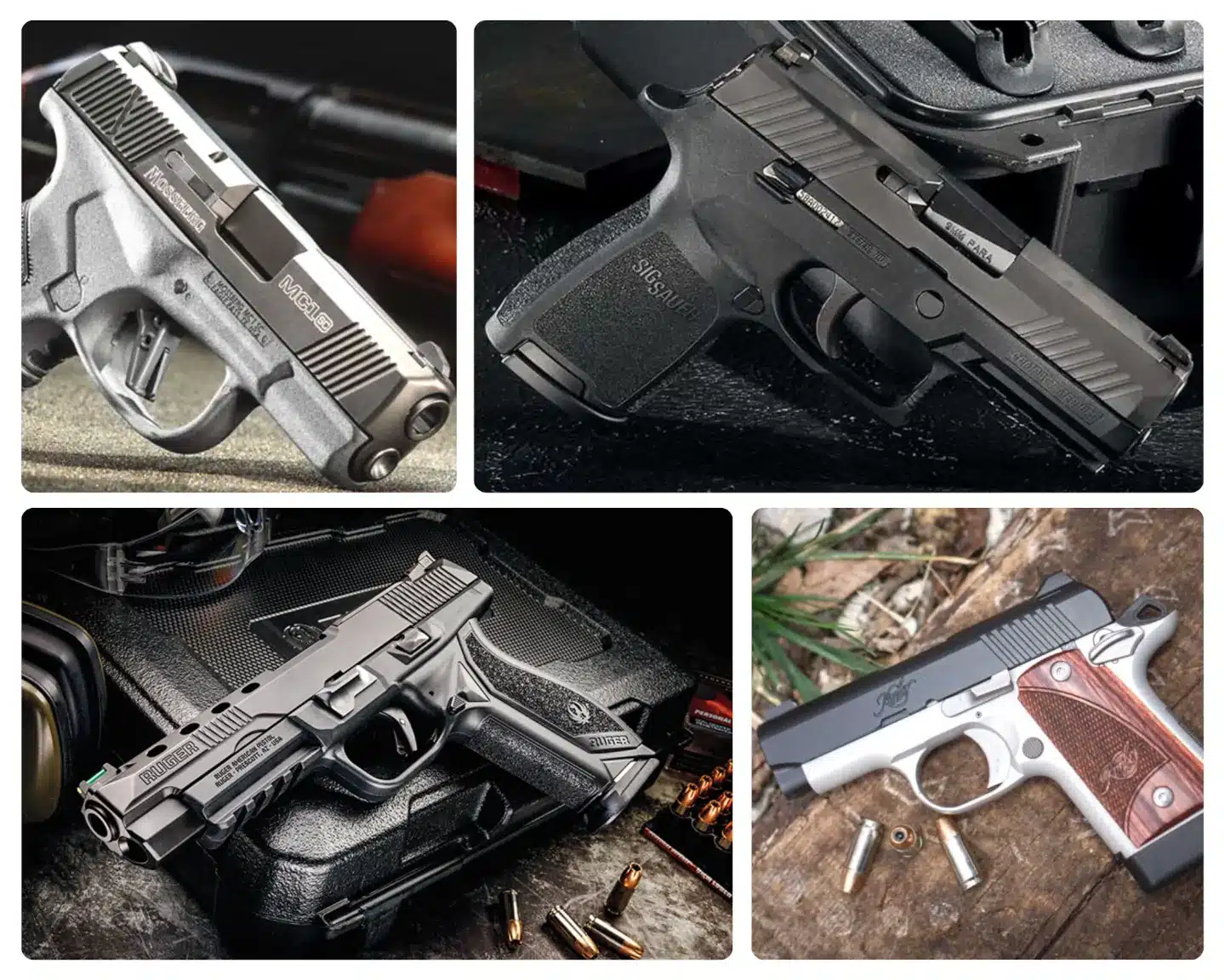
The seven pistols examined here have documented connections to American production. They span compact defensive pistols, military-derived modular designs, service-size handguns, and models with established collector interest. Their significance varies, but each occupies an identifiable place in modern American firearms history.
Smith & Wesson M&P Shield
Smith & Wesson introduced the M&P Shield on April 12, 2012. The original models were striker-fired, polymer-frame pistols chambered in 9mm and .40 S&W.[2]
Both versions had 3.1-inch barrels, Melonite-treated stainless-steel slides and barrels, and unloaded weights of approximately 19 ounces. The 9mm model shipped with seven- and eight-round magazines, while the .40 S&W version included six- and seven-round magazines. Smith & Wesson offered the pistol with a manual thumb safety and incorporated a sear-release lever that allowed disassembly without pulling the trigger.[2]
The Shield’s importance stems from its successful adaptation of a service pistol operating system to a slim, concealed-carry format. For collectors, early-production examples, original-caliber variants, factory configurations, and pistols that retain their boxes, magazines, and paperwork are more relevant than extensively modified specimens.
Later Shield models should be identified separately. Similar appearance does not make a Shield, Shield M2.0, and Shield Plus the same firearm for cataloging or valuation purposes.
SIG Sauer P320
The P320 is built around a removable, serialized fire-control unit containing the trigger, sear, slide-catch lever, and other functional components. SIG Sauer designed the unit for use with compatible grip modules, slides, and barrels, allowing the pistol’s external size and configuration to be changed while retaining the serialized component.[3]
In January 2017, the U.S. Army selected SIG Sauer for its Modular Handgun System program. The resulting M17 and M18 were based on the P320, but the Army emphasized that the military pistols incorporated different safety features and performance requirements. The M17 and M18 should not be described as ordinary commercial P320s with military markings.[4]
SIG Sauer reported in November 2020 that it had delivered its 200,000th Modular Handgun System pistol from the company’s Newington, New Hampshire, facility. The M17 is the full-size version, while the M18 is the compact configuration.[5]
Collectors must also distinguish between original-design P320 pistols and upgraded examples. SIG Sauer’s voluntary upgrade program replaced the trigger, sear, and striker with lighter components and added a mechanical disconnector. Serial number, factory configuration, upgrade status, and supporting documentation are therefore material to an individual pistol’s history.[6]
Ruger American Pistol
Ruger introduced the full-size American Pistol on December 30, 2015. The original line consisted of 9mm Luger and .45 Auto models built around a one-piece, black-nitrided stainless-steel chassis housed within a glass-filled nylon grip frame.[7]
The design incorporated a pre-tensioned striker, interchangeable wraparound grip modules, a low-mass slide, and a barrel cam intended to spread recoil over a longer period. The 9mm version had a 4.20-inch barrel, a listed weight of 30 ounces, and a standard 17-round magazine. The .45 Auto model had a 4.50-inch barrel, weighed 31.5 ounces, and used a 10-round magazine.[7]
The American Pistol has less established collector recognition than the Colt Series 70 or a military-associated P320. Its historical relevance lies instead in its role as Ruger’s purpose-designed, full-size striker-fired service pistol.
Launch-era examples in their original configuration are the clearest representation of that design. Compact versions and later variations should be documented separately rather than treated as interchangeable members of one model.
Remington 1911 R1
Remington returned to the commercial 1911 market in 2010 with the R1. The launch-era pistol was manufactured in Ilion, New York, and marketed as a practical, Government-size .45 ACP pistol rather than an exact reproduction of a particular military model.[8]
The original R1 used a steel frame and slide, a five-inch barrel, a seven-round magazine, three-dot sights, and double-diamond walnut stocks. Its configuration combined features associated with both the M1911 and the later M1911A1.[9]
The R1 must be distinguished from two historically separate pistols. Remington-UMC manufactured approximately 21,500 Model of 1911 pistols at Ilion during World War I. Remington-Rand, which produced M1911A1 pistols during World War II, was an unrelated office-machine manufacturer.[9]
Remington later expanded the R1 into numerous finishes and enhanced configurations. The company’s firearms business entered bankruptcy and was divided among multiple buyers in 2020 after Remington had withdrawn from the pistol market.[10] Consequently, an R1 should be evaluated based on its serial number, markings, configuration, condition, and documentation. It is not safe to assume that every R1 has the same production history.
FN 509
FN America introduced the FN 509 to the commercial market on April 17, 2017. The 9mm, striker-fired pistol developed from FN’s entry in the U.S. Army Modular Handgun System competition and incorporated elements of the earlier FNS Compact architecture.[11]
The original commercial version had a four-inch barrel, a listed weight of 26.9 ounces, ambidextrous controls, and either a 10- or 17-round magazine. FN stated that the platform underwent more than one million rounds of testing during development, but that figure represents the company’s cumulative development testing—not the endurance record of an individual pistol.[11]
FN’s American manufacturing presence dates to 1981, when the company opened a production facility in Columbia, South Carolina, initially to support manufacture of the M240 for the U.S. Army. FN identifies the 509 with the firearms produced through its South Carolina operation.[12]
The growing 509 family now includes full-size, midsize, compact, Tactical, optics-ready, and law-enforcement configurations. Collectors should record the exact model designation and factory features. The 509’s military-trial ancestry provides historical context, but a commercial example is not a U.S. military-issue M17 or M18.
Colt Government Model MK IV/Series 70
Colt introduced the Government Model MK IV/Series 70 in the early 1970s. Its principal mechanical distinction was a four-finger collet barrel bushing designed to center the barrel consistently within the slide.[13]
Colt subsequently abandoned the collet bushing. The Series 80 system later added a trigger-operated firing-pin safety, prompting continued interest in earlier Series 70 pistols among shooters and collectors who preferred the prior firing system.[13]
Colt introduced a new Series 70 Government Model in 2002.[14] These later pistols should not be represented as mechanically identical to the original 1970s production. In modern terminology, “Series 70” commonly identifies a Colt firing system without the Series 80 firing-pin block; it does not, by itself, establish that a pistol has the original collet barrel bushing.
First-generation and later-production Series 70 pistols consequently belong in separate collector categories. Serial number, roll marks, barrel and bushing configuration, finish, stocks, and evidence of modification are essential to proper identification. Because the 1911 has long been a popular platform for customization, original and correctly documented examples deserve particular scrutiny.
Mossberg MC1sc
Mossberg introduced the 9mm MC1sc in January 2019 as part of its centennial observance. It marked the company’s return to production handguns a century after the introduction of the four-shot Mossberg Brownie.[15]
The MC1sc had a 3.4-inch barrel, an empty weight of 19 ounces, and six- and seven-round single-stack magazines. Its distinctive features included transparent polymer magazines and a takedown system that did not require pulling the trigger during disassembly. The slide and barrel were stainless steel with diamond-like carbon finishes.[15] Contemporary published reporting identified Mossberg’s Eagle Pass, Texas, plant as the model’s production location.[16]
The most clearly defined collector version is the Centennial Limited Edition. Mossberg limited production to 1,000 sequentially numbered pistols. These examples received engraved 24-karat gold slide accents, titanium nitride-finished barrel and small parts, and a special serial number.[15]
Completeness is particularly important with a commemorative firearm. The original case, magazines, documentation, and accessories form part of the package and should be considered when comparing surviving examples.
Evaluating American-Made Pistols
American manufacture does not automatically establish rarity, historical importance, or monetary value. Those qualities depend on the specific model and example.
Collectors should verify:
- The manufacturer and production location shown by the firearm’s markings
- The exact model, variation, caliber, and serial number
- Whether the finish and major components are factory original
- The presence of the correct magazines, box, manual, and accessories
- Any factory upgrade, recall, or modification history
- Whether a claimed military or law-enforcement association is documented
- Whether a commemorative edition has a verifiable production limit
Marketing descriptions are not substitutes for physical evidence or factory documentation. A defensible collector assessment begins with the individual firearm and works outward to reliable records.
Frequently Asked Questions
Its documented place of manufacture must be in the United States. An American distributor or brand name alone does not establish domestic production.
The SIG Sauer P320 formed the basis of the M17 and M18. The military pistols have distinct requirements and features and are not standard commercial P320s.
No. Original examples used a collet barrel bushing, while later Series 70 pistols do not necessarily reproduce that feature.
Mossberg limited it to 1,000 sequentially numbered pistols. It featured engraved gold accents and titanium-nitride-finished components.
Collectors should confirm the serial number, markings, factory configuration, finish, accessories, and documentation. Military, commemorative, or law-enforcement associations should be supported by records.
Sources
- Christopher Olsen, “Tested: Springfield Armory 9 mm XD-S Mod.2 Pistol,” American Rifleman, June 28, 2018.
- Smith & Wesson Holding Corporation, “Smith & Wesson Unveils New M&P Shield Pistol,” April 12, 2012.
- SIG Sauer, “Fire Control Unit (FCU).”
- Todd C. Lopez, “Modular Handgun to Begin Fielding Before Christmas,” U.S. Army, October 3, 2017.
- SIG Sauer, “SIG Sauer Achieves Historic Program Milestone for U.S. Military Handgun,” November 17, 2020.
- SIG Sauer, P320 Voluntary Upgrade Notice.
- Sturm, Ruger & Co., “The New Ruger American Pistol,” December 30, 2015.
- Gun Tests, “Remington Re-Enters Handgun Market with R1 1911,” May 12, 2010.
- Wiley Clapp, “The Remington R1 M1911,” American Rifleman, January 13, 2011.
- Mark A. Keefe IV, “The Keefe Report: The Future of Remington Arms,” American Rifleman, October 1, 2020.
- FN America, “FN Launches the FN 509,” April 17, 2017.
- FN America, “About FN.”
- Wiley Clapp, “Colt Series 70 Model 1911,” American Rifleman, February 18, 2011.
- Colt’s Manufacturing Company, “Company History.”
- O.F. Mossberg & Sons, “Mossberg Celebrates Centennial with Launch of MC1sc Handgun,” January 3, 2019.
- Denny Hansen, “Mossberg MC1SC Pistol: Back to Their Roots,” S.W.A.T. Magazine, 2019.

One Response
The Springfield Armory XD-S Mod.2 with the USA stamped on the slide has made in croatia stamped on the frame right below how can they claim made in the USA.