
Key Takeaways:
- The U.S. Army formally adopted Browning’s Colt-produced .45-caliber pistol on March 29, 1911.
- The M1911A1 designation became official in 1926 after several improvements were introduced progressively.
- Accurate identification requires examining the manufacturer, serial-number range, markings, finish, parts, and evidence of military rebuilding.
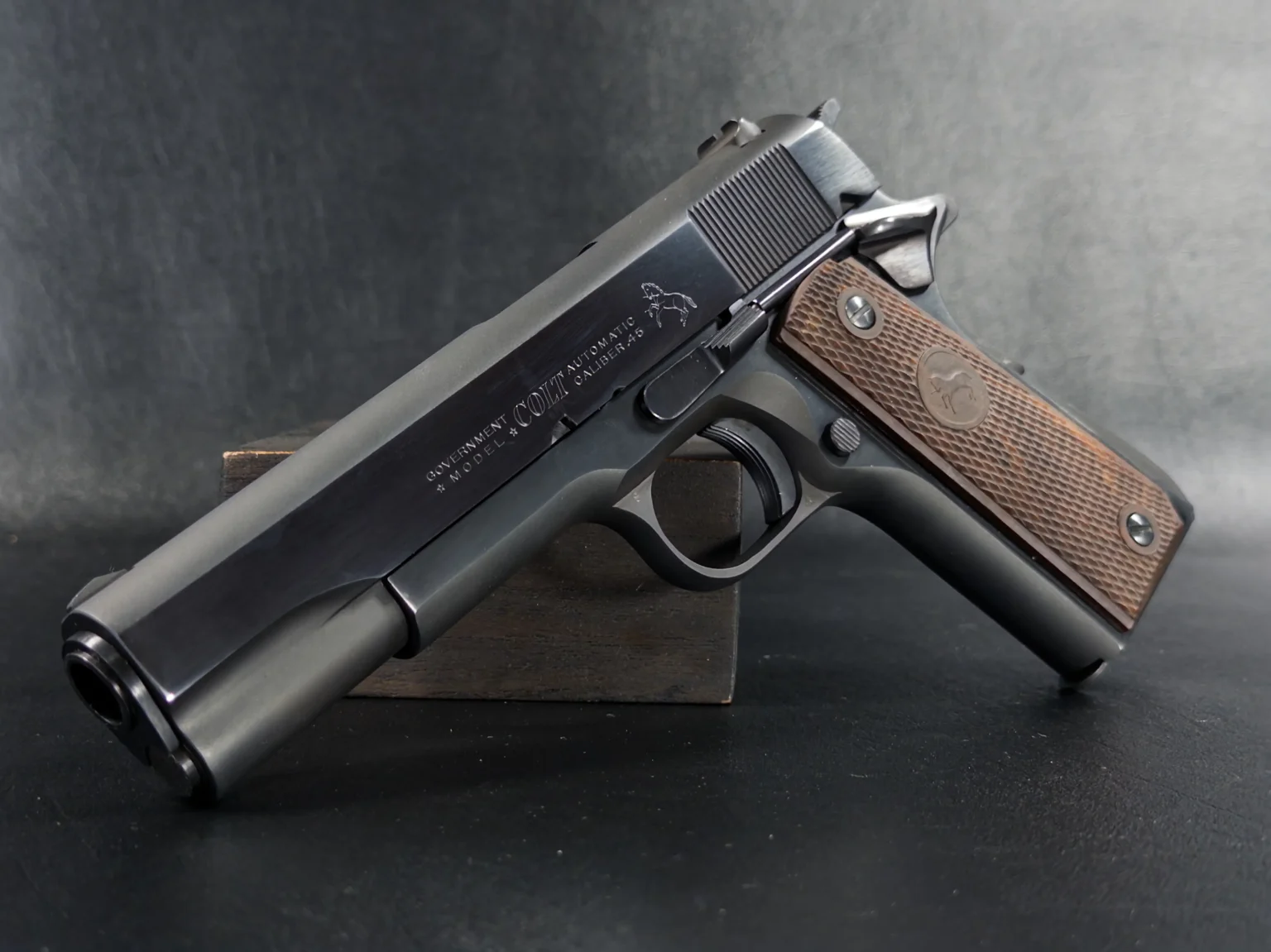
John Moses Browning developed the pistol that Colt refined and manufactured as the Model 1911. The U.S. Army adopted the .45-caliber pistol in March 1911 to replace its .38-caliber service revolvers.[1] The formal adoption date was March 29, 1911.[2]
The M1911 was a product of American industrial manufacturing rather than a bespoke, individually built firearm. By the time it entered production, specialized machinery and gauges had made interchangeable firearms components practical.[3] Skilled labor remained important to machining, assembly, and finishing, but claims that every early Colt was extensively hand-built or individually fitted should be treated cautiously.
From M1911 to M1911A1
The original M1911 had a long trigger, flat mainspring housing, small sights, and a relatively short grip-safety tang. Experience during World War I led to several modifications, including a shorter trigger, relief cuts behind the trigger guard, an arched mainspring housing, larger sights, and a longer grip-safety tang.[2]
These changes did not appear simultaneously. Although collectors often associate the revised configuration with 1924, the Army changed the official nomenclature from M1911 to M1911A1 in June 1926. An Ordnance Committee action distinguished pistols below serial number 700,000 as M1911s and pistols beginning at serial number 700,000 as M1911A1s.[4]
For collectors, the distinction is important. The M1911 and M1911A1 are closely related, but they represent different military configurations and production periods. Features must be evaluated in relation to the pistol’s manufacturer and serial-number range.
Military Manufacturers
Colt was the principal manufacturer associated with the M1911, but it was not the only producer.
Springfield Armory manufactured military M1911 pistols between 1913 and 1917.[3] These pistols followed the government pattern while carrying Springfield markings and inspection details. Bruce N. Canfield documented Springfield production of 25,767 pistols during fiscal years 1914 through 1917.[5]
During World War I, the government also contracted with Remington-UMC. The company delivered its first pistols in August 1918 and completed 21,677 before production ended in early 1919.[5] Remington-UMC pistols had their own serial-number sequence, manufacturer markings, and inspection characteristics.
World War II brought a much larger production program. Approximate procurement totals identify Remington-Rand as the largest manufacturer, with about 900,000 M1911A1 pistols. Ithaca and Colt each produced approximately 400,000, while Union Switch & Signal manufactured approximately 50,000. Singer completed an educational order of 500 pistols but did not enter quantity production.[4]
Remington-UMC and Remington-Rand were separate companies. Remington-UMC manufactured M1911 pistols during World War I. Remington-Rand, a business-machines manufacturer, produced M1911A1 pistols during World War II.[5]
Original, Rebuilt, or Assembled
A serial number can indicate the expected model and production range, but it cannot establish that every component has remained with the pistol since manufacture.
Military pistols were working equipment. During and after World War II, government facilities inspected them, replaced worn or unserviceable components, and refinished many with Parkerizing. Arsenal initials were generally stamped on the frames of rebuilt pistols.[4] Consequently, an authentic government rebuild may contain components made by different manufacturers.
This creates several distinct collecting categories:
- Pistols retaining their apparent factory configuration and finish
- Documented military or arsenal rebuilds
- Period-modified pistols
- Commercially refinished examples
- Pistols assembled from components originating with different firearms
These categories should not be confused. A government rebuild can be historically legitimate without remaining in its original factory configuration. Conversely, correct-looking parts do not prove that a pistol survives exactly as manufactured.
The physical examination should consider the agreement among the serial number, manufacturer markings, inspection stamps, finish, and component configuration. Refinished or heavily polished pistols may have softened edges, weakened markings, or altered surfaces that make identification more difficult. Wear alone does not establish authenticity.
Building a Focused Collection
A coherent collection can be organized around the pistol’s development rather than quantity. One approach is chronological: an early M1911, an interwar example, and a World War II M1911A1. Another is manufacturer-based, combining Colt production with pistols from Springfield Armory, Remington-UMC, or the World War II contractors.
A collection may also focus on government rebuilds. Because many earlier M1911 pistols were refurbished and returned to service, an arsenal-rebuilt example can document military maintenance and continued use across different periods.[4][5]
Production totals provide useful context, but they do not authenticate an individual firearm. Manufacturer, condition, configuration, and documented history must be evaluated together.
Preservation
Historic firearms contain metal, wood, finishes, and other materials that respond differently to humidity, temperature, light, and contaminants. National Park Service guidance calls for stable relative humidity, secure firearm storage, gloves during examination, regular inspection, and separation of firearms from ammunition.[6]
The same guidance warns against storing historic firearms in direct contact with leather slings or scabbards because leather can contribute to metal deterioration and attached hardware can scratch surrounding surfaces.[6] Firearms should also be handled as though loaded, kept pointed away from people, and inspected carefully before examination.[6]
Maintenance should be conservative. The National Park Service recommends consulting a conservator experienced with firearms when dismantling, cleaning, or stabilization is required.[6] Any treatment should preserve historical evidence rather than attempt to make an old pistol appear new.
The Colt 1911’s significance rests in documented design, military production, and surviving physical evidence. For collectors, the essential discipline is straightforward: identify the pistol accurately, distinguish original manufacture from later rebuilding, and preserve the evidence that explains its history.
Frequently Asked Questions
The Army formally adopted the .45-caliber pistol on March 29, 1911.
The revised pistol incorporated changes including a shorter trigger, an arched mainspring housing, larger sights, trigger-relief cuts, and a longer grip-safety tang. The M1911A1 designation became official in 1926.
Yes. Military contractors included Springfield Armory, Remington-UMC, Remington-Rand, Ithaca, Union Switch & Signal, and Singer during different production periods.
It can be. A documented government rebuild may be historically legitimate even if worn components were replaced or the pistol was refinished during military service.
Store it securely under stable environmental conditions, separate it from ammunition, and inspect it regularly. Significant cleaning, dismantling, or stabilization should be entrusted to a conservator experienced with historic firearms.
Sources
- John Keilers, “Arming the Army, John M. Browning,” U.S. Army Military History Institute, January 12, 2009.
- Wiley Clapp, “M1911 & M1911A1,” American Rifleman, February 20, 2013.
- National Park Service, Springfield Armory National Historic Site, “How to Make a Gun.”
- Bruce N. Canfield, “Rifleman Q&A: G.I. M1911 Production,” American Rifleman, February 25, 2022; originally published June 2005.
- Bruce N. Canfield, “G.I. ‘Non-Colt’ M1911s,” American Rifleman, April 26, 2016; originally published June 2001.
- National Park Service, “Caring for Historic Longarms: Storage and Handling,” Conserve O Gram, Vol. 10, No. 1.