
Key Takeaways:
- Under 18 U.S.C. § 921(a)(16), a firearm manufactured in or before 1898, including matchlock, flintlock, and percussion cap designs, meets the federal “antique firearm” definition and falls outside Gun Control Act licensing requirements. Other countries set their own cutoff dates, so this standard does not apply outside the United States.
- Firearm ignition evolved from the matchlock through the wheellock and flintlock before percussion ignition and self-contained cartridges replaced them in the 19th century. The Colt Paterson revolver, produced in Paterson, New Jersey starting in 1836, is a documented example of this transitional period.
- Metal and wood components in antique firearms require different storage conditions, and conservators recommend a controlled, moderate relative humidity to limit corrosion without drying out wood stocks. The National Park Service’s curatorial guidance identifies rising humidity as a primary driver of metal corrosion in firearm collections.
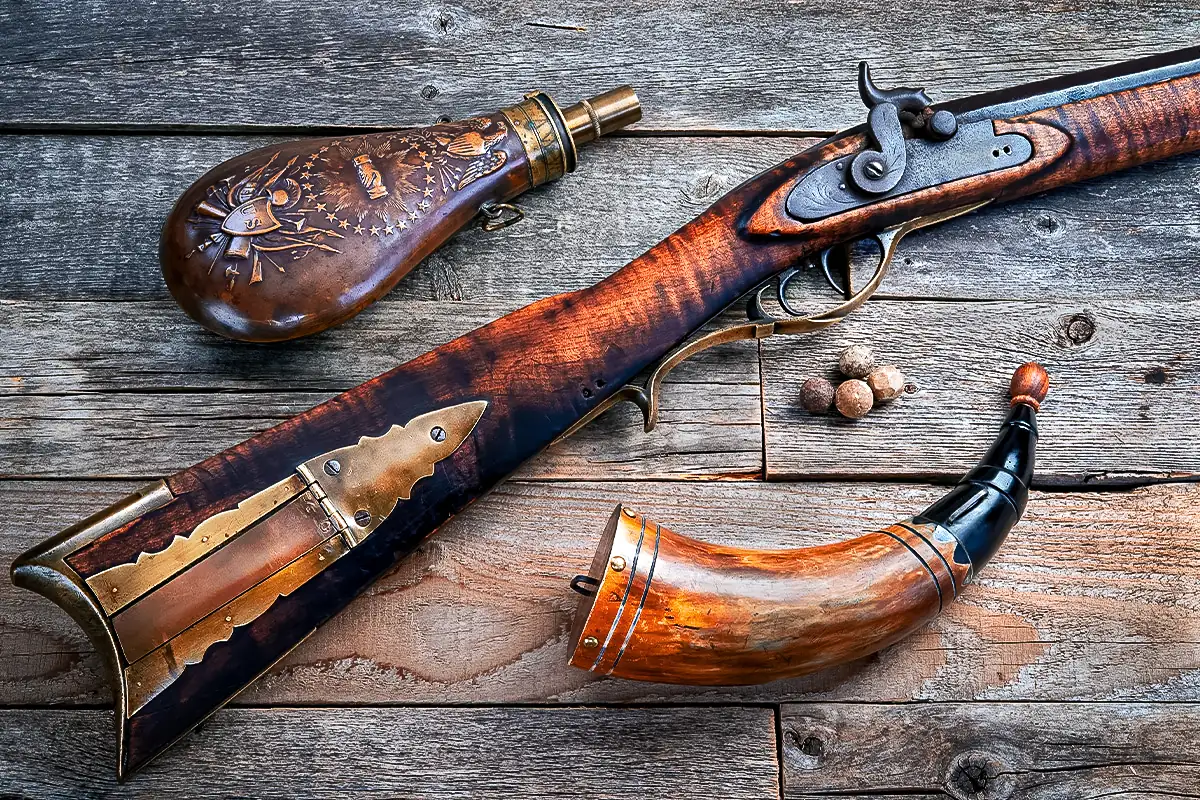
Black powder firearms trace a direct mechanical lineage from the matchlock of the 15th century to the metallic-cartridge arms that succeeded them at the close of the 19th century. For collectors, understanding that lineage, and the legal definition that separates “antique” from “modern,” is the starting point for building an informed collection.
What “Antique” Means Under Federal Law
Black powder is the traditional gunpowder mixture used in firearms before the adoption of smokeless propellants. Under United States federal law, an “antique firearm” is defined in 18 U.S.C. § 921(a)(16) as any firearm, including any firearm with a matchlock, flintlock, percussion cap, or similar ignition system, manufactured in or before 1898, along with certain replicas and firearms using ammunition no longer commercially available.[1][2] Firearms meeting this definition fall outside the licensing and transfer requirements of the Gun Control Act of 1968.[1] Muzzleloading rifles, shotguns, and pistols designed to fire black powder or a black powder substitute are treated the same way regardless of when they were manufactured.[2] Other countries set their own cutoff dates and criteria, so the U.S. federal standard does not automatically apply elsewhere.
The Evolution of Ignition Systems
The matchlock, which used a smoldering cord to ignite priming powder, was the first firearm mechanism to rely on a mechanical trigger rather than direct hand ignition, and it remained in military use for roughly three centuries after its introduction.[3] The wheellock followed in the 16th century, generating sparks from a spring-driven steel wheel spun against iron pyrite. Because the mechanism was expensive to produce and repair, wheellocks were used mainly by nobility and specialized troops rather than common infantry, while the cheaper matchlock remained in wide use alongside it.[3][4]
The flintlock, which struck flint against a steel plate to ignite powder in an exposed priming pan, emerged in the 17th century and dominated firearm design for roughly two centuries with few fundamental changes.[3][4] Through the first half of the 19th century, percussion ignition replaced the flintlock, and muzzleloading construction eventually gave way to breechloading and self-contained cartridge designs, a period of rapid advancement that coincided with the Industrial Revolution and, in the United States, the Civil War.[3]
A Case Study: The Colt Paterson
The Colt Paterson revolver illustrates how this era’s technology translated into a specific, well-documented collectible. Samuel Colt received a U.S. patent for a revolving-cylinder firearm and, in March 1836, formed the Patent Arms Manufacturing Company in Paterson, New Jersey, where the revolver that bears the town’s name was produced.[5][6] The earliest Paterson production consisted of ring-lever revolving rifles and carbines before the factory turned to the five-shot revolving pistols now most associated with the name; both used a folding trigger without a trigger guard, a feature that distinguished them from Colt’s later designs.[5] The Patent Arms Company failed in 1842, and Paterson production ended shortly afterward, leaving a fixed and well-documented body of surviving examples for collectors and historians to study.[5]
Storage and Preservation
Because black powder firearms combine ferrous metal components with wood stocks, the two materials call for different storage conditions, and conservators generally recommend a controlled, moderate relative humidity to slow metal corrosion while avoiding the wood damage that comes with excessively dry air. The National Park Service’s guidance on the curatorial care of metal museum objects notes that corrosion accelerates as relative humidity rises and recommends keeping humidity as low as practical for stable storage of metal artifacts, within a controlled range appropriate for mixed collections.[7] Stable temperature and humidity, combined with clean, low-acid storage materials, are the primary means institutions use to slow deterioration in firearms held for the long term.[7]
Frequently Asked Questions
Federal law defines an antique firearm as one manufactured in or before 1898, including matchlock, flintlock, and percussion cap designs, along with certain replicas and firearms using ammunition no longer commercially available. Firearms meeting this definition fall outside Gun Control Act licensing and transfer requirements.
No. Other countries set their own cutoff dates and criteria for what qualifies as an antique firearm, so the U.S. federal standard does not apply automatically outside the United States.
The matchlock, introduced in the 15th century, was the first firearm mechanism to use a mechanical trigger rather than direct hand ignition. It remained in military use for roughly three centuries.
The Colt Paterson was produced starting in 1836 at Samuel Colt’s Patent Arms Manufacturing Company in Paterson, New Jersey, following his patent for a revolving-cylinder firearm. Production ended after the company failed in 1842, leaving a fixed, well-documented body of surviving examples.
Conservators recommend a controlled, moderate relative humidity, since metal components corrode as humidity rises while wood stocks need enough moisture to avoid damage from overly dry conditions. The National Park Service’s museum handbook identifies stable humidity, clean storage materials, and low acidity as primary tools for slowing long-term deterioration.
Sources
[1] Bureau of Alcohol, Tobacco, Firearms and Explosives. “Top 10 Frequently Asked Firearms Questions and Answers.” ATF, n.d.
[2] Bureau of Alcohol, Tobacco, Firearms and Explosives. “27 CFR § 478.11, Meaning of Terms.” ATF, n.d.
[3] NRA National Firearms Museum. “A Brief History of Firearms.” NRA National Firearms Museum, n.d.
[4] Buffalo Bill Center of the West. “Powder Hour: Evolution of Firearms.” Buffalo Bill Center of the West, 2016.
[5] American Rifleman. “The First Colts.” National Rifle Association, n.d.
[6] Colt’s Manufacturing Company LLC. “Timeline.” Colt’s Manufacturing Company LLC, n.d.
[7] National Park Service. “Museum Handbook, Part I, Appendix O: Curatorial Care of Metal Objects.” National Park Service, n.d.