
Key Takeaways:
- Colt did not invent the revolver, but his patented mechanism made the percussion revolver more practical.
- The Colt Walker military contract revived Colt’s firearms business and supported its subsequent expansion.
- Colt’s Hartford operation advanced large-scale precision manufacturing through specialized machinery, standardized inspection, and interchangeable parts.
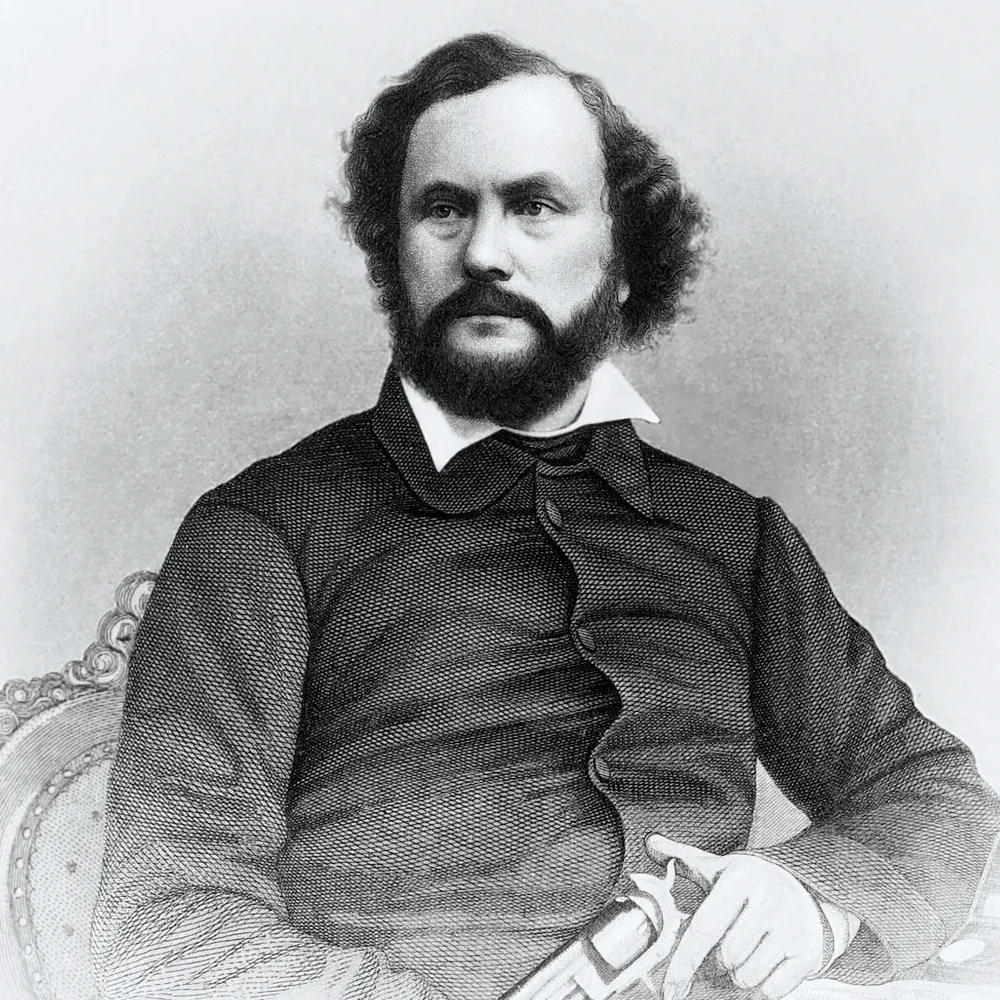
Samuel Colt did not invent the revolving firearm. Multi-shot weapons with rotating cylinders existed centuries before his work, and Artemas Wheeler and Elisha Collier patented revolver mechanisms in 1818. Colt’s achievement was to develop a practical percussion revolver, protect its operating system through patents, and establish a manufacturing enterprise capable of producing such arms on a large scale.[1]
Colt’s Revolver Patent
Colt’s U.S. patent of February 25, 1836, described a firearm with multiple chambers arranged in a rotating breech. Cocking the hammer rotated the cylinder, brought a loaded chamber into alignment with the barrel, and locked the cylinder in position. Each chamber had its own percussion-cap nipple.[2]
This linked sequence, cocking, rotating, aligning, and locking, was Colt’s essential mechanical contribution. It distinguished his design from earlier revolvers that depended on manual cylinder rotation or less practical operating systems.
Colt’s first production handgun, subsequently known as the Paterson, established the foundation for his later revolvers. The design showed that a repeating handgun could provide several shots from one barrel before the user had to reload. Its commercial success, however, came only after further development and renewed military interest.
The Colt Walker
Colt’s decisive opportunity came through Captain Samuel Hamilton Walker, a Texas Ranger serving in the U.S. Mounted Rifle Regiment during the Mexican-American War. Walker had experience with earlier Colt revolvers and recommended improvements for a handgun intended for mounted troops.
The resulting Colt Walker was a six-shot, .44-caliber percussion revolver jointly developed by Colt and Walker. Weighing approximately four pounds nine ounces, it was considerably larger and more powerful than the earlier .36-caliber Paterson. The federal contract covered approximately 1,000 revolvers, while total Walker production amounted to 1,100.[3]
The revolvers were marked by military company, with serial numbers running from 1 through 200 for Companies A through E. The additional 100 examples were manufactured for the commercial market. Because Colt lacked a factory capable of completing the government order, production took place at Eli Whitney Jr.’s armory in Whitneyville, Connecticut.[3]
For collectors, an authentic Walker is significant not simply because the model is rare, but because its company marking and serial number can connect it to a specific portion of the military contract. Those markings must be evaluated with the firearm’s physical configuration, condition, and documented ownership history.
Expanding the Colt Line
The Walker contract revived Colt’s firearms business and established the basis for subsequent production. Later Dragoon revolvers retained the Walker’s general military purpose while refining its size and construction.
Colt also developed smaller models suited to military and civilian carry. The six-shot, .36-caliber Model 1851 Navy, introduced in 1851, had a 7½-inch barrel and weighed approximately two pounds ten ounces. It remained in production through 1873 and continued to be one of Colt’s most successful percussion revolvers during the Civil War, even after the introduction of the .44-caliber Model 1860 Army.[4]
The Model 1851 Navy also demonstrates why collectors must distinguish between a model’s introduction date and the date of an individual firearm. Production continued for more than two decades, spanning changes in markings, mechanical details, finish, and historical context.
Precision Manufacturing at Hartford
Colt did not invent interchangeable parts. American government armories had pursued standardized firearms production before his Hartford operation reached maturity. His importance lies in applying specialized machinery, division of labor, inspection gauges, and controlled production methods to revolver manufacture on an unusually large scale.
At Hartford, forged metal blanks were shaped with purpose-built lathes, drills, milling machines, and rifling equipment. Jigs and fixed bearing points held components in consistent positions, while gauges and calipers helped workers verify dimensions. The Smithsonian’s National Museum of American History describes Colt and his engineers as being among the first American manufacturers to achieve interchangeable parts on a mass scale.[5]
Armory superintendent Elisha K. Root played a central role in developing these methods and the specialized machinery that supported them. The Hartford factory became known as a training ground for mechanics, some of whom later carried their expertise into the manufacture of sewing machines, bicycles, automobiles, and other precision-made products.[5]
Colt’s industrial legacy therefore extends beyond firearm design. His factory demonstrated how precision machinery, standardized inspection, and organized labor could transform a mechanically complex product into a mass-manufactured one.
Presentation Arms and Promotion
Colt also understood the commercial power of exhibition, ornament, and influential ownership. He displayed firearms at international fairs, including London’s Great Exhibition of 1851 and New York’s Exhibition of the Industry of All Nations in 1853.[6]
His company produced elaborately engraved and gold-inlaid revolvers for exhibition and presentation. These firearms demonstrated both the mechanical quality of Colt products and the capabilities of the company’s engravers, finishers, and stock makers. Recipients included government officials, military officers, distributors, and foreign rulers.
Among the documented recipients was Czar Nicholas I of Russia, who received three gold-inlaid Colt revolvers at Gatchina Palace on October 30, 1854. Colt also used presentation arms to cultivate other influential figures and potential government customers.[6]
Such history makes presentation Colts especially desirable, but decoration alone does not prove a personal association with Samuel Colt. A credible attribution requires supporting evidence such as matching serial numbers, inscriptions, factory documentation, contemporary correspondence, or an independently documented chain of ownership.
The Company After Colt
Samuel Colt died in 1862, but the company continued developing firearms under his name. This distinction is essential when attributing later models to him personally.
The Colt Single Action Army, for example, was introduced in 1873, 11 years after Colt’s death. Chambered for a self-contained metallic cartridge, it represented a later stage of the company’s development rather than a firearm designed by Samuel Colt himself. Colt subsequently supplied more than 30,000 Single Action Army revolvers under U.S. government contracts between 1873 and 1891.[7]
Samuel Colt’s historical importance rests on a combination of mechanical, industrial, and commercial accomplishments. He developed an influential revolver mechanism, rebuilt his business through the Walker contract, expanded percussion-revolver production, helped advance large-scale precision manufacturing, and promoted his firearms with exceptional effectiveness. The surviving arms document that history directly through their mechanisms, markings, finishes, serial numbers, and provenance.
Frequently Asked Questions
No. Revolving firearms existed before Colt, but his patented mechanism made the percussion revolver more practical and commercially influential.
Colt patented a system in which cocking the hammer rotated, aligned, and locked a chamber of the cylinder for firing.
The six-shot, .44-caliber Walker resulted from Colt’s collaboration with Captain Samuel Hamilton Walker. Its government contract helped revive Colt’s firearms business.
No. Colt and his engineers helped apply specialized machinery, gauges, and standardized production methods to achieve interchangeability on a large scale.
No. Colt died in 1862, and the Single Action Army was introduced by his company in 1873.
Sources
- The Metropolitan Museum of Art, “Collier Second Model Five-Shot Flintlock Revolver”.
- United States Patent Office, Samuel Colt, “Improvement in Fire-Arms,” patented February 25, 1836.
- Dieter Stenger, “The Colt Walker Model Revolver,” Army History, No. 102, Winter 2017.
- The Metropolitan Museum of Art, “Gold-Inlaid Colt Model 1851 Navy Revolver, Serial No. 20133”.
- Eric Hintz, National Museum of American History, “Samuel Colt…and Sewing Machines?—Part 1” and “Part 2”.
- The Metropolitan Museum of Art, “Gold-Inlaid Colt Model 1849 Pocket Revolver, Serial No. 63306”.
- Colt’s Manufacturing Company, “Company Timeline”.