

Key Takeaways:
- Introduced in 1857, the seven-shot Model 1 was Smith & Wesson’s first production firearm.
- The Model 3 American, introduced in 1870, established Smith & Wesson’s large-caliber centerfire revolver line.
- The .38 Military & Police appeared in 1899 and received the Model 10 designation in 1957.
Three revolver families illustrate major stages in Smith & Wesson’s history: the Model 1, the No. 3, and the .38 Military & Police, later designated the Model 10. Introduced in 1857, 1870, and 1899 respectively, they span the company’s development from small rimfire revolvers to large-caliber centerfire arms and solid-frame hand-ejector designs.[1]
Model 1
Introduced in 1857, the Model 1 was Smith & Wesson’s first production firearm. It was a small-frame, seven-shot, single-action revolver chambered for a .22 rimfire cartridge comparable to the modern .22 Short.[1][3]
The revolver’s development depended on Rollin White’s 1855 patent. White described a rotating cylinder with chambers extending through its rear, allowing cartridges to be inserted from behind.[2] Smith & Wesson obtained exclusive rights to use the system and incorporated it into the Model 1.[4]
To load or unload the Model 1, the barrel tipped upward, and the cylinder was removed. A rod mounted beneath the barrel was then used to push fired cases from the chambers. The arrangement eliminated the separate percussion caps, loose powder, and projectiles required by conventional percussion revolvers.[4]
The Model 1 appeared in three principal issues. The First Issue was manufactured from 1857 to 1860, with approximately 11,671 produced. The Second Issue followed from 1860 to 1868, with approximately 117,000 produced. The Third Issue was manufactured from 1868 to 1881, with approximately 131,000 produced.[4]
Collectors can distinguish the issues through their frames, sideplates, grips, and cylinders. First Issue revolvers generally have a rounded frame, square butt, unfluted cylinder, and small round sideplate. The Second Issue introduced a larger, irregularly shaped sideplate and flatter frame profile. The Third Issue has a bird’s-head grip and fluted cylinder.[4]
Those production figures also place rarity in context. A Model 1 may be an early cartridge revolver without being an unusually scarce example. Its precise issue, subvariation, serial-number range, condition, finish, and originality must be considered individually.
No. 3 Revolvers
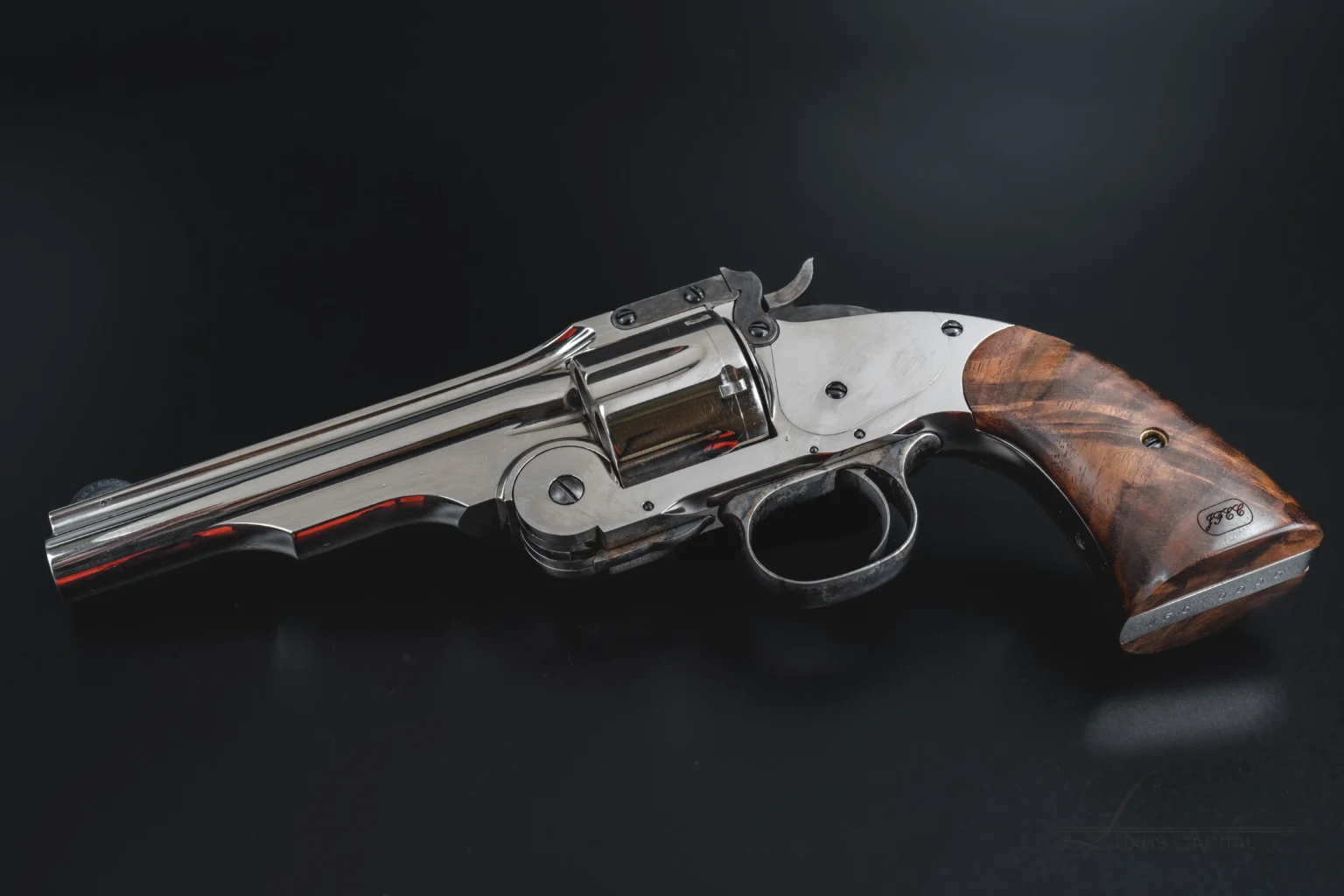
Smith & Wesson introduced the Model 3 American in the summer of 1870. The company identifies it as the first large-caliber, centerfire cartridge revolver manufactured in the United States.[1]
The No. 3 designation eventually encompassed several configurations rather than one uniform revolver. Surviving examples differ in model designation, caliber, barrel length, grip configuration, finish, engraving, and intended market. Correctly identifying the particular variation is therefore essential.
The Metropolitan Museum of Art holds a documented example that demonstrates the level of specificity possible with a well-recorded No. 3. Its New Model No. 3, serial number 25120, is a .44-caliber, single-action revolver manufactured by Smith & Wesson around 1888. Smith & Wesson’s records document its shipment to Tiffany & Co. on November 11, 1888.[5]
Tiffany fitted the nickel-plated revolver with a two-piece silver grip etched with a buffalo-hunting scene. The museum records its five-inch barrel, overall length of 11 inches, and weight of two pounds, eight ounces. The object combines an identifiable serial number, factory shipping information, documented decoration, and institutional provenance.[5]
Such documentation is materially different from an unsupported association with a historical person or event. A recognized factory entry or museum record tied to the firearm’s serial number can establish details that appearance alone cannot prove.
Military & Police and Model 10
Smith & Wesson introduced the .38 Military & Police in 1899. The revolver combined a solid frame with a hand-ejector system and established the company’s medium-size K-frame. It was also closely associated with the introduction of the .38 S&W Special cartridge.[1][6]
Early Military & Police revolvers were offered in several barrel lengths and configurations. Subsequent changes included different butt shapes, finishes, grips, sights, and internal engineering. Collectors commonly divide early production into successive changes based on those mechanical and external differences.[6]
During World War II, Smith & Wesson manufactured more than 800,000 Military & Police revolvers for Allied forces. These wartime arms became known as Victory Models and are identified in part by a “V” serial-number prefix.[1][6]
In 1957, Smith & Wesson changed the Military & Police designation to Model 10. The underlying revolver remained part of the same long-running product family, although its configuration continued to change. Smith & Wesson reports cumulative production of more than six million examples.[1][6]
The production total means that the Model 10 family is not uniformly scarce. Collectibility depends on the particular variation. An early Military & Police, a correctly configured Victory Model, and a later commercial Model 10 should not be evaluated as interchangeable examples.
Identifying a Collectible Example
Identification should begin with the firearm itself. The complete serial number, barrel inscription, caliber marking, frame markings, sights, grips, finish, and mechanical configuration should be recorded before assigning a production period or variation.
Originality and condition are separate questions. A revolver can retain substantial original finish but contain replacement grips or altered components. Another may show considerable wear while remaining in its original configuration. Refinishing, modern engraving, shortened barrels, replaced sights, and mixed parts can remove or obscure identifying evidence.
Serial numbers should be compared only after determining where the relevant model and production period normally carried numbered components. A repeated number is useful only when its location and purpose are understood.
Provenance requires documentation connecting a particular firearm to its claimed history. Factory shipping records, period correspondence, dated inventories, and museum accession records are stronger than an undocumented family account. The Tiffany-decorated New Model No. 3 demonstrates how a serial number, shipping date, physical configuration, and museum record can establish a specific history without relying on promotional language or inference.[5]
Frequently Asked Questions
The Model 1, introduced in 1857, was the company’s first production firearm and used a seven-shot .22 rimfire cylinder.
Smith & Wesson manufactured three principal Model 1 issues between 1857 and 1881.
Smith & Wesson introduced the Model 3 American in the summer of 1870 as a large-caliber centerfire revolver.
Smith & Wesson assigned the Model 10 designation to the Military & Police revolver in 1957.
Exact variation, originality, condition, configuration, and documented provenance are more meaningful than age alone.
Sources
[1] Smith & Wesson. “The History of Smith & Wesson.” Smith & Wesson, n.d.
[2] White, Rollin. “Improvement in Repeating Fire-Arms.” United States Patent No. 12,648, issued April 3, 1855.
[3] Naval History and Heritage Command. “Smith & Wesson Model No. 1 Revolver.” Naval History and Heritage Command, n.d.
[4] National Firearms Museum. “Smith & Wesson No. 1 1st Issue Revolver with Original Gutta Percha Case.” National Firearms Museum, n.d.
[5] Metropolitan Museum of Art. “Smith and Wesson .44 New Model No. 3 Single-Action Revolver, Serial No. 25120.” Metropolitan Museum of Art, n.d.
[6] American Rifleman. “Smith & Wesson Model 10 (Military & Police).” American Rifleman, September 17, 2012.

3 Responses
I have a c546965 pearl handle snub all original hardly shot m&p pre10 anyone know the value.
32 20 smith wesson revolver 3 1/4 serial number 14005 marking on barrel 1889. to1901 all markings match cylinder and bottom off gun i think it 1st change. it got indentation on cylinder wondering value. I had gun 39 year. forgot about it found it in closet
I have a Smith and Wesson 38 snobe nose sn BKE1361 what is it worth never been shot