
Key Takeaways:
- A compelling ownership story is not provenance unless reliable evidence connects the specific firearm to the claimed owner.
- Factory records may confirm configuration, shipment dates, or destinations, but they usually do not establish subsequent ownership.
- Record unresolved gaps and contradictions honestly. Never replace missing evidence with assumptions or repeated claims.
Provenance is the documented history of an object’s ownership from its creation to the present. For a collectible firearm, provenance may establish previous owners, transfers, recorded configurations, and associations with particular people or events. It can also help address questions of authenticity and historical significance.[1]
Provenance does not turn a plausible story into a fact. A family account, engraved name, factory letter, photograph, or auction description may contribute evidence, but none automatically proves a complete ownership history.
Why Provenance Matters
Collectors commonly evaluate firearms according to authenticity, rarity, condition, and market demand.[2] Provenance addresses a separate question: what can be established about the history of this specific firearm?
A standard revolver does not become historically significant because someone says a prominent officer carried it. The claim becomes credible only when reliable evidence connects the identifiable firearm to that person.
Strong provenance can:
- Support attribution to a documented owner.
- Confirm a recorded factory configuration.
- Establish a shipping date or destination.
- Explain engraving, repairs, refinishing, or replacement components.
- Connect the firearm to an estate, collection, exhibition, or earlier sale.
- Preserve historical information through subsequent transfers.
The number of documents is less important than their quality. Several later sources repeating the same unsupported account remain one unsupported account. Independence, chronology, authenticity, and a demonstrable connection to the firearm matter more than volume.
Begin With the Firearm
The firearm itself is the first source. Before investigating an ownership claim, create a thorough record of its observable characteristics.
Photograph:
- Both sides of the complete firearm.
- The serial number and any secondary numbers.
- Manufacturer, model, caliber, and address markings.
- Proof, inspection, acceptance, and property marks.
- Engraving, inscriptions, monograms, and presentation text.
- The barrel, frame, receiver, cylinder, slide, stock, and grips.
- Visible repairs, alterations, refinishing, and replacement parts.
- The case, accessories, labels, and accompanying documents.
Transcribe markings exactly as they appear. Record their locations and whether they appear stamped, engraved, etched, or applied by another process. Do not silently correct spelling, punctuation, abbreviations, or dates.
Physical evidence still requires interpretation. An engraved name identifies a possible research subject; it does not prove that the person owned or received the firearm. The inscription could be contemporary, commemorative, later, or fraudulent. The inscription and the ownership claim must therefore be evaluated separately.
The Getty Museum’s provenance work begins with physical evidence—including inscriptions, stamps, and other marks—and compares it with sale catalogs, personal papers, inventories, and archival documents.[3] The same basic method is applicable to collectible firearms.
Factory Letters: Strong but Limited Evidence
A factory letter can be one of the most useful records available, but it must be read literally.
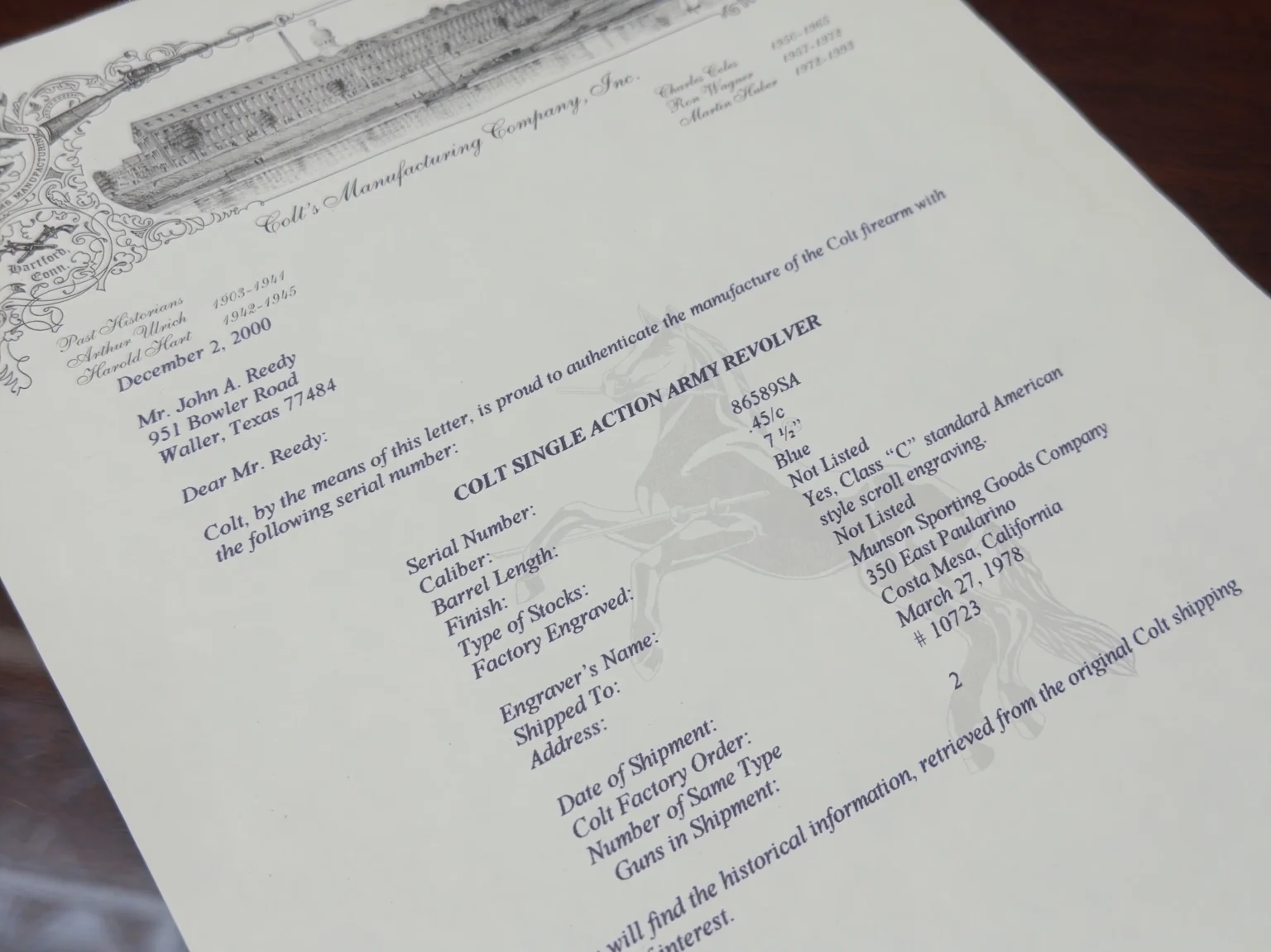
Colt states that its archive letters may document a firearm’s original specifications and delivery information. The contents vary according to the model and the surviving shipping record for the individual firearm.[4] Depending on the record, a letter may report the model, caliber, finish, barrel length, engraving, special features, shipment date, or destination.
The Smith & Wesson Historical Foundation reports that its factory letters draw on Smith & Wesson’s corporate archives and generally document factory specifications and initial distribution. It also states that subsequent ownership transfers usually occurred through distributors, dealers, and retailers and ordinarily do not appear in the factory records.[5]
Winchester records have similar limitations. The Cody Firearms Records Office states that surviving early records may contain configuration details such as caliber, barrel type, trigger type, and special-order features. Customer information is rarely available, and many later surviving records contain only the date on which a serial number was applied.[6]
A factory letter can establish what a surviving factory record says. It does not necessarily prove:
- The identity of the first retail purchaser.
- Ownership by a particular individual.
- The firearm’s history after shipment.
- That every present component remains in its original configuration.
- That engraving or alterations were factory-applied unless the record says so.
- That an accompanying family or dealer account is accurate.
“Shipped to” and “owned by” are not interchangeable.
A Winchester Model 1873 Example
A Winchester Model 1873 preserved by the National Park Service demonstrates the difference between factory history and ownership history.
Records at the Buffalo Bill Center of the West connected the rifle’s serial number to a manufacture and shipping date in 1882. Those records did not identify the purchaser or even where the rifle was shipped after leaving the Winchester warehouse.[7]
The records established a date. They did not establish an owner.
Because the rifle was found outdoors in what is now Great Basin National Park, it invites speculation. No reliable evidence identified who left it there or why. Assigning the rifle to a particular prospector, rancher, or historical event would go beyond the documented facts.
Build the Ownership Chain Backward
Begin with the current owner and work backward one transfer at a time. For every person or institution in the proposed chain, record:
- The full name.
- The documented or approximate dates of possession.
- How the firearm was acquired or transferred.
- The source supporting the transfer.
- Whether the source is an original, copy, transcription, or recollection.
- Any uncertainty or contradiction.
Relevant evidence may include:
- Original invoices and receipts.
- Bills of sale.
- Estate and probate inventories.
- Insurance schedules.
- Dealer and distributor records.
- Factory correspondence.
- Dated personal correspondence.
- Period photographs showing identifiable features.
- Collection and exhibition catalogs.
- Published auction catalogs.
- Repair, engraving, or restoration records.
A previous auction catalog establishes that a firearm was offered under a particular description at a particular time. It does not independently prove every historical assertion in that description. Important claims should be traced to the documents or physical evidence on which the auction house relied.
A photograph of a person holding the same model is not necessarily a photograph of the same firearm. A persuasive photographic comparison requires identifying characteristics such as a visible inscription, unusual configuration, distinctive damage, or readable serial number.
Test the Chronology
Every proposed ownership chain should survive a basic chronological review.
Ask:
- Was the claimed owner alive when the firearm existed?
- Was the person in the stated location?
- Had the model entered production?
- Is the configuration consistent with the proposed date?
- Did the engraving, proof mark, military unit, agency, or business exist at that time?
- Could the seller, recipient, or witness have participated in the transfer?
- Does the serial number on every document match the firearm?
An impossible date invalidates the claim, regardless of how often the story has been repeated.
Discrepancies should be investigated rather than dismissed. A transposed serial number may be a clerical error, but it may also show that the document belongs to another firearm. The available evidence must determine which explanation is defensible.
Warning Signs
Provenance deserves additional scrutiny when:
- The ownership story first appears when the firearm is offered for sale.
- Documents are supplied only as cropped photographs.
- The serial number is absent from the supporting records.
- A factory destination is represented as an individual purchaser.
- An inscription is the sole evidence connecting the firearm to a famous owner.
- Different accounts provide incompatible dates or owners.
- Several websites repeat identical language without identifying the original source.
- An auction description cites an earlier auction description as its authority.
- The documents use terminology inconsistent with the claimed period.
- The conclusion depends on “believed to be,” “reportedly,” or “possibly” without explaining the evidence.
Forgery is not merely theoretical. Springfield Armory National Historic Site includes imitation and misrepresented arms in its collection to demonstrate that convincing fakes can enter the market without clear evidence of their modern manufacture.[2]
Present the Evidence Clearly
A useful provenance file should allow another researcher to retrace the work. It should include:
- A concise description of the firearm.
- A complete list of serial numbers, markings, and identifying features.
- A chronological ownership history.
- An inventory of supporting documents.
- Complete copies or high-quality images of those documents.
- Citations sufficient to relocate archival and published records.
- A separate account of family tradition and oral history.
- A list of unresolved questions.
- Notes explaining contradictions without forcing a conclusion.
The language should reflect the strength of the evidence:
- “Owned by” requires evidence of ownership.
- “Shipped to” reports a recorded destination.
- “Attributed to” acknowledges that the identification remains incomplete.
- “Family tradition identifies” describes the source without presenting the story as fact.
- “Possibly associated with” is appropriate only when the reason for the possible association is stated.
Preserve, Do Not Improve
Research should not damage the object being researched. Do not polish away markings, force seized components, remove finishes, or disassemble an unfamiliar firearm merely to locate a number or inscription.
The National Park Service treats firearms and associated ammunition as potentially hazardous collection objects. Its museum guidance directs institutions to use an experienced specialist to determine whether a firearm is loaded and to perform any necessary unloading.[8] Although written for museums, the principle is sound for private collections: if a firearm’s condition or status is uncertain, stop and seek qualified assistance.
Historical evidence also resides in condition. Wear, repairs, finishes, tool marks, and accumulated alterations may help explain a firearm’s history. Restoration intended to improve appearance can erase information that cannot be recovered.
Evidence Before Story
The best provenance is not necessarily the most dramatic. A documented chain of ordinary family ownership is more credible than an attribution to a famous person supported only by an inscription and a repeated story.
The correct standard is straightforward: state what the evidence proves, identify what remains uncertain, and preserve the documentation so the research can be checked independently. Provenance becomes reliable history only when it survives scrutiny.
Frequently Asked Questions
It is the documented history of a firearm’s ownership and transfers. It may also include verified factory, configuration, repair, exhibition, and sale records.
Not necessarily. A factory letter may confirm specifications and an initial shipping destination without identifying the retail purchaser or later owners.
No. An inscription is a research lead that must be corroborated through independent records connecting the person to the specific firearm.
Useful evidence includes factory records, original receipts, estate inventories, dated correspondence, and photographs showing identifiable features. Each document must be authenticated and connected directly to the firearm.
Document the conflict and test each account against physical evidence, chronology, and independent records. Do not present the claim as fact until the contradiction is resolved.
Sources
- Smithsonian Institution, “Provenance,” National Collections Program
- Springfield Armory National Historic Site, “Arms Collecting,” U.S. National Park Service
- J. Paul Getty Museum, “Research on Museum Collection Provenance”
- Colt’s Manufacturing Company, “Archive Services”
- Smith & Wesson Historical Foundation, “Factory Letters”
- Buffalo Bill Center of the West, “Winchester Factory Records”
- U.S. National Park Service, “Winchester Model 1873 Rifle Found and Preserved”
- U.S. National Park Service, Museum Handbook, Part I, Appendix G: Museum Firearms, Small Arms Ammunition, Munitions, and Artillery