
Key Takeaways:
- White progressed from industrial die cutting to becoming a Colt master engraver during the 1950s.
- His obituary credits him with presentation-firearm commissions for U.S. presidents from John F. Kennedy through Ronald Reagan.
- White helped preserve American firearms engraving by sharing his knowledge with engravers including Andrew Bourbon and Daniel Cullity.
Alvin Alexander White built his reputation by combining the precision of industrial die cutting with the artistic demands of firearms engraving. Known as the “Dean of American Arms Engravers,” he became one of the most prominent American practitioners of the craft during the 20th century.[1]
White was born in Attleboro, Massachusetts, and worked as a die cutter for the L.G. Balfour Company before World War II. He subsequently served with the U.S. Army Air Corps in North Africa and the Pacific. In the 1950s, he began engraving firearms for Colt and rose to the position of master engraver.[1][2]
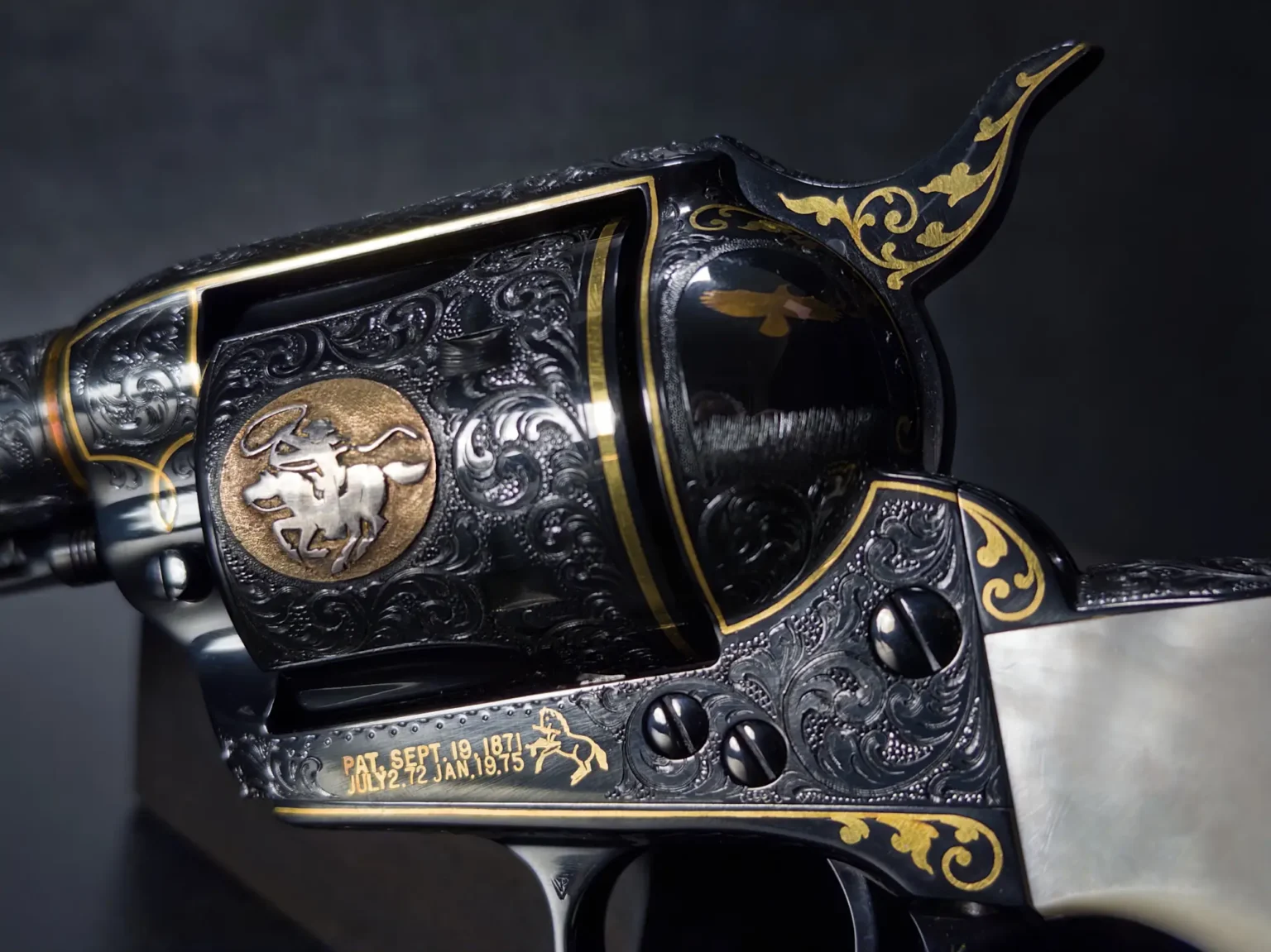
Die cutting provided a practical foundation for his later work. Cutting designs into steel requires control, consistency, and an understanding of how ornament must conform to a finished object. White applied those disciplines to firearms while developing a body of work associated particularly with Colt revolvers. He also engraved other types of arms, including traditional muzzleloaders, European-style firearms, derringer pistols, Winchester rifles and Smith & Wesson revolvers.[2]
White’s work included engraved and precious-metal-inlaid presentation firearms. His obituary records commissions for every U.S. president from John F. Kennedy through Ronald Reagan, as well as for Soviet leader Leonid Brezhnev and King Hussein of Jordan.[1] These commissions reflected the established use of decorated firearms as ceremonial gifts and demonstrations of American craftsmanship.
Although White is best remembered for his work on firearms, his interests were considerably broader. Items retained in his personal collection included bronze sculptures, miniature arms, knives, silver objects, and traditional American firearms that he built, engraved, or embellished.[2] In his later years, he also designed and cut dies for Pairpoint Glass Works. Among those projects was a series of cup plates depicting characters created by Massachusetts naturalist and author Thornton W. Burgess.[1]
White also contributed to the continuation of American engraving by sharing his knowledge with other craftsmen. Published accounts identify Andrew Bourbon and Daniel Cullity among the engravers he mentored.[2] This willingness to teach is an important part of the reputation expressed by the title “Dean”: White was recognized not only for the quality of his own work, but also for helping transmit the craft to another generation.
Alvin A. White died in Sandwich, Massachusetts, on May 8, 2006, at the age of 91.[1][3] His career connected several strands of American decorative art, industrial die cutting, traditional gun engraving, precious-metal work, carving and sculpture. The surviving record presents him as a disciplined and versatile craftsman whose work helped sustain ornamental firearms engraving in modern America.
Frequently Asked Questions
Alvin A. White was a master firearms engraver associated closely with Colt. He became known as the “Dean of American Arms Engravers.”
White worked as a die cutter for the L.G. Balfour Company before World War II. He began engraving for Colt during the 1950s and became a master engraver.
White’s obituary credits him with commissions for U.S. presidents from John F. Kennedy through Ronald Reagan. It also names Leonid Brezhnev and King Hussein of Jordan.
No. Published accounts document his work on other firearms, including Smith & Wesson revolvers, Winchester rifles, muzzleloaders and derringer-style pistols.
White helped sustain American decorative firearms engraving through his craftsmanship and teaching. Andrew Bourbon and Daniel Cullity are identified among the engravers he mentored.