

Key Takeaways:
- The HSP 701 uses a fixed barrel and roller-delayed action, not a rotating-barrel system.
- Edgar Budischowsky filed the German patent application for its operating mechanism in 1978.
- Surviving examples vary in caliber, barrel length, trigger system, safety arrangement, and finish.
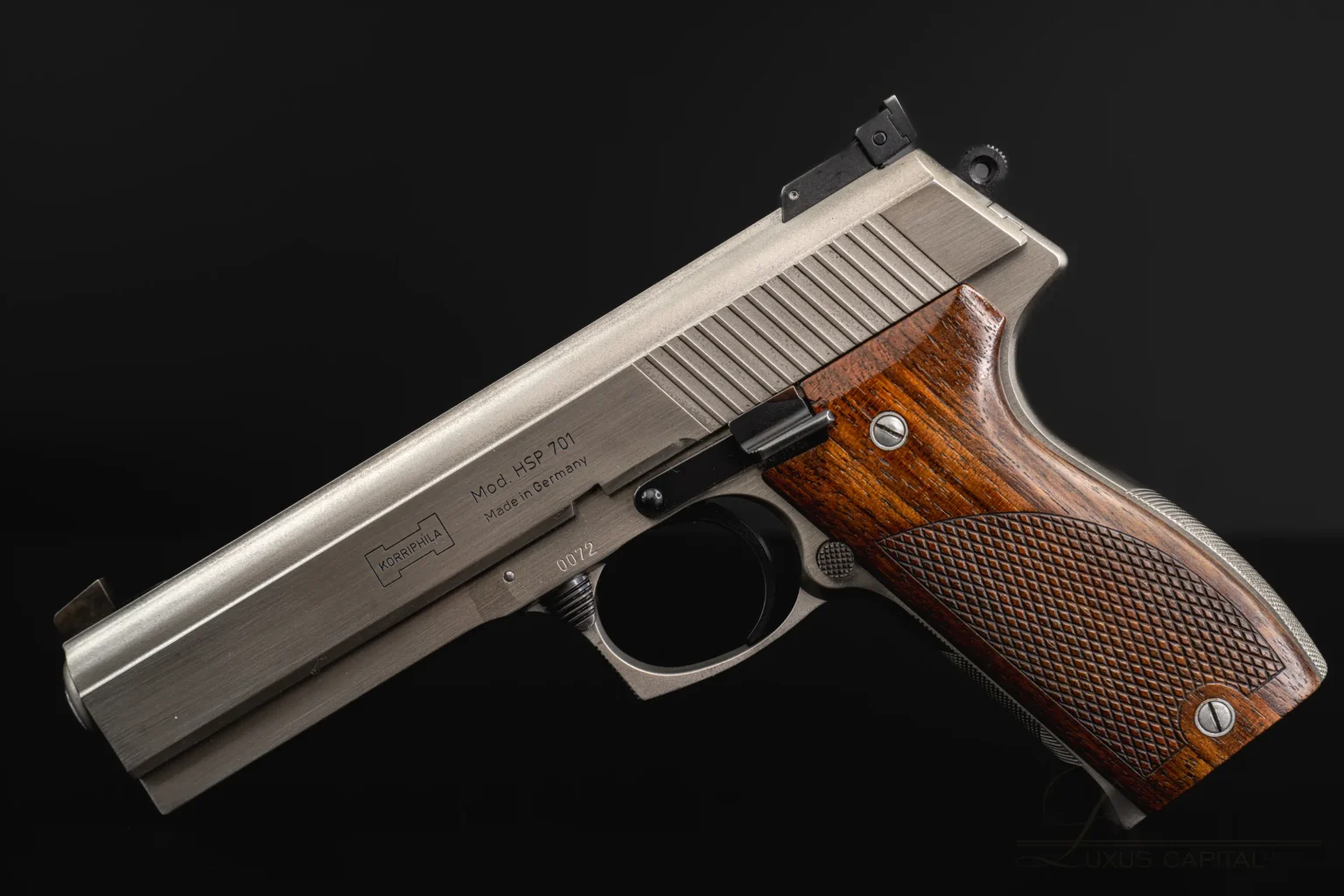
The Korriphila HSP 701 is distinguished by an unconventional operating system, limited manufacture, and meticulous construction. Designed by Edgar Budischowsky and produced in Heidelberg, West Germany, it appeared in documented production form by 1984.[1][2]
Budischowsky filed the German patent application underlying the pistol’s action on May 26, 1978. Published as DE 2822914 A1 on November 29, 1979, the patent describes a self-loading firearm with a fixed barrel and chamber, a separate breechblock, and a roller controlled by an inclined locking wedge connected to the slide.[1]
The Budischowsky System
Contrary to some later descriptions, the HSP 701 does not employ a rotating or tilting barrel. Its barrel remains fixed to the frame, with the recoil spring positioned around it.[1][2]
When the pistol is fired, rearward force acts on the breechblock. A roller and inclined locking wedge initially resist its movement while transferring force to the slide. As the slide travels rearward, the wedge permits the roller to leave its recess, releasing the breechblock so that extraction and ejection can occur.[1] This roller-delayed arrangement allows the action to cycle without moving the barrel.
The patent also describes the use of interchangeable locking wedges with different inclined surfaces. Budischowsky intended this feature to adapt the locking system to cartridges generating different levels of force.[1]
A Documented Early Example
Walter L. Rickell examined HSP 701 serial number 0017 in 1984 for an article published in the March/April 1985 issue of American Handgunner. He identified it as one of the first production pistols and reported that it was then the only example in the United States.[2][3]
That pistol was chambered in .45 ACP and had a 4 1/16-inch fixed barrel, a seven-round detachable magazine, walnut grips, a squared trigger guard, and sights adjustable for windage and elevation. Its overall dimensions were reported as 7¼ inches long, 5⅝ inches high, and one inch wide.[3]
The pistol used a traditional double-action trigger mechanism. Instead of a manual thumb safety, it incorporated an automatic system that blocked the firing pin and prevented the hammer from contacting it until the trigger was pulled or the hammer was cocked for single-action fire.[2]
Rickell described the machining, polish, bluing, and component fitting favorably. During the reported test, the pistol fed full-metal-jacket, hollow-point, and semiwadcutter ammunition without a malfunction. Its best 25-yard group, fired from a rest with Winchester 185-grain match ammunition, measured approximately 2⅝ by 1¾ inches.[3] These results document the performance of serial number 0017 under one test protocol, not every HSP 701 produced.
Variations and Individual Specifications
Published research documents HSP 701 pistols in multiple calibers and with both 4- and 5-inch barrels, although .45 ACP appears to have been the principal chambering.[4] Because examples were made in limited quantities and could differ in configuration, collectors should verify each pistol through its markings, proof date, serial number, mechanical features, and accompanying documentation.
A Hermann Historica auction catalog illustrates that variation. Its May 2025 sale included serial number 0055, a .45 Auto pistol with a 125-millimeter barrel, single-action trigger, adjustable trigger weight, manual safety, roller-delayed action, walnut grips, 1984 proof mark, original correspondence, invoice, and operating manual. The same auction included serial number 0705, a later 5-inch HSP 701 manufactured by Intertex Maschinenbau with a Damascus-steel frame, slide, and barrel.[5]
These documented differences make careful, example-specific examination essential. Caliber, barrel length, trigger system, safety arrangement, finish, proof marks, matching parts, accessories, and original paperwork can all help establish what an individual pistol is and how closely it retains its documented configuration.
The HSP 701’s historical importance rests on a clear body of evidence: Budischowsky’s patented roller-delayed mechanism, its fixed-barrel construction, and surviving pistols that demonstrate unusually varied and carefully executed production.
Frequently Asked Questions
Edgar Budischowsky designed the HSP 701 and filed the German patent application for its operating mechanism in 1978.
No. The HSP 701 has a barrel fixed to the frame and uses a roller-delayed operating system.
A roller and inclined locking wedge delay the breechblock’s rearward movement after firing. The slide’s movement releases the roller, allowing extraction and ejection.
The best-documented early example was chambered in .45 ACP. Published research also documents pistols in other calibers and configurations.
Collectors should examine its serial number, proof marks, caliber, barrel length, trigger system, safety arrangement, finish, matching components, and documentation. Specifications should be verified for each individual pistol.
Sources
- Edgar Budischowsky, “Semi-Rigid Lock for Small Firearm Breech Block,” German patent DE 2822914 A1, filed May 26, 1978; published November 29, 1979.
- Walter L. Rickell, “Korriphila HSP 701,” American Handgunner, March/April 1985, p. 42.
- Walter L. Rickell, “Korriphila HSP 701,” American Handgunner, March/April 1985, pp. 44–45.
- Ian McCollum, “Korriphila HSP-701: A Masterful Bespoke German Pistol,” Forgotten Weapons, November 27, 2020.
- Hermann Historica, Auction 104: Historical and Modern Firearms, HSP 701 lots 7610–7611, May 2025.

One Response
This really answered my problem, thank you!