
Key Takeaways:
- FEGA certifies Master Engravers, not individual firearms.
- Signatures, FEGA marks, factory records, invoices, and photographs can support attribution.
- Hand engraving, pointillé, etching, inlay, and overlay are distinct decorative techniques.
The Firearms Engravers Guild of America certifies engravers, not individual firearms. Its Master Engraver Program recognizes members whose hand engraving has been judged by FEGA Master Engravers at the guild’s convention. A successful applicant may use the FEGA Master Engraver logo and stamp or mark work with it.[1] The precise description for a documented piece is therefore “engraved by a FEGA Master Engraver,” not “FEGA-certified firearm.”
The Master Designation
The guild’s Master Engraver directory lists, among others, Chang Jun Cai, Lee Griffiths, Mark Hoechst, Jesse Kaufman, Brian Powley, and Sam Welch.[2] Inclusion in that directory establishes the individual’s guild status. It does not, by itself, attribute a particular Colt, Winchester, Browning, Smith & Wesson, Ruger, Remington, or other firearm to that person.[1][3]
That distinction matters in collection records and sale descriptions. FEGA states that a signature or other marking can assist attribution, while unmarked work, including some factory engraving, can be difficult to identify.[3] A FEGA logo on a firearm may support an attribution because successful Master Engravers are entitled to mark their work with it, but the mark should be examined together with the firearm, its paperwork, and its ownership history.[1][3]
Reading the Techniques
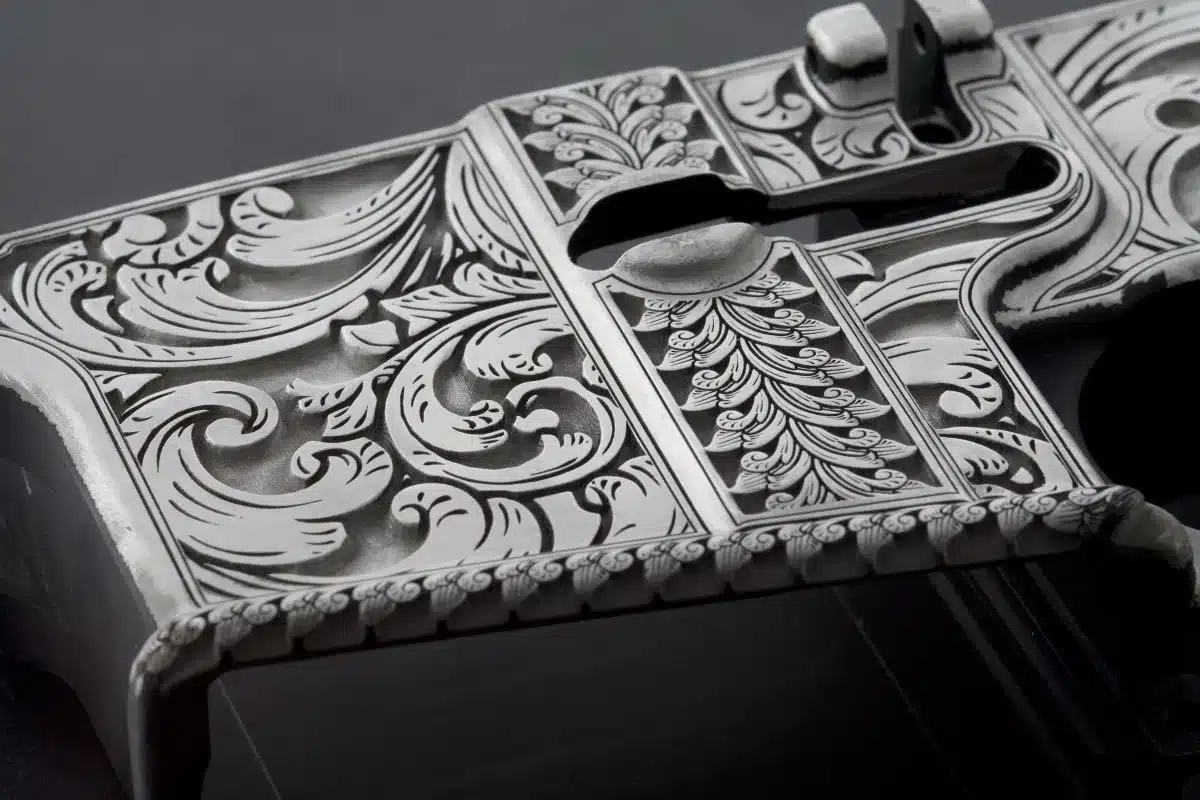
Hand engraving cuts a pattern or inscription into metal with a hardened, pointed tool. Pointillé creates an image from punched dots rather than cut lines. Etching is different: an acid-resistant coating is applied to the surface, the design is opened through that coating, and acid cuts the exposed metal.[4]
Metal inlay requires channels or recesses that receive a softer metal, commonly gold, silver, or a copper alloy. In true inlay, an undercut cavity mechanically secures the metal when it is hammered into place. Overlay, sometimes called damascening, attaches foil or wire to a roughened or crosshatched surface. Inlaid or overlaid metal is usually burnished flush; metal intentionally left above the surface is described as encrusting.[4]
These terms describe processes, not grades of quality. A useful catalog entry identifies what is present and where: cut scrollwork on the receiver, pointillé shading in a game scene, flush gold inlay around a border, or relief carving on a stock. It should not use “hand engraved” as a catchall for etching or machine-cut ornament.
Historical American Factory Engraving
American manufacturers offered elaborate firearm decoration by the mid-19th century. A gold-inlaid Colt Model 1851 Navy revolver in The Metropolitan Museum of Art, serial number 20133 and dated about 1853, combines extensive engraving, relief carving, and gold inlay. Its cylinder carries a hand-engraved naval battle scene designed by Waterman Lilly Ormsby. The museum identifies five known Model 1851 revolvers with extensive gold inlay, including this example.[5]
Winchester later organized factory decoration through published patterns. The company’s Highly Finished Arms, first issued in 1897, offered ten receiver-decoration options and eight stock-decoration options. A 1906 Winchester Model 1894 takedown rifle in The Met, serial number 311946, has Style No. 1 engraving and Style A stock carving, together with gold and platinum inlay. The rifle is signed by John Ulrich, and its features correspond to patterns illustrated in the factory catalog.[6]
These museum records show why “engraved firearm” is only the beginning of a useful description. The maker, model, serial number, date, decorative method, factory or later origin, artist attribution, markings, and supporting records are separate facts. Each requires its own evidence.
A Documentation Standard for Collectors
Start with the firearm itself. Record the maker’s markings, model designation, serial number, proof and inspection marks, dimensions, caliber or gauge, and all visible signatures or logos. Photograph the complete firearm and close details before interpreting the decoration.
Next, establish who performed the work. Strong documentation may include an engraver’s signature or FEGA mark, an invoice naming the firearm, correspondence, dated photographs, a factory record, or an exhibition catalog. A stylistic resemblance can guide research, but it should not replace direct documentation. FEGA’s own guidance makes clear that unsigned engraving is often harder to attribute.[3]
Factory originality and later custom work must also be kept separate. A firearm can be authentically engraved by a FEGA Master Engraver without being factory engraved. Conversely, a factory-engraved firearm may have no connection to FEGA. For an older arm, refinishing, restored ornament, recut lines, replaced components, and later inlays should be described individually rather than folded into a broad claim of originality.
The most accurate catalog language is narrow and object-specific: “engraved by,” “signed by,” “marked with,” or “factory record states.” FEGA Master Engraver status identifies a juried practitioner of hand engraving. The firearm’s authorship, configuration, condition, and provenance still depend on the evidence attached to that particular object.
Frequently Asked Questions
It means an engraver’s handwork has passed the guild’s review process.
No. The designation applies to the engraver, although a Master Engraver may mark completed work with the FEGA logo.
A signature, FEGA mark, invoice, correspondence, factory record, or dated photograph can support attribution.
No. Hand engraving cuts metal mechanically, while etching uses acid to cut exposed areas of the surface.
No. The mark may identify the engraver, but factory origin must be established through separate documentation.
Sources
[1] Firearms Engravers Guild of America. “Master Engraver Information.” Firearms Engravers Guild of America, n.d.
[2] Firearms Engravers Guild of America. “Meet the Master Engravers.” Firearms Engravers Guild of America, n.d.
[3] Firearms Engravers Guild of America. “Frequently Asked Questions.” Firearms Engravers Guild of America, n.d.
[4] Breiding, Dirk H. “Techniques of Decoration on Arms and Armor.” Heilbrunn Timeline of Art History, The Metropolitan Museum of Art, October 2003.
[5] The Metropolitan Museum of Art. “Gold-inlaid Colt Model 1851 Navy Revolver (serial no. 20133), with Case and Accessories.” The Metropolitan Museum of Art, n.d.
[6] The Metropolitan Museum of Art. “Winchester Model 1894 Takedown Rifle (serial no. 311946) with Box of Sights.” The Metropolitan Museum of Art, n.d.