
Key Takeaways:
- Mechanical innovation, manufacturing quality, documented history, and provenance can make a revolver collectible.
- Model names alone are insufficient; chambering, configuration, production period, condition, and originality must be verified.
- Collectible firearms should not be treated as guaranteed investments because values can rise or fall independently.
Price alone does not make a revolver collectible. Enduring interest generally rests on mechanical distinction, manufacturing quality, documented history, scarcity, condition, and provenance. The following ten revolvers merit consideration for different reasons, but none should be purchased on the assumption that its value will inevitably appreciate.
Mateba Model 6 Unica Autorevolver
Emilio Ghisoni’s Italian-designed Mateba 6 Unica is one of the most unconventional modern revolvers to reach production. Instead of relying entirely on the trigger or manual cocking to prepare each successive shot, its movable upper assembly uses recoil energy to cock the hammer and advance the cylinder. The barrel is aligned with the cylinder’s bottom chamber rather than the conventional top chamber.[1]
These features give the Mateba genuine mechanical significance. They also make condition particularly important. Prospective buyers should examine the action carefully and confirm that any included barrels, tools, cases, or accessories belong with the specific revolver. Assertions about production totals or rarity should be supported by factory or import records rather than repeated online estimates.
Korth Mongoose
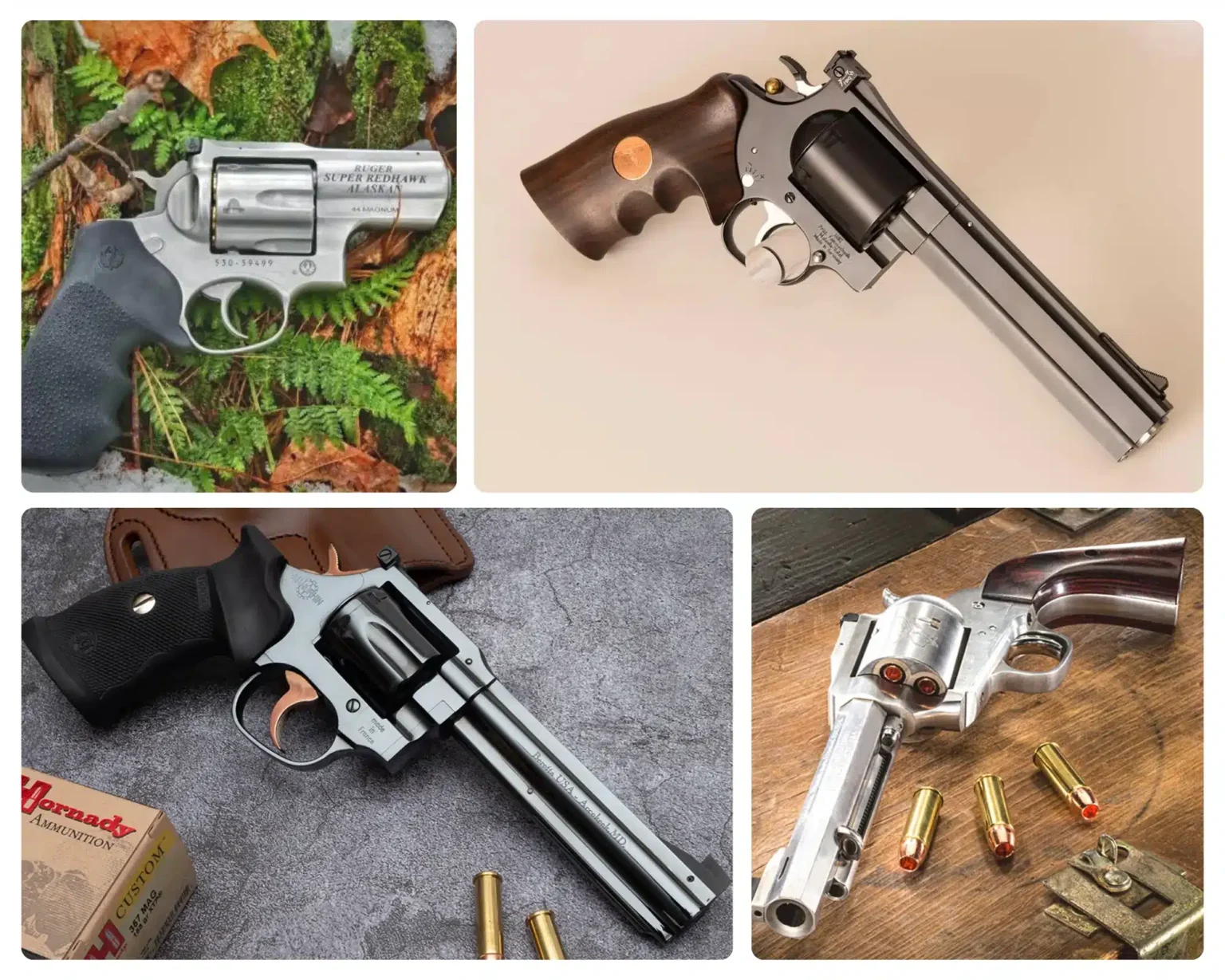
The Mongoose is a German-made Korth double-action revolver developed for the American market through Korth’s collaboration with Nighthawk Custom. The original partnership announcement identified it as a .357 Magnum model alongside the 9mm Sky Hawk and .357 Magnum Super Sport.[2]
Depending on configuration, a Mongoose may also have an individually fitted 9mm conversion cylinder. Published testing describes two conversion-cylinder arrangements: one using moon clips and another with a clipless extraction system.[3] Because chambering, barrel length, finish, and accessories vary, collectors should document the exact configuration rather than treating every Mongoose as equivalent.
The broader Korth name has a longer history than this particular model. Willi Korth began developing his revolver design during the mid-1960s, and the present company states that Martin Rothmann has continued the Korth operation since 2008.[4] Modern Mongoose revolvers should therefore be distinguished from earlier Korth production associated directly with Willi Korth and subsequent company owners.
Janz Interchangeable-Caliber Revolver
Janz-Präzisionstechnik of Germany treats the revolver as a configurable system. Its Type S and EM-S revolvers accept interchangeable barrels and cylinders, while the company also offers fixed-caliber models and several frame sizes.[5]
This modularity gives complete Janz sets particular collecting interest. Their identity encompasses more than the serialized frame: cylinders, barrels, tools, fitted cases, test targets, and factory paperwork may all contribute to completeness. A component that fits the frame should not automatically be assumed to have been supplied with it originally.
Korth Sky Hawk
The Sky Hawk emerged from the same Korth–Nighthawk collaboration as the Mongoose. It is a compact, six-shot revolver chambered in 9mm Luger rather than .357 Magnum. Its two-inch barrel, aluminum frame, and extraction system—which permits the use of rimless 9mm cartridges without moon clips—distinguish it from conventional small-frame revolvers.[6]
The model was based on Korth’s Sky Marshal and adapted for importation and sale by Nighthawk Custom. Contemporary reporting documented German manufacture and Nighthawk Custom markings on the American-market revolver.[6] Its specialized chambering and relatively short market history make originality, mechanical condition, and accompanying documentation more meaningful than unsupported claims that every example is rare.
Smith & Wesson Performance Center Model 627
The Performance Center Model 627 is not one uniform revolver but a family of stainless-steel N-frame configurations. Smith & Wesson currently lists both a 2.63-inch model and a five-inch model, each chambered in .357 Magnum and fitted with an eight-round cylinder.[7]
The 2.63-inch version has an adjustable rear sight, a cylinder cut for full moon clips, and a Performance Center action with ball-detent lockup. The five-inch model also has a moon-clip-cut cylinder and adds a tuned action, trigger stop, and gold-bead front sight.[7]
Collectors should record the catalog number, barrel length, sights, grips, and original accessories. The Model 627 designation alone is not specific enough to establish a revolver’s configuration or desirability.
Colt Python, 2020 Production
Colt returned the Python to production in 2020. The initial stainless-steel revolvers were chambered in .357 Magnum and offered with 4.25- and six-inch barrels. Although they retained the Python’s familiar ventilated rib and full underlug, Colt redesigned the action rather than reproducing the original mechanism unchanged.[8]
That distinction matters. A current-production Python is not an original-production Python, and the two belong to different collecting categories. Earlier examples are judged by their production period, finish, condition, originality, and factory documentation. The revived model should be evaluated as a separate generation that combines recognizable Python styling with contemporary materials and manufacturing.
Manurhin MR73
The French MR73 became closely associated with GIGN, the National Gendarmerie’s intervention unit. GIGN’s intensive training requirements helped establish the revolver’s reputation for durability, while adjustable sights, specialized grips, and different barrel lengths appeared on versions adapted to the unit’s requirements.[9]
Current MR73 revolvers are produced by Chapuis Armes and imported into the United States by Beretta. American-market offerings include Sport, Match, and Gendarmerie configurations built around the six-shot .357 Magnum platform but differentiated by sights and barrel configuration.[10]
Early Manurhin-marked revolvers, later Chapuis production, documented agency arms, and modern commercial imports should not be grouped together without qualification. The manufacturing period and provenance of an individual example are central to its historical and collector significance.
Ruger Super Redhawk Alaskan
Ruger announced the Super Redhawk Alaskan in November 2004 as a compact, large-bore adaptation of the Super Redhawk. The original version had a 2.5-inch barrel, six-shot cylinder, stainless-steel construction, and Hogue Monogrip. Ruger initially offered it in .454 Casull—which also accommodates .45 Colt—and .480 Ruger.[11]
The Alaskan is significant as a purpose-built factory configuration rather than as an embellished presentation revolver. Because Ruger has produced the wider Super Redhawk family in several chamberings and configurations, collectors should confirm the catalog number, chambering, and shipment period of the particular firearm. Ruger cautions that serial numbers can indicate an approximate year but may not establish an exact production or shipment date.[12]
Turnbull-Finished Ruger Super Blackhawk
In 2017, TALO Distributors offered a Ruger Super Blackhawk with metal colored and finished by Turnbull Restoration. The collaboration combined Ruger’s single-action platform with Turnbull’s specialized decorative metal finishing.[13]
Documentation is crucial because Turnbull also performs finishing work on customer-owned firearms. A color-case-hardened Ruger is not automatically one of the TALO-distributed collaboration guns. Original packaging, distributor labels, invoices, and correspondence can establish whether an example was sold as part of the documented edition or refinished separately.[14]
The finish should also be evaluated for preservation. Subsequent polishing, refinishing, replaced grips, or missing packaging can materially change the collector character of an otherwise attractive revolver.
Freedom Arms Model 83
The Freedom Arms Model 83 is a five-shot revolver manufactured in Freedom, Wyoming. The company’s instruction manual identifies the platform specifically as a five-shot Model 83 and explains its traditional single-action loading and operating system.[15]
The Model 83 is closely associated with powerful hunting cartridges. In 2005, Freedom Arms introduced its proprietary .500 Wyoming Express for the Model 83, using a belted cartridge case designed to fit the existing revolver platform.[16] That chambering represents one documented branch of a model family that has appeared in multiple configurations.
For collectors, the precise chambering, barrel length, sights, grips, finish, and factory-installed options must be verified on the individual revolver. Auxiliary cylinders, scope mounts, fitted cases, test targets, and factory correspondence may add significance when their connection to the firearm is documented.
Collecting the Individual Firearm
These revolvers do not constitute a single investment class. Some remain in current production. Others are discontinued designs, limited distributor configurations, or specialized products whose markets may be comparatively narrow. Their prices can move independently, and historical importance does not guarantee financial appreciation.
Before buying, establish the firearm’s exact model, serial number, production period, chambering, barrel length, finish, mechanical condition, and legal status. Claims of limited production, factory engraving, agency use, famous ownership, or special-order manufacture require evidence tied directly to the gun.
Originality also demands precision. Replacement grips, refinished surfaces, conversion cylinders, and altered sights may improve appearance or utility while reducing historical originality. Conversely, a documented factory modification may be entirely correct. The difference is evidence.
The strongest acquisitions are not necessarily the most expensive. They are the examples whose identity, configuration, condition, and history can be demonstrated clearly.
Frequently Asked Questions
Collector interest commonly depends on mechanical distinction, historical significance, manufacturing quality, scarcity, condition, and documented provenance. A high price by itself does not establish collectibility.
The Mateba 6 Unica is mechanically distinctive because recoil movement cocks the hammer and advances the cylinder. Its barrel also aligns with the cylinder’s bottom chamber.
No. Original-production and modern-production Pythons represent different collecting categories and should be evaluated by production period, configuration, originality, and condition.
No. Firearm values depend on changing demand, condition, provenance, originality, and the market for the particular model.
Verify the model, serial number, chambering, barrel length, finish, production period, mechanical condition, and accompanying documentation. Special claims of ownership, factory configuration, or limited production require direct supporting evidence.cdd
Sources
- U.S. Patent No. 6,772,670 B2, “Operating Method for Automatic Weapons and Automatic Revolver Based Thereon”
- Kylie Vess, “Nighthawk Custom and Korth: A New Level of Revolvers,” Shooting Illustrated, May 16, 2016
- Brad Fitzpatrick, “Korth Mongoose .357 Revolver,” Handguns Magazine
- Korth, “About Us”
- Janz-Präzisionstechnik, Revolver Product Range
- Mike Detty, “Wheelgun Test: The Nighthawk-Korth Sky Hawk Revolver,” Athlon Outdoors
- Smith & Wesson, Performance Center Model 627 Specifications and Performance Center Model 627 Five-Inch Specifications
- Colt, “Colt Introduces the New Python,” January 6, 2020
- American Rifleman, “Review: Beretta Manurhin MR73 50th Anniversary Edition Revolver”
- Eugene Nielsen, “Review: Le Manurhin MR-73 Revolver,” Shooting Illustrated
- Sturm, Ruger & Co., “Ruger Introduces the New Super Redhawk Alaskan,” November 11, 2004
- Sturm, Ruger & Co., Super Redhawk Serial Number History
- Turnbull Restoration, “Finishing Collaborations with Nighthawk Custom and TALO Distributors”
- Turnbull Restoration, Turnbull Finished Services
- Freedom Arms, Instruction Manual for Freedom Arms Model 83 Five-Shot Revolver
- Freedom Arms, “Introducing the .500 Wyoming Express,” October 3, 2005