
Key Takeaways:
- Asking prices, auction estimates, and verified sale prices are different measures and should never be treated as interchangeable.
- Condition, originality, provenance, rarity, documentation, and comparable sales are central to determining collector value.
- The Cabot Big Bang set, SIG Sauer P226-XFive, Wilson Combat Supergrade, Heirloom Precision 1911, and Laugo Arms Alien represent distinctly different market categories.
There is no authoritative ranking of the world’s most expensive semiautomatic pistols. Public asking prices, bespoke commissions, retail prices, auction estimates, and completed sales are different measures. A multimillion-dollar listing does not establish market value, while the cost of an individual commission may never become public.
For collectors, price is only the starting point. Condition, rarity, provenance, originality, historical significance, and comparable sales all affect value.[1] Contemporary pistols may also command premiums for specialized materials, extensive handwork, limited production, or unconventional engineering.
The following five pistols represent distinct parts of the high-end market. They are not presented as a price ranking.
Cabot Guns Big Bang Pistol Set
Cabot Guns unveiled the Big Bang Pistol Set in May 2016. The project comprised two mirror-image, 1911-style pistols, one right-handed and one left-handed, made from a 35-kilogram section of the Gibeon meteorite. Cabot reported using X-ray imaging, three-dimensional modeling, computer-aided manufacturing, aerospace-production methods, and electron-beam technology to work with the meteorite’s irregular structure.[2]
The pistols were intended to function, not merely serve as display pieces. Cabot stated that both were test-fired at its Indiana facility. Their surfaces display the meteorite’s Widmanstätten pattern, revealed through acid etching, together with selected portions of its weathered exterior.[2]
The frequently repeated $4.5 million figure was Cabot’s announced listing price. It was not a documented auction result. No public sale record cited here establishes that the set changed hands for that amount. The Big Bang pistols are therefore best described as a unique manufacturing project offered at an extraordinary price, not as evidence of a multimillion-dollar market for contemporary 1911s.
SIG Sauer P226-XFive
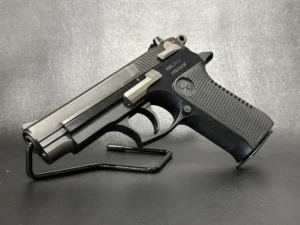
The P226-XFive occupies a different category: a premium factory pistol built around an established service-pistol platform. SIG Sauer’s operator’s manual identifies the XFive as a hammer-fired pistol with an adjustable single-action trigger, an all-metal frame, a stainless-steel slide, an ambidextrous manual safety, and a magazine catch that can be installed for right- or left-handed operation.[3]
The manual also documents a fixed fiber-optic front sight, an adjustable rear sight, and compatibility with selected SIG Sauer optical sights. Configuration varies by model, so specifications from one XFive should not automatically be applied to every pistol carrying the designation.[3]
These features support the XFive’s position as a specialized performance pistol, but they do not establish the inflated prices sometimes attached to rare, discontinued, or customized examples. A standard-production pistol, a German-made earlier variant, and a presentation-grade custom model are separate collecting propositions. Each requires its own documentation and comparable sales.
Wilson Combat Supergrade
Wilson Combat’s Supergrade represents the upper end of the company’s 1911 production. Published technical coverage describes the Tactical Supergrade as a hand-assembled, carbon-steel pistol with a hand-fitted match barrel and barrel bushing, checkered gripping surfaces, and premium small components.[4]
Its appeal lies in extensive fitting and finishing within an established manufacturer’s product line. Options can substantially alter a pistol’s final cost, but an advertised base price should not be treated as the value of every Supergrade. Caliber, finish, configuration, condition, factory documentation, engraving, and later alterations must all be considered.
A Supergrade may be an expensive working pistol without necessarily being a historically important collectible. Stronger collector interest generally requires something beyond the model name: a scarce factory configuration, recognized decorative work, notable ownership, exceptional condition, or convincing comparable sales.
Heirloom Precision 1911
Heirloom Precision represents the traditional bespoke-pistol model. In a detailed review published by American Handgunner, Roy Huntington documented a Jason Burton-built Colt Series 70 that underwent extensive manual work. The frame rails were welded and refitted to the slide, the magazine well was cut by hand, the front strap was hand-checkered, and the trigger guard was reshaped.[5]
That example demonstrates why the price of a bespoke 1911 cannot be reduced to a reliable model-wide figure. The starting firearm, mechanical work, hand finishing, engraving, materials, and client specifications can differ substantially from one commission to another.
Burton states that he generally accepts commissions from previous clients or selects new projects that offer sufficient historical, personal, or creative interest. He also says that his work is not governed by annual production quotas or fixed completion schedules.[6] Accordingly, undocumented claims about standard Heirloom Precision prices or delivery periods should be treated cautiously.
For a collector, the evidentiary file matters as much as the name on the pistol. A strong record should identify the base firearm, the work performed, the maker, any engravers or other collaborators, the commissioning client, and the chain of ownership.
Laugo Arms Alien
The Laugo Arms Alien derives its premium position principally from engineering. The manufacturer’s 2025 U.S. catalog describes it as a semiautomatic pistol with a fixed barrel, a gas-piston-delayed-blowback operating system, and a non-reciprocating upper rail. The catalog places the bore axis 1.7 millimeters below the grip axis.[7]
For the Alien Creator, the catalog lists a 124-millimeter (4.8-inch) barrel, a trigger pull of approximately 15 newtons, and magazine options holding 10, 17, or 22 rounds, depending on configuration. Creator variants offer interchangeable upper rails and modular grip components. Some competition packages add optical-sight equipment, magazines, tools, and fitted cases.[7]
The Alien is therefore better understood as a specialized performance pistol than as a traditional presentation arm. Its operating system, fixed barrel, low bore axis, and modular sighting arrangement distinguish it mechanically. Limited variants may attract collectors, but innovative design alone does not guarantee future value.
What Collectors Are Actually Paying For
These examples show why “most expensive” is too broad to be meaningful. The Cabot set is a singular exercise in material and manufacturing. The SIG Sauer and Wilson Combat pistols are premium factory or production-custom models. Heirloom Precision represents individual commission work. The Laugo Alien commands attention through unconventional mechanical design.
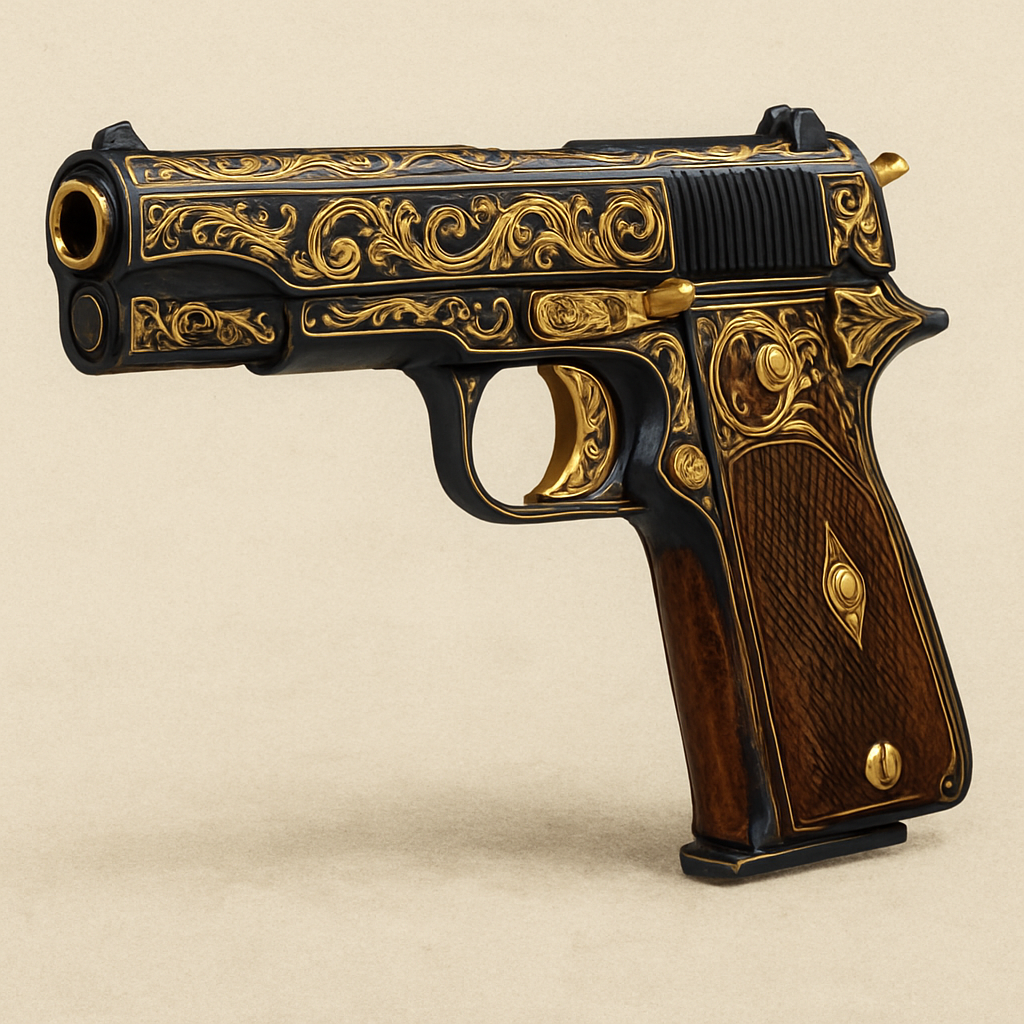
Decoration has an established place in arms collecting. Engraving, etching, bluing, gilding, and metal inlay have been used for centuries to turn functional arms into objects of artistic display.[8] Ornament, however, does not by itself prove authorship, rarity, or value. Those points require documentation.
A disciplined collector should distinguish among four numbers: original retail price, current asking price, auction estimate, and verified price realized. Only the last represents a completed public transaction, and even that result applies to one firearm at a particular time and venue.
For a serious acquisition, the strongest valuation rests on physical inspection, maker or factory documentation, provenance, originality, condition, and credible comparable sales. Superlatives are marketing. Evidence establishes value.
Frequently Asked Questions
Rarity, condition, originality, provenance, craftsmanship, historical importance, and documented market demand can all contribute to collectibility.
The $4.5 million figure was Cabot’s announced listing price. The cited public record does not establish a completed sale at that price.
It combines an all-metal frame, stainless-steel slide, adjustable single-action trigger, ambidextrous controls, and competition-oriented sights.
A bespoke 1911 is individually commissioned and may involve extensive hand-fitting, finishing, engraving, or client-directed features. A premium factory pistol is produced in more standardized configurations.
The Alien uses a fixed barrel, gas-piston-delayed-blowback operation, low bore axis, and non-reciprocating upper rail. These features distinguish it mechanically but do not guarantee future appreciation.
Sources
- Rock Island Auction Company, “True Gun Value,” 2025.
- Cabot Gun Company, “$4.5 Million Dollar Meteorite Pistols Unveiled,” May 23, 2016.
- SIG Sauer, “P226 X-Series Pistols Operator’s Manual,” Revision 01.
- GUNSweek, “Wilson Combat Tactical Supergrade,” July 10, 2019.
- Roy Huntington, “Sublime Steel Art,” American Handgunner, May–June 2009.
- Heirloom Precision, “Commissioning the Project,” accessed August 5, 2026.
- Laugo Arms USA, “2025 Product Catalogue,” 2025.
- Donald J. La Rocca, “Techniques of Decoration on Arms and Armor,” Metropolitan Museum of Art, October 2003.