
Key Takeaways:
- Premium American pistols range from traditional hand-fitted 1911s to double-stack duty and competition designs.
- Factory records, original accessories, test targets, and ownership history help establish a pistol’s collectible significance.
- Model generations and factory configurations must be verified because later modifications can obscure a pistol’s original form.
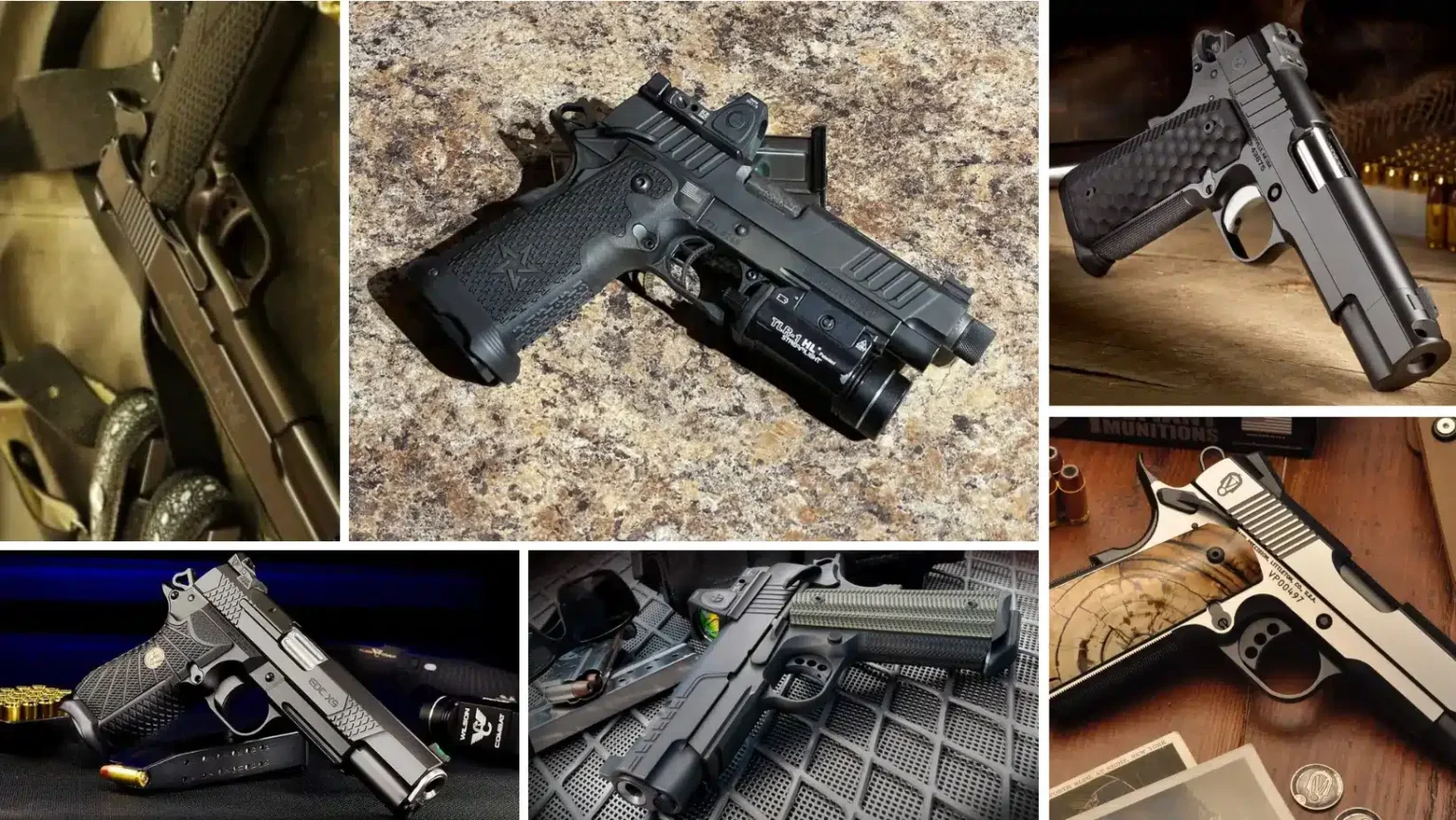
American premium-pistol production encompasses several different traditions: precision competition arms, duty-oriented double-stack designs, large-bore experiments, and carefully fitted interpretations of the 1911. The pistols below are not presented as an objective ranking. Each represents a distinct approach supported by manufacturer records or established firearms publications.
Wilson Combat EDC X9
Wilson Combat’s EDC X9 combines 1911-style controls with a double-column 9mm magazine and an aluminum frame. The current EDC X9 2.0 family includes 3.25-, 4-, and 5-inch configurations.
The 4-inch version has a stated capacity of 15 or 18 rounds, depending on configuration, and an approximate unloaded weight of 30 ounces. Factory specifications include a cone barrel, external extractor, fiber-optic front sight, interchangeable G10 grips, and an optics-ready slide.[1]
Wilson states that the original EDC X9 was launched in 2016. The later 2.0 series introduced a solid aluminum X-Frame, revised slide and barrel geometry, and the company’s Enhanced Reliability System. Collectors should therefore distinguish between original and 2.0 examples, as well as among the three barrel lengths and their numerous factory options.[1]
Cabot Guns Black Diamond Deluxe Bullseye
The Cabot Black Diamond Deluxe Bullseye has a documented connection to American competitive pistol shooting. Jonathan Shue used one for the centerfire and .45-caliber portions of the 2017 NRA National Pistol Championship. Shue won the championship with a score of 2638-126X and also captured the Cabot Guns/NRA Centerfire Championship.[2]
This record establishes the competition model’s place in modern bullseye shooting without relying on subjective claims about machining or finish. A particular pistol’s historical importance, however, would still depend on its own documentation. Factory records, competition records, test targets, and evidence connecting an individual example to a named shooter would be more consequential than the model name alone.
Staccato P
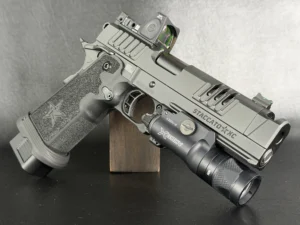
The Staccato P is a steel-framed, double-stack 9mm based on the 2011 pattern. Factory specifications list a 4.4-inch bull barrel, a 4- to 4.5-pound single-action trigger, a 33-ounce unloaded weight, and a capacity of 17+1 or 20+1 rounds. The pistol measures approximately 8.1 inches long, 1.5 inches wide at its widest point, and 5.9 inches high.[3]
The P also uses a tool-less Dawson Precision recoil system and is manufactured in the United States. Staccato identifies the model as a duty pistol and reports that it has been approved by more than 1,600 law-enforcement agencies, including the Houston Police Department, Las Vegas Metropolitan Police Department, and Texas Rangers.[3] This is a manufacturer-reported approval figure; it should not be interpreted as evidence that every named agency issues the pistol to all personnel.
From a collecting perspective, STI-marked predecessors, transitional branding, factory configurations, and pistols with verifiable agency associations warrant separate treatment.
Nighthawk Custom Fire Hawk
The Nighthawk Custom Fire Hawk is a compensated 1911 offered in 9mm and .45 ACP. Its compensator is machined to follow the slide’s profile, creating an integrated assembly rather than the appearance of a separate aftermarket component.[4]
Nighthawk Custom was founded in 2004 and is based in Berryville, Arkansas. The company describes its production method as “One Gun, One Gunsmith”: a single gunsmith is responsible for fitting and finishing an individual pistol. Nighthawk also states that its pistols use fully machined billet-steel parts that are intentionally produced oversize before being hand-fitted.[5]
Because the company offers substantial customization, two Fire Hawks bearing the same model name may differ in caliber, sights, controls, finish, and other details. Original build records and the gunsmith’s identifying marks are consequently important parts of an example’s documentation.
Infinity Firearms Competition Pistols
Infinity Firearms is the trade name used by Strayer-Voigt, LLC. Its pistols should be cataloged by their individual configurations rather than under the imprecise description “SVI Signature Competition Pistol.”
Sandy Strayer founded Infinity in 1994 with the stated objective of advancing the 1911 platform in both form and function. The company specifically identifies competition performance as part of that original purpose. Infinity reports that every pistol is built by hand and identifies Gordon, Texas, as its manufacturing location.[6]
An Infinity competition pistol should be documented by serial number, caliber, barrel and compensator arrangement, sighting system, frame and grip dimensions, finish, and intended competitive division. Those details are generally more informative than a broad or unofficial model name.
Guncrafter Industries Model No. 1
Guncrafter Industries introduced the Model No. 1 and its proprietary .50 GI cartridge at the 2004 SHOT Show. Company founder Alex Zimmermann conceived the project as a practical .50-caliber pistol with approximately the size and weight of a conventional 1911, rather than as an oversized magnum-pattern handgun.[7]
The .50 GI was designed to operate at pressure levels compatible with the 1911 platform. It uses a .500-inch-diameter bullet and a cartridge case with a base dimension comparable to that of the .45 ACP. Documented loads ranged from 185 to 300 grains, with nominal velocities extending from approximately 1,200 to 700 feet per second from a five-inch barrel, depending on bullet weight.[7]
The Model No. 1 is significant because the pistol and cartridge were developed as a unified system. Early production examples, factory records, original magazines, period ammunition, and material associated with the model’s 2004 introduction provide the strongest basis for historical study.
Ed Brown FX1
Ed Brown introduced the FX1 as a modernized 9mm 1911. Its factory features included an accessory rail, distinctive slide cuts, a one-piece magazine well, a recessed slide-stop pin, and a flush-fitting barrel with a recessed crown.[8]
Factory specifications list a stainless-steel frame, nine-round magazine capacity, an approximate overall length of 7.75 inches, and a weight of 40 ounces with a magazine. The pistol was offered with a fixed rear sight and red fiber-optic front sight or with a 3.25-MOA Trijicon RMR and corresponding tall sights.[8]
Documented model numbers include FX1-SS-9 and FX1-G4-RMR-9. These identifiers are useful when determining whether an optics-equipped example left the factory in that configuration or was modified later.[8]
Les Baer Premier II with Trijicon RMR
Les Baer Custom’s 2026 catalog documents a specialized Premier II package built around a five-inch, .45 ACP pistol fitted with a Trijicon RMR Type 2 sight. The slide is machined specifically for the Trijicon mount, and the package includes an adjustable rear sight and a tall front sight that can be viewed through the optic.[9]
The supplied RMR uses a 3.25-MOA red dot and a CR2032 battery. Les Baer identifies the five-inch .45 ACP Premier II as the only version offered in this particular factory package.[9]
That distinction matters to collectors. A factory-machined and cataloged RMR package is not equivalent to a standard pistol altered by a third party, even if the completed firearms appear similar. The original invoice, test target, packaging, and optic documentation can help establish the configuration.
Documentation Matters
Premium manufacture does not automatically confer collectible importance. The strongest examples combine identifiable factory configuration with verifiable history.
Original invoices, order sheets, test targets, cases, magazines, manuals, and correspondence can establish how a pistol left the maker. Competition records or documented professional use may add historical context. Conversely, refinishing, replacement barrels, aftermarket optic cuts, altered triggers, and substituted controls can make it difficult to determine the original configuration.
The soundest approach is straightforward: identify the exact model and generation, document every factory option, record later modifications, and separate verifiable history from promotional language.
Frequently Asked Questions
Documented configuration, condition, provenance, and historical associations can contribute to collectibility. A prestigious brand name alone does not establish significance.
Jonathan Shue used a Cabot Black Diamond Deluxe Bullseye during his victory at the 2017 NRA National Pistol Championship.
The EDC X9 combines 1911-style controls with a double-column 9mm magazine and an aluminum frame. The EDC X9 2.0 is available in 3.25-, 4-, and 5-inch configurations.
Guncrafter Industries developed the Model No. 1 alongside its proprietary .50 GI cartridge. The pistol and cartridge debuted at the 2004 SHOT Show.
Collectors should preserve factory invoices, order sheets, test targets, cases, magazines, manuals, and relevant correspondence. These materials help verify how a pistol originally left the manufacturer.
Sources
- Wilson Combat (2026), “EDC X9 2.0 Double Stack Handguns”.
- National Rifle Association (2017), “Results: 2017 NRA National Matches”, American Rifleman.
- Staccato 2011 (2026), “Staccato P”.
- On Target Magazine (2019), “Nighthawk Fire Hawk,” Defensive Handgun Issue.
- Nighthawk Custom (2026), “About Nighthawk Custom”.
- Infinity Firearms (2026), “Our Story”.
- Horman, B. Gil (2016), “Guncrafter Industries’ 50 GI 1911 Dream Guns”, American Rifleman.
- Ed Brown Products (2017), FX1 Specifications.
- Les Baer Custom (2026), Les Baer Custom 2026 Catalog.