
Key Takeaways:
- The STI 2011 Combat Master was developed for John Wick: Chapter 3, Parabellum, not the first two films.
- Its documented launch configuration included a 5.4-inch barrel, 9 mm chambering, competition-style sights, and a 21-round magazine.
- Authentic STI markings identify examples from the period before STI International adopted the Staccato corporate name in 2020.
The STI 2011 Combat Master made its screen debut in John Wick: Chapter 3, Parabellum, where Keanu Reeves’ character carries it during the climactic defense of the Continental. The pistol’s proper period designation is the STI 2011 Combat Master, or STI/TTI Combat Master, not the “TTI x Staccato JW Combat Master.” STI International did not rebrand itself as Staccato until 2020, the year after the film’s release.[1]
The pistol grew out of the working relationship between Taran Tactical Innovations and the John Wick production team. Taran Butler, the founder of Taran Tactical, had trained Reeves for the preceding film and continued that work for Chapter 3. In a March 2019 interview, Butler said director Chad Stahelski wanted the third installment’s firearms to surpass those featured in John Wick: Chapter 2. Butler responded by proposing a custom STI 2011.[2]
That chronology matters. The STI 2011 Combat Master was not the signature pistol of the original John Wick or its first sequel. Reeves primarily used a Heckler & Koch P30L in the first film and a TTI-modified Glock 34 in the second. The STI-based Combat Master belongs specifically to the third chapter, released in 2019.[3]
From Competition Pistol to Screen Weapon
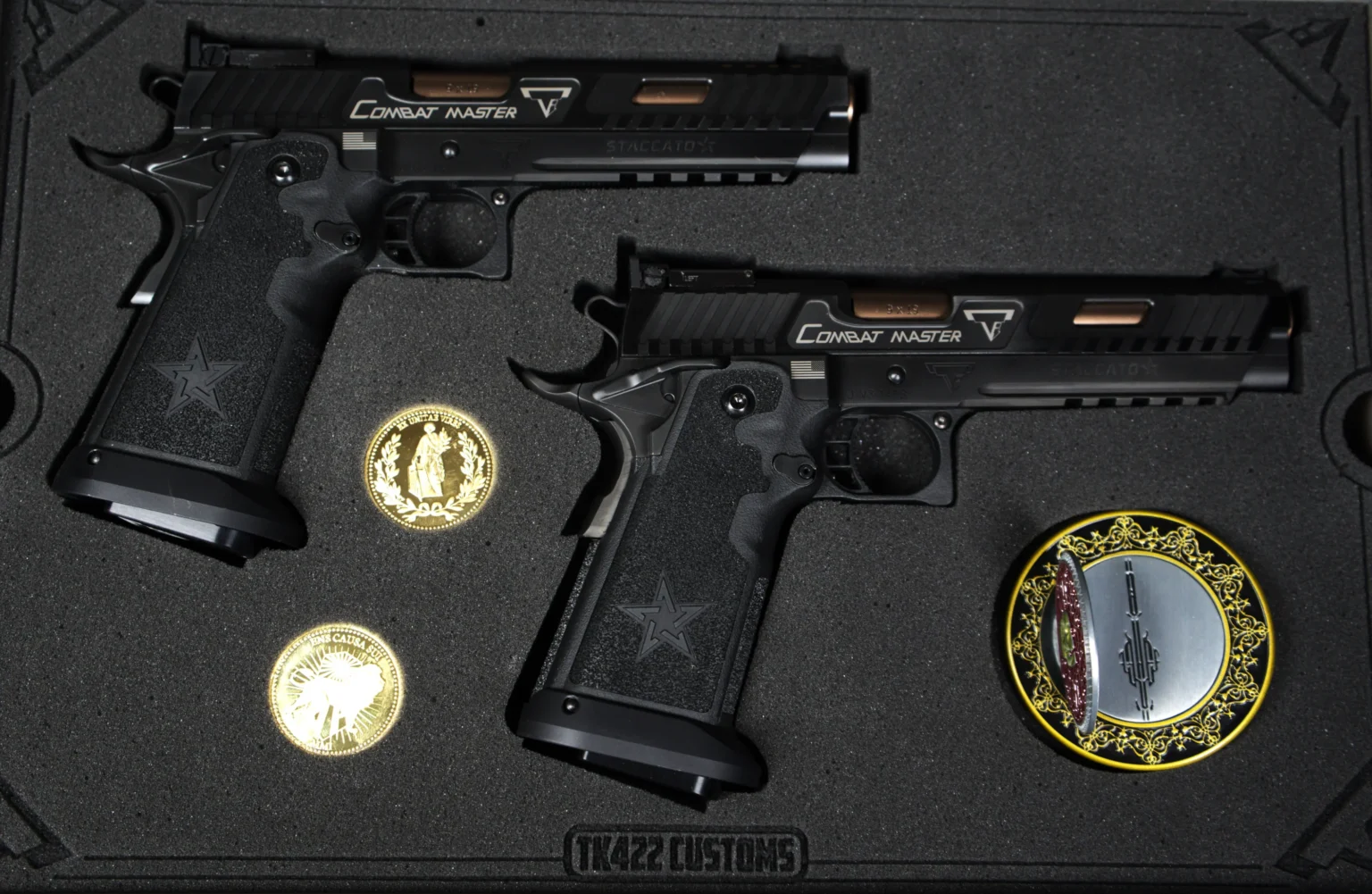
The Combat Master was based on STI’s 5.4-inch 2011 platform. A working version and a blank-firing screen version were displayed at STI’s booth during the 2019 SHOT Show. Contemporary reporting described the production pistol as a 9 mm semiautomatic with a 5.4-inch barrel, a 21-round magazine, a fiber-optic front sight, a fully adjustable rear sight and an ambidextrous Wilson Combat safety.[4]
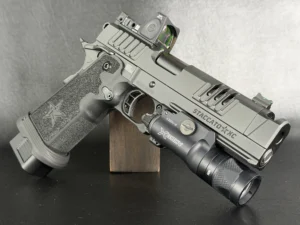
Taran Tactical’s modifications were readily visible. The slide received extensive lightening cuts, forward and rear gripping surfaces and a bronze-colored barrel visible through the openings. The pistol also incorporated a deeply undercut trigger guard, a heavily textured grip and an enlarged magazine well. These were recognizable competition-pistol features intended to support a high grip, rapid manipulation and efficient magazine changes.[4]
The published capacity of 21+1 referred to the standard 140 mm magazine configuration described at launch. Magazine capacity can vary with the particular magazine body, spring, follower and extension installed, so that figure should not be applied indiscriminately to every surviving Combat Master or associated screen gun.
Butler also stated that the production selected 9 mm Major ammunition from ASYM Precision. “Major” in this context denotes ammunition loaded to meet a scoring threshold used in certain practical-shooting disciplines; it is not a separate cartridge designation. The firearm remained chambered for the 9×19 mm cartridge.[2]
What the 2011 Platform Contributed
The 2011 architecture combines familiar M1911 operating controls with a separate grip and frame arrangement designed to accept a staggered-column magazine. Sandy L. Strayer and Virgil P. Tripp filed the foundational U.S. patent application for this frame-and-handgrip assembly in 1992. Patent No. 5,293,708, issued in 1994, described a gripless frame joined to a removable grip structure and specifically addressed increased ammunition capacity without greatly enlarging the grip’s external dimensions.[5]
That construction distinguishes the platform from a conventional single-stack M1911. It also explains why describing the Combat Master simply as a “double-stack 1911” is useful shorthand but technically incomplete: its detachable grip assembly is fundamental to the design.
STI built its reputation around this competition-oriented platform before moving toward duty and defensive pistols under the Staccato name. The company introduced “Staccato” as a product name in 2019 and adopted it as the corporate brand in 2020.[1] Consequently, an authentic early Combat Master’s STI markings place it within a specific and short-lived period immediately before that transition.
Collecting the Combat Master
For collectors, the pistol’s importance rests on the intersection of three documented histories: the development of the high-capacity 2011 platform, Taran Tactical’s practical-shooting influence, and the firearm’s identifiable role in a major film franchise. Its connection to Chapter 3 is direct rather than retrospective; the model was developed for the production and marketed contemporaneously through Taran Tactical.[2]
The launch price reported at the 2019 SHOT Show was $3,899, but that figure is historical rather than a measure of present value.[4] Current value depends on configuration, condition, markings, accessories, and provenance. A production Combat Master should not be represented as screen-used merely because it matches the model seen in the film. A credible claim of film use requires documentation tying the individual firearm to the production, such as armorer records, studio inventory, verifiable correspondence, or an established auction history.
The same caution applies to claims of rarity. Contemporary reporting said that a limited number would be offered, but no reliable public factory record establishes a final production total.[4] Without such documentation, the Combat Master is best described as a limited-production, film-associated custom pistol, not assigned an unsupported surviving population or rarity ranking.
The STI 2011 Combat Master endures because its cinematic identity was grounded in a genuine competition-derived design. Its lightened slide, high-capacity 2011 frame and conspicuous TTI treatment were not merely decorative additions to a prop. They were the defining elements of a purpose-built pistol whose development, training history and appearance became inseparable from John Wick: Chapter 3, Parabellum.
Frequently Asked Questions
John Wick uses an STI 2011 Combat Master during the Continental Hotel battle in John Wick: Chapter 3, Parabellum.
It was manufactured when the company was still called STI International. STI adopted Staccato as its corporate name in 2020.
The documented film-associated model is chambered in 9×19 mm. Production reporting listed a 21+1 capacity with its standard 140 mm magazine.
The 2011 uses a separate frame-and-grip assembly designed to accommodate a staggered-column magazine. This generally provides greater ammunition capacity than a traditional single-stack M1911.
No. Film use must be established through reliable provenance connecting the individual firearm to the production.
Sources
- Staccato 2011, “Our Story,” company history, accessed August 10, 2026.
- Kimmie Dillon, “Taran Butler: John Wick’s Gun Coach,” The Blue Press, March 2019, pp. 78–81.
- Lionsgate, “John Wick: Chapter 3—Parabellum,” official film page, accessed August 10, 2026.
- Jeff Cramblit, “The STI/TTI Combat Master Pistol Used in John Wick 3—SHOT Show 2019,” GunsAmerica Digest, February 3, 2019, updated August 3, 2024.
- Sandy L. Strayer and Virgil P. Tripp, “Frame/Handgrip Assembly for Autoloading Handgun,” U.S. Patent No. 5,293,708, filed July 8, 1992, issued March 15, 1994.