
Key Takeaways:
- High price, close tolerances, or elaborate decoration alone do not establish quality.
- Performance claims are most credible when supported by test targets, inspection records, and clearly defined testing conditions.
- Collectibility depends on factors such as originality, condition, documentation, provenance, and verified market results.
A high price does not establish exceptional quality. Neither do engraving, exotic materials, close tolerances, or a prestigious maker’s name. A genuinely high-end handgun must demonstrate disciplined construction, sound design, consistent performance, careful finishing, and, when sold as a collectible, a documented identity.
Workmanship Comes First
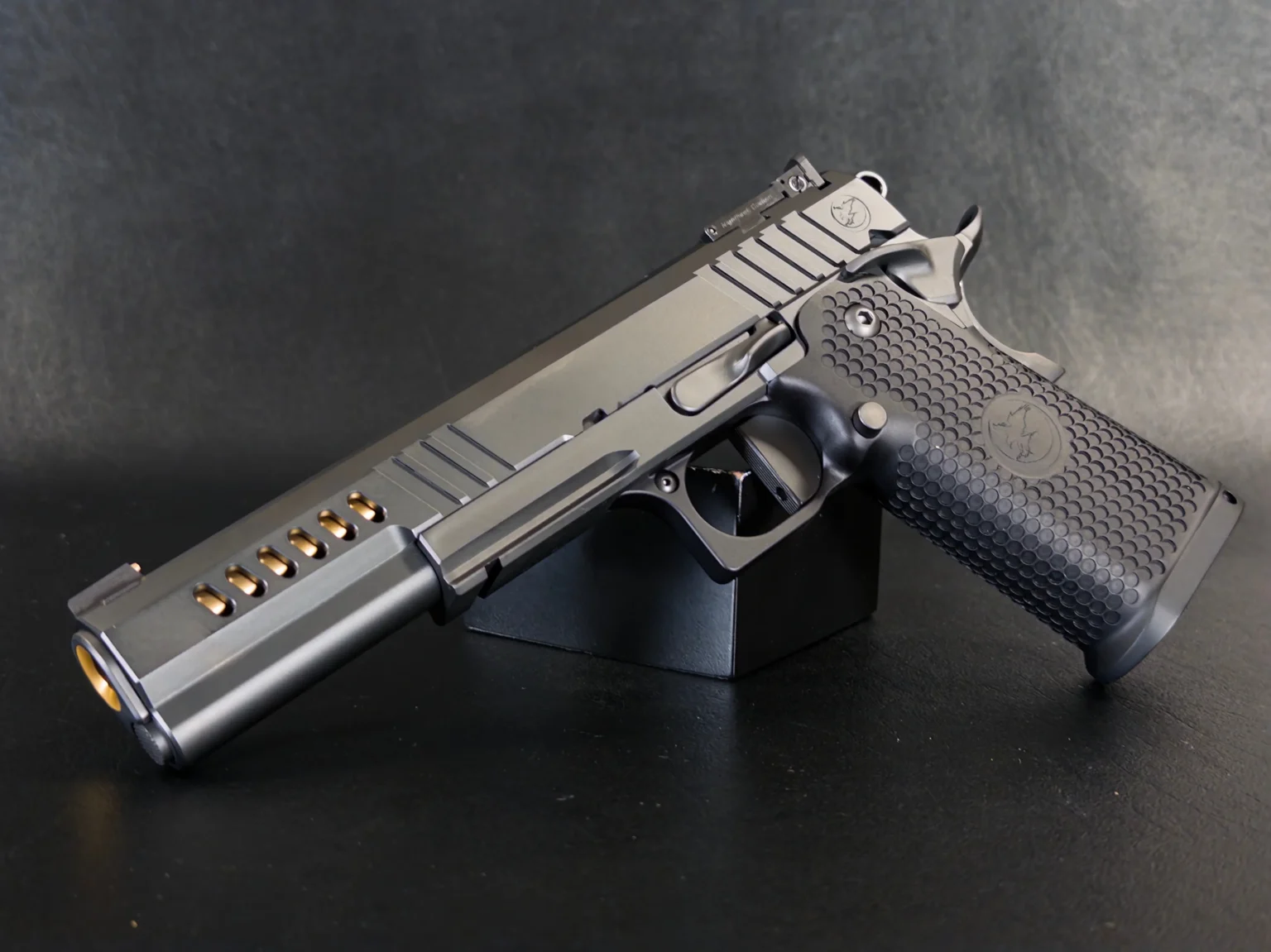
The initial assessment should focus on execution. Flats should remain flat, contours should flow cleanly, checkering should be uniform, and controls, grip panels, pins, and screws should fit without careless gaps or visible tool marks. On a self-loading pistol, slide, frame, barrel, and locking surfaces must function as a complete system. Tightness by itself is not evidence of quality.
Premium makers use different production methods. Nighthawk Custom states that each of its pistols is built by one gunsmith, who hand-fits and polishes the individual parts.[1] Wilson Combat uses a team of specialist gunsmiths, followed by dedicated quality-control, testing, targeting, and finishing processes.[2] Neither system is inherently superior. The relevant questions are whether responsibility is clearly assigned and whether the finished pistol meets a repeatable standard.
Individual authorship becomes particularly important with true custom firearms. Paul Liebenberg, for example, founded Pistol Dynamics in Los Angeles in 1986 after managing Pachmayr Gun Works’ custom shop. He later worked at Smith & Wesson on the development of its Performance Center.[3] A handgun attributed to a recognized gunsmith should be supported by markings, invoices, correspondence, build sheets, or confirmation from the maker. Reputation is not a substitute for documentation.
Performance Requires Evidence
Terms such as “match-grade,” “custom-tuned,” and “exceptionally accurate” are meaningful only when supported by evidence. Useful records include factory test targets, signed inspection sheets, documented accuracy standards, and descriptions of the ammunition, distance, and firing method used.
Wilson Combat states that its custom 1911 pistols undergo a formal quality-control process and extensive test-firing that can involve 100 rounds or more. The company also supplies a signed checklist and test target with each custom 1911.[2] These records do not guarantee performance under every condition, but they provide more useful evidence than an unsupported marketing claim.
Accuracy must be considered in context. Group size depends on distance, ammunition, firing method, environmental conditions, and whether the stated result represents one group or repeated testing. Reliability is equally specific. A pistol that functions with one load and magazine has not necessarily been proven with every compatible combination.
Trigger characteristics, sight configuration, balance, grip geometry, and control placement also matter. These features should suit the handgun’s intended role and its owner. Ergonomic quality cannot be reduced to a universal formula because hand size, technique, and intended use differ.
Materials and Decoration
Material selection should serve the design. Conventional steel, stainless steel, aluminum, titanium, and other alloys can all be appropriate when used intelligently. Buyers should determine why a material was selected, how it was manufactured, and whether it creates maintenance or repair concerns.
Rare materials can make a firearm distinctive without making it mechanically superior. Cabot Guns’ Big Bang Set demonstrates the distinction. Cabot describes it as a matched right- and left-handed pair made principally from Gibeon meteorite, with bimetal support added to specified working components and surfaces. The company states that both pistols are functional.[4] The set’s importance rests on its unusual material, ambitious manufacture, and singular character, not on proof that meteorite performs better than conventional gun steel.
Finishing should also be judged by execution rather than expense. Polished surfaces should retain their geometry. Coatings should be even. Engraving should complement the firearm’s form, and inlays should be cleanly installed. Decoration can add substantial artistic value, but it cannot correct poor mechanical construction.
High-End Does Not Automatically Mean Collectible
A well-made modern handgun is not necessarily collectible. Collectibility depends on the identity, originality, condition, rarity, provenance, and market history of the specific firearm.
A serious evaluation should establish:
- Maker, model, serial number, and original configuration
- Production period and any verifiable production quantity
- Original finish, components, markings, and accessories
- Alterations, refinishing, restoration, or replacement parts
- Factory records, invoices, correspondence, and photographs
- Documented ownership, exhibition, or publication history
- Verified sales of genuinely comparable firearms
Provenance must be supported by a traceable chain of evidence. Historical inventories can provide particularly strong documentation. Surviving inventories of the Princes of Liechtenstein’s firearms collection, for example, have helped identify individual arms and trace their passage through generations of the family.[5] Without comparable evidence, a prestigious ownership story remains an attribution.
Originality should be evaluated just as carefully. Refinishing, replacement components, later engraving, or other modifications may improve appearance or utility while diminishing interest to collectors seeking an original example. Documented period alterations may still form an important part of a firearm’s history.
Price Is Not Proof of Future Value
An asking price is not a completed sale. An auction estimate is not an appraisal, and an appraisal does not guarantee what a buyer will pay. Condition, provenance, timing, location, buyer competition, and the sale venue can all affect value. Firearms writer Wiley Clapp identified condition as a critical factor in used-handgun value and noted that precise valuation remains subjective even when the firearm is available for direct inspection.[6]
Claims that a modern premium handgun will appreciate should therefore be treated cautiously. Limited production, recognized authorship, unusual materials, and complete documentation may strengthen collector demand, but none guarantees liquidity or profit.
The strongest high-end handgun is not necessarily the most expensive or ornate. It is the one whose construction, function, finish, and documentation withstand close inspection. Price attracts attention. Evidence establishes quality.
Frequently Asked Questions
A high-end handgun combines careful construction, sound design, consistent performance, and well-executed finishing. Its quality should withstand close inspection rather than depend on price or branding.
No. Price may reflect materials, customization, scarcity, or decoration, none of which automatically proves better performance.
Not by themselves. Components must fit precisely while allowing the handgun to function correctly and consistently.
Collectors generally consider originality, condition, maker attribution, rarity, provenance, and supporting records. The importance of each factor varies by firearm and market.
Future appreciation cannot be guaranteed. Market value can change with condition, provenance, buyer demand, timing, and the venue of sale.
Sources
- Nighthawk Custom, “About Nighthawk Custom.”
- Wilson Combat, “About Us: History, Construction, Quality and Gunsmiths.”
- Pistol Dynamics, “About Paul Liebenberg.”
- Cabot Guns, “The Big Bang Set.”
- Thomas DaCosta Kaufmann, Leslie B. Grigsby, and Dirk H. Breiding, Firearms from the Collections of the Prince of Liechtenstein, The Metropolitan Museum of Art.
- Wiley Clapp, “What’s It Worth?,” American Rifleman, September 26, 2012.