
Key Takeaways:
- The featured pistols represent service, competition, and specialized select-fire designs—not a ranking by price or rarity.
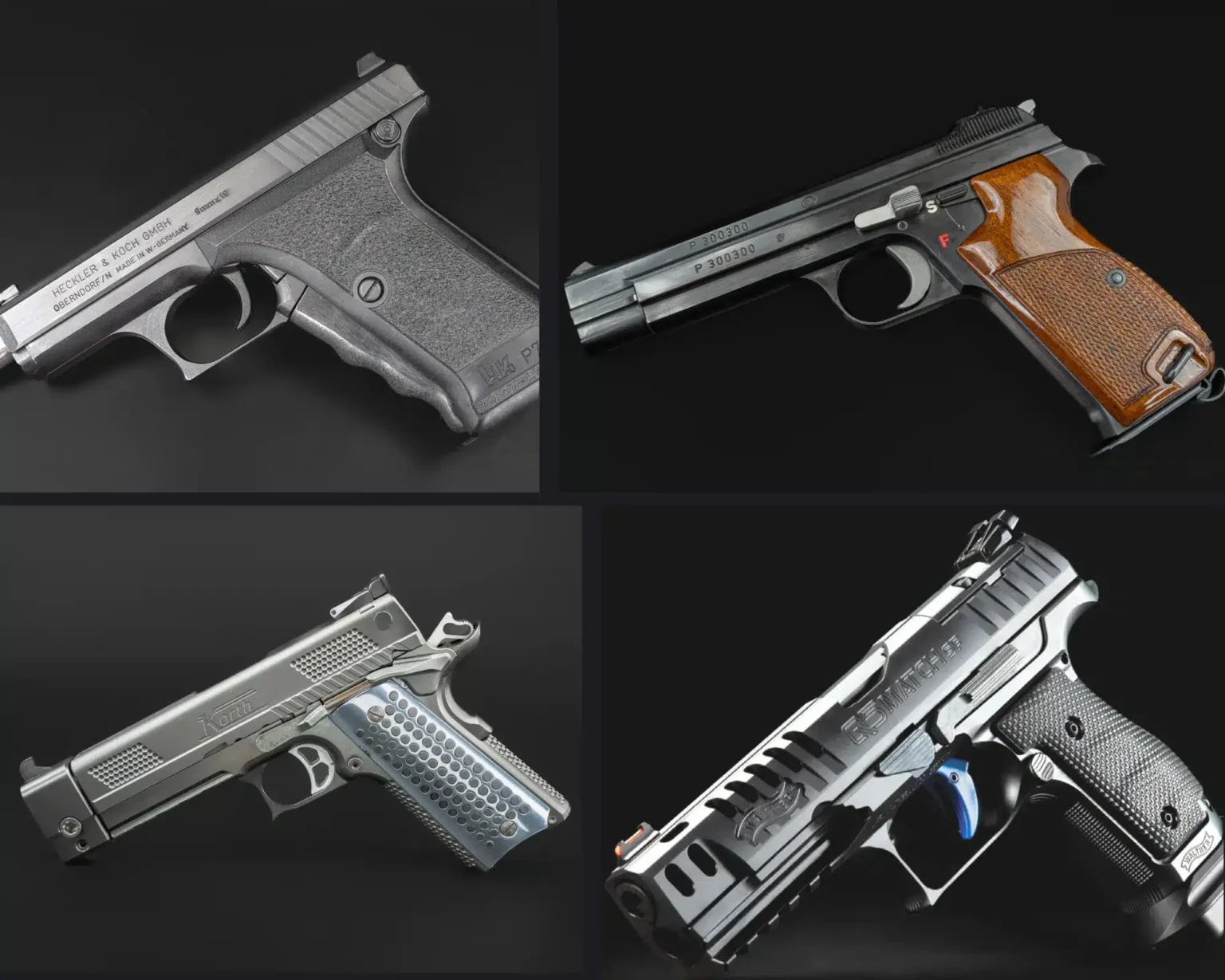
- Models such as the Korth PRS, Laugo Alien, and HK P7 use unconventional operating systems that distinguish them from typical semiautomatic pistols.
- A firearm’s precise variant, originality, condition, documentation, and provenance matter more than broad claims of luxury or exclusivity.
European pistol design encompasses several distinct traditions. Swiss service arms, German mechanical experiments, Italian competition pistols, and recent Czech designs reflect different approaches to accuracy, controllability, manufacture, and intended use.
These ten firearms are not directly comparable in price, rarity, or purpose. Some were developed for military or police service, others for competition, and the Beretta 93R is a select-fire machine pistol rather than an ordinary semiautomatic. Their common appeal lies in identifiable engineering choices—not unsupported claims of exclusivity or superiority.
Sphinx SDP Compact
The Sphinx SDP Compact is a double-action/single-action pistol chambered in 9×19 mm. Its manual specifies a 3.7-inch barrel, 15-round magazine, steel slide, aluminum upper frame, and polymer lower grip assembly. Depending on the configuration, the pistol was fitted with either an ambidextrous decocking lever or a manual safety.[1]
The SDP’s construction distinguishes it from conventional pistols built around a single steel, aluminum, or polymer frame. Its combination of materials was intended to place steel in the operating components, aluminum in the upper frame, and replaceable polymer in the grip area. Collectors should verify the precise configuration of an individual pistol rather than relying on the SDP name alone.
Korth PRS
The German Korth PRS borrows the general form and several internal components of the 1911, but it does not use the 1911’s tilting-barrel, short-recoil action. The .45 ACP pistol instead employs a fixed barrel and roller-delayed blowback mechanism. The version examined by Calibre used seven-round, single-column 1911 magazines.[2]
The roller system delays the opening of the action while allowing the barrel to remain stationary. Korth retained recognizable 1911 elements—including the trigger, disconnector, hammer, and sear—while replacing the design’s established operating system. That combination makes the PRS a mechanically distinct interpretation rather than a conventional custom 1911.
Tanfoglio Stock III Xtreme
The Italian Tanfoglio Stock III Xtreme was developed as a double-action/single-action competition pistol for IPSC Production shooting. It is built on a steel frame and incorporates a full-length dust cover, ambidextrous safety, aluminum grip panels, adjustable rear sight, and fiber-optic front sight.[3]
The Stock III Xtreme also received specialized hammer, guide-rod, firing-pin, sight, and trigger components from Tanfoglio’s Xtreme range. The line was developed with input from championship shooter Eric Grauffel and introduced in late 2013. Its significance lies in its purpose-built competition configuration, with features installed and tuned as part of the factory package.
B&T USW
B&T’s Universal Service Weapon occupies the space between a service pistol and a compact shoulder-fired weapon. The original USW is a double-action/single-action 9 mm firearm with a folding stock and a receiver-mounted Aimpoint Nano sight. Because the sight is mounted to a fixed bridge rather than the slide, it remains stationary while the pistol cycles.[4]
The tested model used a 4.17-inch barrel and accepted 17-, 19-, and 30-round magazines. With the stock folded, it could be handled as a pistol; with the stock extended, it provided an additional point of support. The USW’s importance is therefore conceptual: B&T designed the stock, optic mounting system, holster, and pistol as an integrated package.
AREX Alpha
The Slovenian AREX Alpha is a steel-frame competition pistol chambered in 9×19 mm. Factory specifications list a 5-inch barrel, a 42.3-ounce weight, an adjustable rear sight, a fiber-optic front sight, and a 20-round magazine.[5]
The pistol uses a double-action/single-action trigger mechanism with an exposed hammer. AREX eliminated the decocker found on its service-oriented pistols and fitted oversized ambidextrous manual safeties, an extended magazine release, a flared magazine well, and a redesigned grip. These are substantive competition features rather than cosmetic alterations to a standard duty pistol.
SIG P210
The original SIG P210 was developed from the Swiss Pistole 49, which was adopted by the Swiss Army in 1949. It is an all-steel, single-action pistol whose design incorporated features associated with Charles Petter’s French Model 1935A, including internal slide rails and a removable lockwork assembly.[6]
The P210 served as Switzerland’s principal military pistol until it was replaced in 1975 by the lighter, double-stack SIG Sauer P220. The P210 name has subsequently been applied to Swiss-, German-, and American-made pistols, with important differences in construction and controls. Country of manufacture, markings, mechanical configuration, and documented history are therefore central to identifying a collectible example.
Laugo Arms Alien
The Laugo Arms Alien is a fixed-barrel pistol using gas-piston-delayed blowback operation. Instead of placing a conventional reciprocating slide above the barrel, the Alien positions much of its moving assembly internally and behind the barrel. The upper sight rail remains stationary during firing.[7]
The manufacturer’s manual for the Alien Creator Limited Optics lists a 4.8-inch barrel and describes the pistol’s exceptionally low bore axis. The architecture places the barrel much lower in the frame than in a conventional tilting-barrel pistol. Its collectible interest rests primarily on this unusual mechanical layout and the deliberate separation of the sighting system from the reciprocating components.
Walther Q5 Match Steel Frame
Walther’s Q5 Match Steel Frame is a striker-fired, short-recoil-operated competition pistol chambered in 9×19 mm. Its factory manual specifies a 5-inch barrel, 15-round magazine, and an unloaded weight of approximately 40.9 ounces with an empty magazine.[8]
The frame, slide, and barrel are made from treated carbon steel. Walther also provided interchangeable mounting plates for several reflex-sight patterns. The pistol represents a factory-built steel-frame development of Walther’s modern striker-fired system, combining the mass of an all-steel structure with an optics-compatible competition slide.
Beretta 93R
The Beretta 93R is a select-fire machine pistol rather than a conventional semiautomatic. Beretta engineer Paolo Parola developed it during the 1970s using the Beretta 92 as a starting point. Its fire-control system permits semiautomatic fire or three-round bursts; there is no unrestricted fully automatic setting.[9]
The 93R incorporates a folding forward grip, a detachable shoulder stock, a heavier slide, and an extended 20-round magazine. The burst mechanism is housed beneath the right grip panel. Although visibly related to the Beretta 92, these components and its specialized operating role make the 93R a substantially different firearm.
Heckler & Koch P7
The Heckler & Koch P7 combines a gas-delayed blowback action with a squeeze-cocking lever forming the front strap of the grip. Compressing the lever cocks the firing mechanism; releasing it returns the pistol to an uncocked condition. The cocking lever also serves as a conventional grip safety and decocker.[10]
The original 9 mm P7 used an eight-round, single-column magazine. The later P7M13 increased capacity to 13 rounds through a wider, double-column magazine. The fixed barrel and gas-delayed action distinguish the P7 mechanically, while its unconventional cocking system gives it a manual of arms unlike that of most service pistols. Heckler & Koch discontinued the series in 2008.
These firearms arose from different requirements. The P210 and P7 were service pistol designs; the Stock III Xtreme, Alpha, Q5, and Alien emphasize competition; the USW addresses the gap between pistol and compact shoulder arms; and the 93R belongs to the specialized select-fire category.
For collectors, the meaningful questions remain specific: Which version is it? Where and when was it manufactured? Does its configuration match the relevant factory documentation? Are its components, finish, and accessories original? Engineering interest may explain why a model deserves study, but condition, originality, documentation, and provenance determine the significance of an individual firearm.
Frequently Asked Questions
Their appeal comes from distinctive engineering, historical context, manufacturing quality, or specialized purpose. An individual firearm’s condition, originality, documentation, and provenance determine its particular significance.
No. Availability varies by model, variant, production period, and market, so rarity must be established for the individual firearm rather than assumed from its name.
The Beretta 93R can fire semiautomatically, but it also has a three-round-burst setting. It is therefore classified mechanically as a select-fire machine pistol.
The original design was adopted by the Swiss Army as the Pistole 49 in 1949. Later Swiss, German, and American P210 versions differ in construction and controls.
Collectors should confirm the exact model and variant, country and period of manufacture, mechanical configuration, originality, condition, and provenance. Claims should be checked against reliable factory, archival, or professionally published documentation.
Sources
- Sphinx Arms, SDP Compact Owner’s Manual, technical specifications, pp. 3–4. View the manual.
- Geordie Pickard, “Korth PRS: America’s Gun, Germanified,” Calibre, July 14, 2018. Read the article.
- M. Recktenwald and Michael Schippers, “Test: Pistola Sportiva Tanfoglio Stock III Xtreme 9 mm,” all4shooters.com, April 28, 2017. Read the article.
- Combat Handguns, “Say Hello to the B&T USW: A Unique 9mm Pistol-Carbine Hybrid,” July/August 2017, republished by Athlon Outdoors. Read the article.
- AREX Defense, “AREX Alpha,” factory specifications and product description. View the product page.
- Wiley Clapp, “Tested: SIG Sauer’s Made-In-America P210 Pistol,” American Rifleman, December 21, 2018. Read the article.
- Laugo Arms, Alien Creator Limited Optics Instruction Manual, 2024, pp. 6–7. View the manual.
- Carl Walther, Q5 Match Steel Frame Instruction Manual, 2019, pp. 27–29. View the manual.
- Ian McCollum, “Beretta 93R: The Best Machine Pistol?” Forgotten Weapons, December 13, 2024. Read the article.
- Guy J. Sagi, “Heckler & Koch P7: H&K’s ‘Squeeze-Cocking’ Pistol,” American Rifleman, September 25, 2021. Read the article.