
Key Takeaways:
- Factory engraving requires documentation; appearance alone does not establish when or by whom a firearm was decorated.
- Rarity claims should specify whether they concern production, surviving examples, configuration, decorative grade, or an engraver’s work.
- Factory records, authenticated comparisons, and documented provenance provide stronger evidence than signatures or ownership stories alone.
Engraved firearms occupy a distinctive place between mechanical design, decorative art, and historical artifact. Their appeal may lie in the quality of the engraving, the reputation of the maker or engraver, documented ownership, or the survival of an unusually original example. Understanding that appeal requires more than admiring the ornament. It requires knowing how the decoration was made, when it was applied, and what evidence supports the firearm’s history.
Decoration With a Purpose
Weapons have been decorated across cultures for centuries. Engraving, inlay, gilding, carving, chiseling, and etching appeared on armor, edged weapons, and firearms. These embellishments could communicate rank, status, or ownership. Particularly elaborate arms also served as diplomatic gifts and demonstrations of artistic and technical accomplishment.[1]
European workshops established many of the decorative traditions later associated with fine firearms. Nineteenth-century American gun engraving drew heavily on those traditions, in part through German-trained engravers who worked for manufacturers including Colt, Smith & Wesson, and Winchester. Gustave Young, for example, trained in Thuringia before becoming a leading Colt engraving contractor. Surviving ink impressions of his work demonstrate how German training and pattern books influenced American scrollwork.[2]
Colt’s decorated firearms illustrate the broader role of engraving in American manufacturing. The company employed skilled artisans at its Hartford factory, producing deluxe firearms with scrollwork, figures, and gold or silver inlay. Some were made for exhibitions or presented to prominent recipients and heads of state.[3] Such documented presentation arms belong to a different historical category from standard-production firearms embellished after leaving the factory.
Engraving, Etching, and Modern Processes
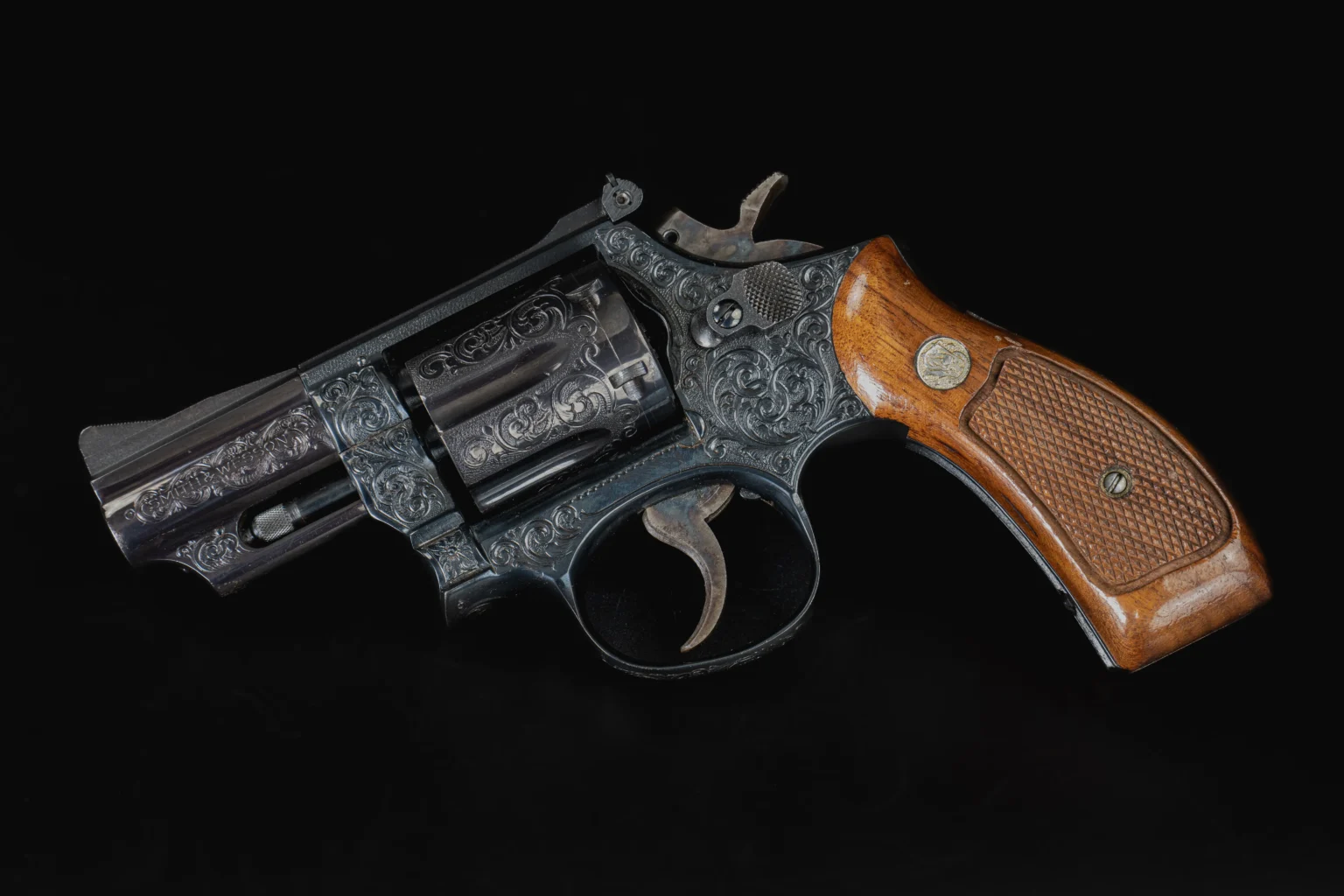
Engraving removes metal. A hardened cutting tool—traditionally a burin or graver—is guided across the surface to form lines, shading, lettering, and ornament. The width and character of a cut depend on the tool’s geometry, angle, and pressure. Pointillé, chiseling, relief carving, and metal inlay may be incorporated into a larger decorative scheme.[4]
Etching is a separate process. The metal is covered with an acid-resistant coating, the design is opened through that coating, and acid removes the exposed areas. Etching can produce intricate decoration, but the process and resulting surface differ from directly cut engraving.[4]
Contemporary metal decoration may also employ powered tools, mechanical methods, or lasers. These processes can produce precise and consistent designs, but the process alone does not determine artistic quality or historical importance.[5] Collectors should establish exactly how a firearm was decorated rather than relying on an imprecise description such as “factory engraved” or “hand finished.”
Factory Engraving Versus Later Embellishment
The distinction between original factory decoration and later work is fundamental. A factory-engraved firearm was decorated under the manufacturer’s authority before its original sale or as part of a documented factory return. A custom-engraved firearm may display exceptional workmanship, but it should not be described as factory engraved without supporting evidence.
Relevant evidence may include:
- Original order sheets, invoices, correspondence, or shipping records
- Factory letters derived from surviving ledgers
- Period photographs or exhibition records
- A documented engraver’s signature or mark
- A traceable chain of ownership
- Consistency among the serial number, configuration, finish, and documented production period
The Cody Firearms Records Office holds original records for several manufacturers, including Winchester, Marlin, L.C. Smith, Ithaca, Savage, and A.H. Fox. Depending on the manufacturer, model, and surviving records, a factory letter may confirm a manufacturing date, caliber, barrel type, trigger arrangement, or special-order feature. Record coverage varies, and customer information is rarely available for many early Winchesters.[6]
A signature is useful evidence, but it is not conclusive by itself. Signatures can be absent or incorrectly interpreted, and many historical firearms remain unattributed. Even museum catalogs distinguish carefully between documented authorship and work merely attributed to a particular engraver.[2][3]
Examining the Firearm
A careful evaluation begins with the firearm itself. Record the complete serial number, markings, dimensions, mechanical configuration, materials, finish, and visible alterations. Detailed photographs should cover the entire firearm as well as the engraving, screw heads, edges, markings, inlays, wood-to-metal fit, and concealed areas accessible without risking damage.
The decoration should be examined as part of the complete object. Differences in line depth, scroll structure, background treatment, lettering, borders, or finish may indicate that work was completed at different times or by different hands. Those differences warrant investigation, but they should not be treated as proof without supporting documentation or comparison with authenticated examples.
Condition must also be considered in relation to originality. Refinishing, polishing, recutting, replacement parts, repaired stocks, and renewed plating can change an object’s historical character. Crisp engraving does not automatically establish originality because older cuts can be refreshed and new decoration can be applied to an old firearm. Conversely, wear consistent with age and documented use is not necessarily a defect.
Provenance and Attribution
Provenance should be treated as an evidence trail rather than a compelling story. A claim that a firearm belonged to a notable person requires records connecting that individual to the specific object—preferably through a serial number, contemporary inventory, correspondence, photograph, presentation inscription, or documented chain of custody. A name engraved on a firearm proves only that the inscription is present.
Presentation firearms deserve particular care. Colt produced decorated firearms for exhibitions and as gifts, but the histories of individual examples are not always documented. The Metropolitan Museum of Art notes, for example, that the original exhibition or presentation history of one of its gold-inlaid Model 1849 Pocket revolvers remains unknown despite the firearm’s rarity and elaborate decoration.[2] An object’s quality should never be used to invent a missing recipient or occasion.
Attribution to an engraver should be based on signed work, archival documentation, or sustained comparison with authenticated examples. The Met’s surviving impressions of Gustave Young’s engraved ornament are especially valuable because they preserve direct records of his designs.[2] Such reference material allows researchers to compare scroll formation, figures, borders, and compositional habits without relying on reputation alone.
Understanding Rarity
“Rare” is meaningful only when the category is defined. A firearm may be rare as a model, caliber, factory configuration, decorative grade, engraver’s work, or documented presentation piece. These are different claims and require different evidence.
A small surviving population does not necessarily establish a small original production quantity. Survival and production are separate questions. Reliable rarity claims should therefore identify whether the number refers to factory production, known surviving examples, recorded special orders, or firearms currently documented by researchers.
Museum records demonstrate the importance of precision. The Met identifies approximately 20 known examples within a particular group of profusely decorated and gold-inlaid Colt percussion firearms. It separately identifies six known gold-inlaid Model 1849 revolvers.[2] Those figures apply to specifically defined groups; they should not be expanded into broader claims about all engraved Colts.
Buying With Discipline
Before purchasing, request a written description identifying the serial number, configuration, engraving method, attributed engraver, condition, restoration, provenance, and accompanying documents. Compare those claims with factory records, period catalogs, museum examples, and established reference works.
A factory letter is valuable only for the information the surviving record contains. It may confirm a date or configuration without identifying the customer or proving the firearm’s complete ownership history.[6] Likewise, stylistic similarity can support further research but does not substitute for documentary attribution.
For an important acquisition, independent inspection is preferable to relying solely on photographs or a seller’s description. The objective is not simply to determine whether the engraving is attractive. It is to determine what the firearm is, when and how it was decorated, what remains original, and which parts of its history can be demonstrated.
Federal Classification
Historical importance and legal classification are separate matters. Under the Gun Control Act definition incorporated into federal regulations, an “antique firearm” includes any firearm manufactured in or before 1898, along with specified replicas and qualifying muzzleloading firearms.[7]
The regulation contains detailed conditions for replicas and muzzleloaders. Consequently, appearance, ignition type, or a seller’s use of the word “antique” should not replace identification of the firearm’s actual date and configuration.[7]
Collecting as Stewardship
The strongest engraved-firearm collections are built through disciplined observation and documentation. Craftsmanship matters, but so do originality, attribution, configuration, and provenance. Records, photographs, and accompanying documents should remain with the firearm because they preserve information that the object alone may not reveal.
An engraved firearm is more than a decorated mechanism. Properly studied, it can document an engraver’s technique, a manufacturer’s commercial strategy, international artistic influence, or a particular history of ownership. Collectors who distinguish evidence from assumption preserve that history rather than merely repeating it.
Frequently Asked Questions
Collectibility may reflect craftsmanship, originality, documented provenance, rarity, historical importance, or an engraver’s authenticated work.
Engraving cuts directly into metal with a hardened tool. Etching uses acid to remove metal exposed through a resistant coating.
Collectors should consult surviving factory records, order sheets, correspondence, period photographs, and other documentation tied to the firearm’s serial number.
No. A signature is evidence, but attribution should also rely on documentation and comparison with authenticated examples.
The federal definition includes firearms manufactured in or before 1898, along with certain replicas and qualifying muzzleloaders subject to specified conditions.
Sources
- Dirk H. Breiding, “The Decoration of Arms and Armor,” The Metropolitan Museum of Art, October 2003.
- The Metropolitan Museum of Art, “Ink Impression (‘Pull’) from a Gold-inlaid Colt Revolver,” collection record for work attributed to Gustave Young, ca. 1854.
- The Metropolitan Museum of Art, “Colt Model 1851 Navy Percussion Revolver, Serial No. 2,” collection record, 1850.
- Dirk H. Breiding, “Techniques of Decoration on Arms and Armor,” The Metropolitan Museum of Art, October 2003.
- Victoria and Albert Museum, “A Guide to Metalworking Techniques,” revised April 2026.
- Cody Firearms Records Office, “Winchester Factory Records,” Buffalo Bill Center of the West.
- Bureau of Alcohol, Tobacco, Firearms and Explosives, “27 C.F.R. § 478.11—Meaning of Terms,” definition of “antique firearm.”