
Key Takeaways
- A recognized model name does not, by itself, establish rarity, originality, or value.
- Production period, configuration, condition, factory documentation, and provenance are central to evaluating a revolver.
- Historical importance, scarcity, and collector demand are separate factors and should not be treated as interchangeable.
Revolver collecting is not a single market. Historical importance, mechanical design, production history, originality, condition, and provenance all affect collector interest. A famous model name alone does not establish rarity or value.
The following revolvers represent distinct areas of the field, from nineteenth-century military arms to modern specialty handguns.
Colt Python
Colt introduced the Python in 1955 and returned it to production in 2020 using modern design and manufacturing methods.[1] The two production eras should be treated separately. An original-production Python is not interchangeable, historically or financially, with a current model.
Collectors should establish the production period, barrel length, finish, mechanical condition, and originality of each example. Factory documentation and original packaging can add important evidence, but neither should substitute for a physical inspection.
Smith & Wesson Performance Center Model 627
The Performance Center Model 627 is an N-frame, stainless-steel revolver chambered in .357 Magnum and .38 Special +P. The cited factory configuration has an eight-round cylinder, distinguishing it from the traditional six-shot .357 Magnum format.[2]
The Model 627 has appeared in multiple configurations. Consequently, barrel length, product code, engineering revision, factory equipment, and production period must be identified before scarcity or collectibility can be assessed.
Freedom Arms Model 83
Freedom Arms manufactures the Model 83 as a five-shot, single-action revolver. Factory specifications list several chamberings and barrel lengths, including versions in .454 Casull, .475 Linebaugh, .500 Wyoming Express, and .44 Magnum.[3]
The company attributes the Model 83’s accuracy in part to closely fitted chambers. Its manual also states that .45 Colt ammunition should not be used in the .454 Casull cylinder; Freedom Arms offers a separate .45 Colt cylinder for that purpose.[4]
Collector interest is most defensible when tied to an identifiable feature, such as an early production date, documented special order, unusual factory configuration, or exceptional original condition.
Magnum Research BFR
The Magnum Research BFR is a five-shot, single-action revolver manufactured in long- and short-cylinder configurations. The factory manual lists chamberings ranging from conventional handgun cartridges to .30-30 Winchester and .45-70 Government.[5]
This unusual range is central to the BFR’s identity. From a collecting perspective, discontinued chamberings, documented custom configurations, factory-fitted auxiliary cylinders, and uncommon barrel lengths deserve more attention than the model name by itself.
Smith & Wesson Model 29
Smith & Wesson completed its original .44 Magnum revolver in 1955. The company initially offered 4-inch and 6.5-inch barrels and later added an 8⅜-inch option. Demand increased substantially during the 1970s following the Model 29’s association with the film Dirty Harry.[6]
The Model 29’s long production history contains numerous engineering revisions and configurations. Early production, finish, barrel length, stocks, mechanical condition, and original accessories can materially affect collector interest. Any assertion that a revolver retains its original finish or components should be supported by inspection and, when available, factory records.
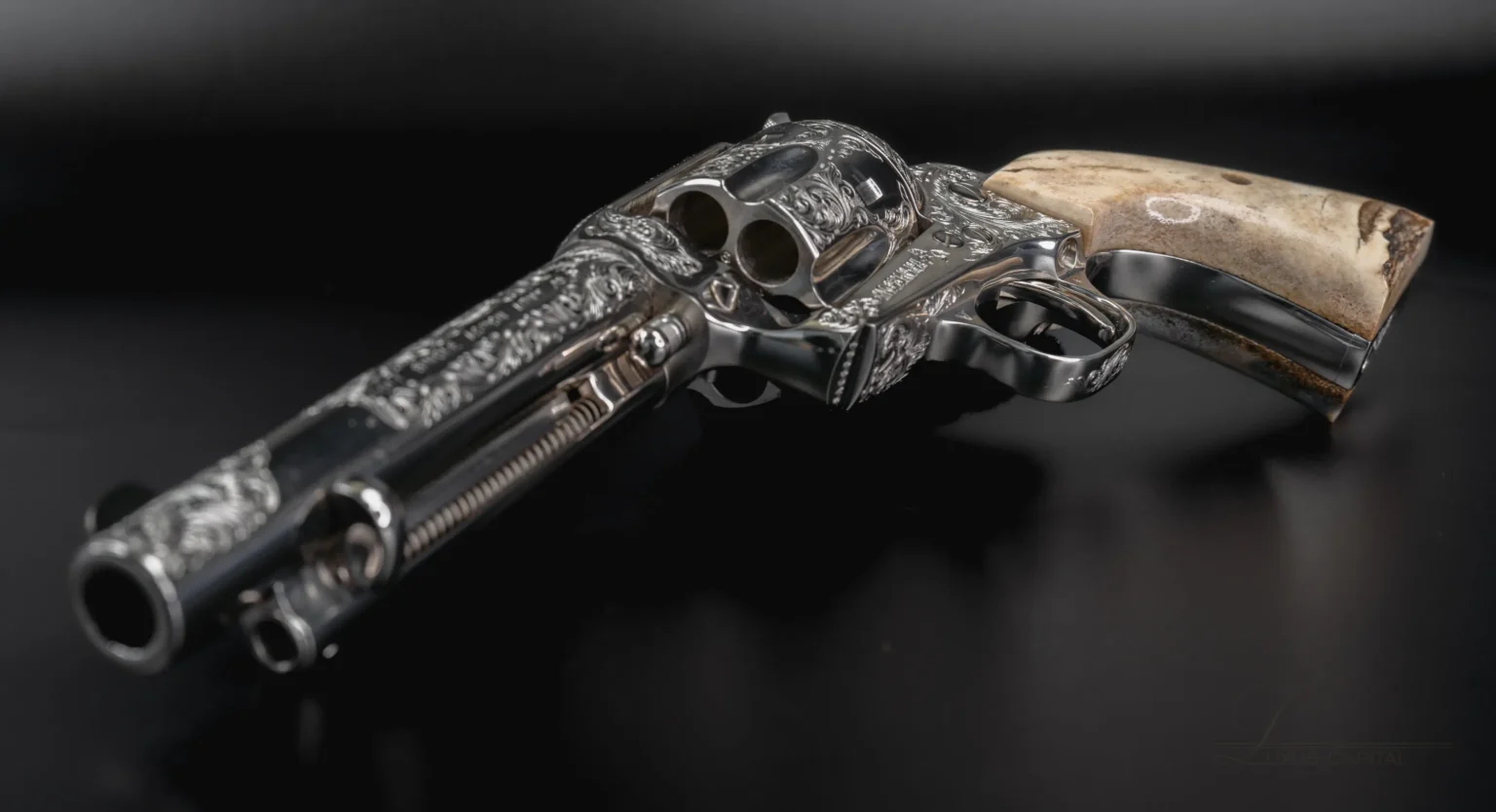
Colt Single Action Army
The Colt Single Action Army entered production in 1873. It is a six-shot, single-action revolver with a fixed cylinder and loading gate. Although strongly associated with the .45 Colt cartridge, the model has been produced in multiple chamberings and barrel lengths.[7]
The Single Action Army is not one uniform collecting category. First-, second-, and third-generation revolvers must be distinguished, while military-inspected arms, factory-engraved examples, scarce configurations, and documented presentation guns require still more specialized analysis.
Its association with the American West is historically important, but broad references to frontier figures do not establish the provenance of a particular firearm. Ownership claims require a documented chain connecting the individual to the specific serial-numbered revolver.
U.S. Fire Arms Single-Action Revolvers
U.S. Fire Arms Manufacturing Company produced historically styled single-action revolvers in Hartford, Connecticut. The business began under the United States Patent Fire Arms name, later adopted the USFA identity, and by 2001 was manufacturing its firearms’ principal components in-house.[8]
USFA revolvers now form a discontinued collecting category. Even so, discontinuation does not make every example rare. Model, production period, finish, barrel length, originality, condition, and factory documentation remain the relevant distinctions.
Claims that USFA revolvers were categorically superior to Colt products are matters of opinion, not verifiable historical conclusions.
What Establishes Collectibility
These revolvers should not be reduced to star ratings or universal rankings. A historically significant design can be common, while an obscure variation may be genuinely scarce. Likewise, scarcity alone does not guarantee demand.
A defensible evaluation begins with the firearm itself: exact model, serial number, configuration, markings, finish, mechanical condition, and evidence of alteration. Factory records, period catalogs, original accessories, and documented provenance can then place that physical evidence in context.
The name on the barrel may begin the inquiry. It does not finish it.
Frequently Asked Questions
Collector interest can reflect historical significance, scarcity, mechanical design, condition, originality, and provenance. No single factor determines collectibility in every case.
No. Discontinuation creates a finite supply, but value still depends on demand, condition, originality, configuration, and documented scarcity.
Manufacturers often revise materials, features, and production methods over time. Revolvers bearing the same model name can therefore belong to substantially different collecting categories.
Documented provenance can connect a specific firearm to a notable owner, event, or institution. An unsupported story does not establish provenance.
Original packaging and factory accessories can improve completeness and collector interest. They do not independently prove that the firearm itself is original or authentic.
Sources
- Colt’s Manufacturing Company, “Timeline”
- Smith & Wesson, “Performance Center Model 627”
- Freedom Arms, “Revolver Specifications Chart”
- Freedom Arms, Model 83 Instruction Manual
- Magnum Research, BFR Revolver Owner’s Manual
- Smith & Wesson, “Company History”
- National Park Service, “1873 Colt Revolver”
- American Rifleman, “This Old Gun: United States Patent Fire Arms ‘Tombstone’ Buntline”