
Key Takeaways:
- Korth, Janz, and Manurhin demonstrate distinct approaches to precision manufacturing and specialized revolver design.
- The Chiappa Rhino, Mateba Autorevolver, and Nagant Model 1895 employ unconventional mechanisms to address recoil or escaping propellant gas.
- Collectibility depends on exact identification, originality, condition, markings, and documented provenance, not age or reputation alone.
The United States occupies a central place in revolver history, but manufacturers elsewhere developed equally distinctive interpretations of the form. European designs ranged from hand-finished target arms and specialized police weapons to unconventional recoil-operated mechanisms and military revolvers intended for widespread service.
These firearms do not belong to a single market category. Some are premium modern revolvers; others are historically important service or commercial arms. Their significance rests on documented craftsmanship, mechanical originality, institutional history, or provenance.
Korth Super Sport and Classic
Germany’s Korth is closely associated with the modern luxury revolver. The company describes a manufacturing process combining precision machinery, selected steel and timber, traditional gunsmithing, and extensive handwork.[1]
The Super Sport STX applies that approach to a competition-oriented platform. Official specifications describe a six-inch, six-shot .357 Magnum revolver manufactured from machined billet steel. Its features include a cold-hammer-forged polygonal barrel, adjustable rear sight, four-position front sight, accessory rails, walnut grip, and an interchangeable cylinder system permitting the use of 9 mm Luger.[2]
The Korth Classic presents the company’s manufacturing philosophy in a more traditional revolver profile. Its importance is not that it reproduces an antique mechanism, but that it combines conventional sporting-revolver aesthetics with modern Korth construction. The Super Sport emphasizes technical complexity; the Classic emphasizes restrained form and finish.
Manurhin MR73
The French Manurhin MR73 was developed through cooperation among Manurhin, defense professionals, and competitive shooters. Chapuis Armes records its selection by organizations including the French National Police, GIGN, RAID, and other European intervention units.[3]
The MR73 was also engineered with competitive shooting in mind. Current manufacturer specifications include models chambered for .38 Special and .357 Magnum, along with a dedicated .32 S&W Long target version. Depending on configuration, barrel lengths range from compact service dimensions to eight-inch sporting formats.[3]
Chapuis machines the frames from forged-steel blanks, cold-hammer-forges the barrels, and performs assembly, fitting, and finishing by hand. Both single- and double-action trigger pulls can be adjusted.[3] These characteristics explain the MR73’s unusual position between an institutional sidearm and a precision sporting revolver.
Chiappa Rhino
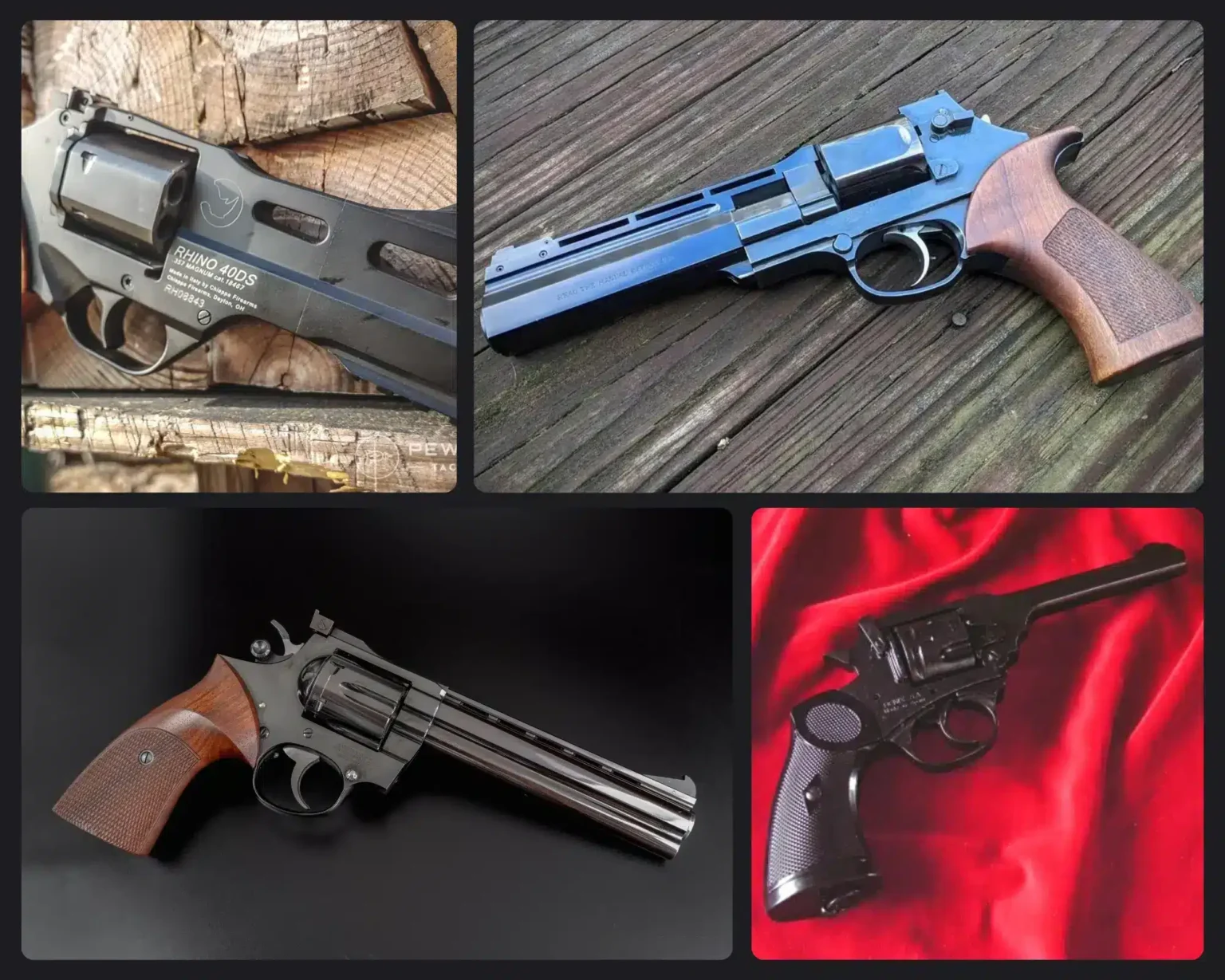
The Chiappa Rhino is distinguished by a barrel aligned with the lowest chamber of the cylinder. Conventional revolvers normally fire from the upper chamber. Placing the Rhino’s bore closer to the shooter’s hand reduces the distance between the bore axis and the point of resistance, thereby limiting the leverage that produces muzzle rise.[4]
The Rhino also uses an internal firing hammer. The visible external lever cocks the concealed action and then returns to its resting position. A separate indicator shows when the revolver is cocked for single-action fire.[4]
Its flattened cylinder and angular frame make the Rhino immediately recognizable, but its appearance follows its mechanics. The low barrel, concealed hammer, and unusual cylinder profile are functional elements rather than purely cosmetic styling.
Webley Mark VI
The Webley Mark VI was a British military service revolver rather than a luxury firearm. Adopted in 1915, it was a six-shot, double-action revolver chambered for the .455 British service cartridge. Opening its hinged top-break frame activated the extractor, allowing all six fired cases to be removed together.[5]
The British military issued Webley revolvers to personnel including machine-gun crews, aircrew, tank crews, naval personnel, and raiding parties. The Mark VI remained in official British service from 1915 to 1923, while earlier and later Webley-pattern revolvers contributed to a broader service history extending beyond that period.[5]
Collector evaluation requires more than identifying the Webley name. Model designation, military and proof marks, matching numbers, finish, mechanical condition, and subsequent alterations all matter. An undocumented example should not automatically be described as a battlefield-used firearm.
Nagant Model 1895
Designed by Belgian gunmakers Léon and Émile Nagant, the Model 1895 was adopted as a Russian military sidearm. The solid-frame revolver holds seven cartridges and was produced in both single- and double-action forms.[6]
Its defining feature is a gas-seal mechanism. Cocking the action rotates the cylinder and moves it forward toward the barrel. The specially configured cartridge case extends into the rear of the barrel, substantially closing the gap through which propellant gas normally escapes.[6]
The first 20,000 Model 1895 revolvers were manufactured in Liège. Mass production subsequently began at Russia’s Tula Arms Factory around 1898.[6] Despite its advanced sealing mechanism, the revolver retained a slow loading system in which cartridges and empty cases passed individually through a loading gate.
Not every Nagant is rare. Manufacture, date, markings, condition, originality, and evidence of later refurbishment determine the significance of an individual example.
Janz Revolver
Janz began developing its German revolver during the late 1990s. Company records indicate that its first prototype, serial number 0001V, was produced in 1998, followed by a .44 Magnum prototype and an enlarged frame intended to accommodate .454 Casull.[7]
The design’s principal distinction is its exchange system. Janz states that one frame can accept caliber assemblies ranging from .22 Long Rifle to .454 Casull and barrels from 2½ to 12 inches. The assemblies can be changed without tools.[7]
This differs from simply supplying an additional cylinder for cartridges of similar dimensions. The Janz system treats the frame, barrel, and cylinder as configurable parts of a broader platform. That mechanical adaptability is the design’s strongest claim to collector and technical interest.
Mateba Autorevolver
Italian designer Emilio Ghisoni pursued a fundamentally different approach to revolver operation. His U.S. patent for a “semiautomatic operation revolving cylinder pistol” describes a frame containing the firing mechanism and a movable upper assembly carrying the barrel and cylinder.[8]
When fired, the upper assembly recoils along the frame. That movement energizes a mechanism that prepares the revolver for the next shot by recocking the action and advancing the cylinder.[8] The design therefore uses recoil energy to perform work ordinarily accomplished by the shooter’s trigger pull or manual cocking of the hammer.
The patent establishes Ghisoni’s mechanical concept and explains the Autorevolver’s unusual architecture. It does not, by itself, establish production totals, the rarity of surviving examples, or present market value. Those questions require factory records or documentation tied to individual firearms.
Orbea Hermanos
Orbea Hermanos was an Eibar gunmaker associated with several revolver patterns rather than one standardized model. Consequently, “Orbea revolver” is not a sufficiently precise identification for historical or valuation purposes.
One documented example in Spain’s Army Museum is an Orbea hinged-frame revolver derived from a model patented in 1883 and marketed under the name Ona. The museum’s presentation-grade example has pearl grips, blackened metalwork, gold-inlaid military ornament, and an inscription connecting it to King Alfonso XIII and artillery officer Juan Loriga.[9]
That firearm demonstrates that Orbea produced elaborately decorated presentation arms as well as military-pattern revolvers. It does not prove that every Orbea revolver received equivalent workmanship or possesses comparable historical importance. Exact configuration, markings, decoration, provenance, and condition must be evaluated separately.
Astra Cadix
The Astra Cadix was a Spanish commercial double-action revolver, not a hand-built luxury arm. The Official Gun Digest Book of Guns & Prices identifies .22- and .38 Special versions with four- and six-inch barrels and places production between 1960 and 1968.[10]
The Cadix followed familiar swing-out-cylinder revolver practice rather than introducing a radically new action. Its collector interest lies primarily in its place within Spain’s postwar firearms industry and in the specifications and condition of individual examples.
Claims that the Cadix was widely adopted by European police agencies should not be repeated without institutional records. Caliber, barrel length, finish, mechanical condition, original grips, packaging, and documentation provide a firmer basis for evaluating a surviving revolver.
Collecting Beyond National Boundaries
These designs illustrate several distinct collecting fields. Korth and Janz represent high-grade German manufacture. The MR73 combines specialist service history with target-oriented construction. The Rhino and Mateba demonstrate unconventional mechanical thinking. The Webley and Nagant are military arms, while Orbea and Astra represent different periods of Spanish revolver production.
Price alone does not establish collectibility, and age does not guarantee rarity. A credible evaluation begins with precise model identification, markings, original configuration, mechanical condition, provenance, and comparison with documented examples. Evidence, not reputation or promotional language, determines the historical importance of an individual firearm.
Frequently Asked Questions
Collectibility depends on the model, configuration, originality, condition, markings, provenance, and documented historical significance.
Korth and Janz are documented examples of high-grade German revolver manufacture. The Manurhin MR73 combines specialized service history with precision construction.
Its barrel aligns with the cylinder’s lowest chamber. This lowers the bore axis and limits the leverage that produces muzzle rise.
Cocking moves the cylinder forward toward the barrel. Its extended cartridge case helps close the normal barrel-cylinder gap.
No. Rarity and significance must be determined from the exact model, production details, markings, condition, originality, and provenance.
Sources
- Korth, “About Us,” official manufacturer history and production overview.
- Nighthawk Custom, “Korth Super Sport STX .357 Magnum,” official U.S. product specifications.
- Chapuis Armes, “Manurhin MR73,” manufacturer specifications, construction details, and institutional history.
- Chiappa Firearms, “Rhino Safety and Instruction Manual,” official technical and operating description.
- Royal Armouries, “Arms of the First World War: Webley Mark VI Revolver,” museum history and specifications.
- Royal Armouries, “Arms of the First World War: Nagant Model 1895 Revolver,” museum history, production information, and mechanical description.
- Janz-Präzisionstechnik, “Development Stages of the Janz Revolver,” manufacturer history and exchange-system specifications.
- Emilio Ghisoni, “U.S. Patent 4,712,466: Semiautomatic Operation Revolving Cylinder Pistol,” published December 15, 1987.
- Museo del Ejército, “Un revólver para su profesor: un ‘buen regalo’,” official museum record of an Orbea presentation revolver.
- Jerry Lee, ed., The Official Gun Digest Book of Guns & Prices 2016, Gun Digest Books, Astra Cadix reference entry.