
Key Takeaways
- The Feederle brothers performed much of the C96’s design work, while Paul Mauser patented and manufactured the pistol.
- Most C96 pistols were chambered in 7.63×25 mm Mauser and loaded through a fixed magazine using a stripper clip.
- Authenticating a C96 requires examining its markings, caliber, mechanical features, serial numbers, finish, and provenance together.
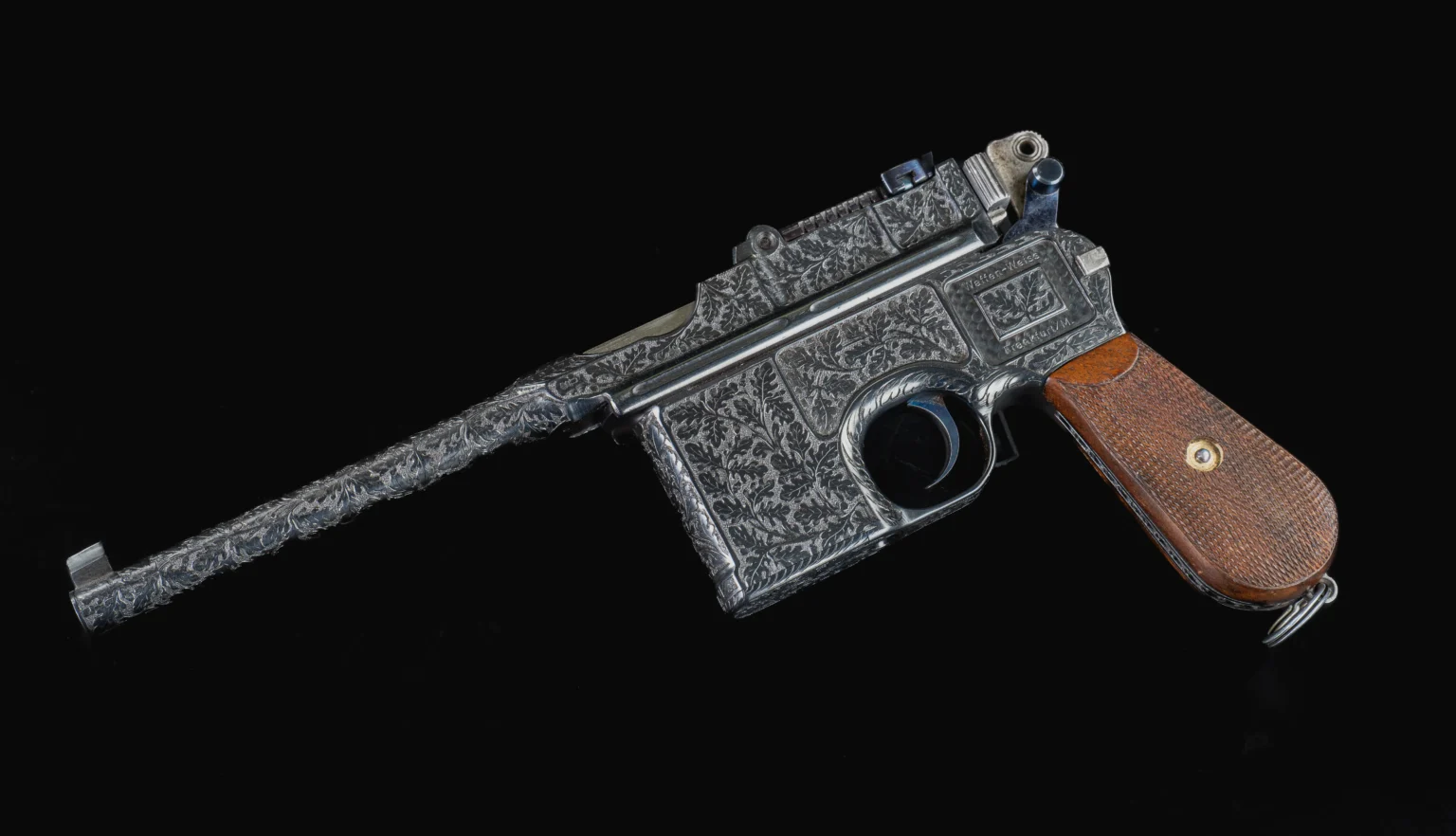
Introduced in 1896, the Mauser C96 was among the earliest self-loading pistols to achieve sustained commercial and military use. Its integral magazine, long barrel, and narrow wooden grip created the unmistakable profile behind the “Broomhandle” nickname.
Development
Much of the C96’s design work was performed by Fidel, Friedrich, and Josef Feederle, who worked at the Mauser factory in Oberndorf am Neckar. Paul Mauser patented and manufactured the resulting pistol.[1]
German patent No. 90,430 was dated December 11, 1895. The corresponding American patent, filed in Paul Mauser’s name, was granted as U.S. Patent No. 584,479 on June 15, 1897.[2]
The C96 entered production when revolvers still dominated military and civilian handgun markets. Although the German military initially declined to adopt it as a standard sidearm, the pistol found commercial buyers and secured several foreign military contracts. Production continued for nearly four decades.[1][3]
Mechanics and Configuration
The C96 is a locked-breech, short-recoil-operated pistol. After firing, the barrel and bolt recoil together briefly before the locking mechanism disengages and permits the bolt to continue rearward. Paul Mauser’s patent emphasized the way its principal components fitted together with minimal reliance on screws.[2]
Most examples were chambered for the 7.63×25 mm Mauser cartridge. Common production pistols had a fixed ten-round magazine ahead of the trigger, although six- and 20-round versions also existed. The fixed magazine was normally loaded from above with a stripper clip.[3][4]
Barrel lengths varied from approximately 99 to 140 mm, with the 140 mm barrel being the most common. Many pistols were supplied with a hollow wooden shoulder stock that doubled as a carrying holster. When attached to the grip, the stock provided additional support and gave the pistol some of the handling characteristics of a compact carbine.[1][4]
Military and International Use
The C96’s early military use often resulted from private purchase. British officers carried privately acquired examples during the Second South African War. Winston Churchill also carried a Mauser pistol during the charge of the 21st Lancers at Omdurman in 1898.[1]
In his autobiography, My Early Life, Churchill described relying on a pistol during the charge because an earlier shoulder injury limited his ability to use a cavalry sword. His account establishes the Mauser’s presence in the engagement without relying on later legend.[5]
During the First World War, the German Army contracted for 150,000 C96 pistols chambered in 9×19 mm Parabellum. Approximately 100,000 were delivered. These pistols became known to collectors as “Red 9” Mausers because a large numeral 9, generally filled with red paint, was cut into the grip panels to distinguish them from 7.63 mm pistols.[1][3]
The marking alone does not authenticate a Prussian-contract pistol. Replacement grips and later alterations exist, so caliber, serial-number range, proof and acceptance marks, and overall configuration must be considered together.
Later Variants
Mauser continued refining the C96 after the First World War. Short-barreled examples with smaller grips are commonly called “Bolo” models, although the term is collector shorthand rather than a precise Mauser model designation.
The most substantial later development was the Model 1932 Schnellfeuer, a select-fire pistol with a detachable magazine. It could fire either semiautomatically or automatically, unlike the fixed-magazine semiautomatic configuration associated with most earlier C96 pistols.[3][4]
Manufacturers in Spain also produced pistols based on the C96 pattern, while Chinese arsenals and workshops made numerous copies and adaptations. These firearms may be historically collectible in their own right, but they should not be represented as Mauser-manufactured C96 pistols without supporting markings and physical evidence.[4]
The C96 in Popular Culture
The C96’s unusual profile preserved its cultural visibility after its military importance declined. For the original Star Wars, set decorator Roger Christian selected a Mauser pistol as the basis for Han Solo’s blaster. A sight and muzzle components were added to create the desired combination of a futuristic weapon and a Western gunslinger’s sidearm.[6]
The resulting prop introduced the C96 silhouette to audiences with no particular interest in historical firearms. Its cinematic recognition, however, is secondary to its importance as a pioneering self-loading pistol with a long and varied production history.
Collecting the C96
The C96 was manufactured in many configurations, and production documentation is incomplete. Reliable identification therefore requires more than a serial number or a familiar nickname.[3]
Collectors should evaluate manufacturer inscriptions, proof and military-acceptance marks, caliber, barrel length, hammer and safety patterns, grip dimensions, magazine arrangement, and serial-number placement. Original finish, matching fitted components, and a correct period stock can materially affect collector interest.
Refinishing may soften edges or markings, while mismatched components can indicate repair, later assembly, or conversion. Such changes do not necessarily erase a pistol’s historical interest, but they must be disclosed and should not be mistaken for factory originality.
Provenance claims require documentation tied to the specific firearm. A compatible production date or model does not prove ownership by a notable person or participation in a particular event. Credible provenance ordinarily depends on contemporary records, correspondence, photographs, or a documented chain of ownership.
The C96’s complexity is central to its appeal. Its changing mechanical features, military contracts, commercial variants, foreign copies, and cultural associations offer a broad field for study—but also make careful authentication essential.
Frequently Asked Questions
What is the Mauser C96?
The Mauser C96 is a German self-loading pistol introduced in 1896. Its integral magazine and narrow wooden grip produced its distinctive “Broomhandle” appearance.
Who designed the Mauser C96?
Mauser employees Fidel, Friedrich, and Josef Feederle performed much of the design work. Paul Mauser patented and manufactured the resulting pistol.
Why is one variant called the “Red 9”?
The German Army contracted for C96 pistols chambered in 9×19 mm Parabellum during the First World War. A large red-filled numeral 9 on the grips distinguished them from 7.63 mm pistols.
How was the Mauser C96 loaded?
Most C96 pistols had a fixed magazine ahead of the trigger and were loaded from above with a stripper clip. The later Model 1932 Schnellfeuer used detachable magazines.
What should collectors examine when evaluating a C96?
Collectors should assess the manufacturer’s markings, proofs, caliber, serial numbers, mechanical features, finish, stock, and provenance. No single marking or serial number establishes authenticity by itself.
Sources
- Royal Armouries, “Arms of the First World War”.
- Paul Mauser, “Recoil-Operated Firearm,” U.S. Patent No. 584,479, United States Patent Office, June 15, 1897.
- Garry James, “In the Beginning: Semi-Automatic Pistols of the 19th Century,” American Rifleman, January 4, 2018.
- Dave Campbell, “The Mauser C96: A Look Back,” American Rifleman, February 28, 2020.
- Winston S. Churchill, My Early Life: A Roving Commission, Thornton Butterworth, 1930.
- James Floyd, “Roger Christian on Forging the Lightsaber, Han’s Blaster, and More from Star Wars: A New Hope,” StarWars.com, January 26, 2017.