
Key Takeaways:
- Serial numbers can help identify a firearm, but they rarely reveal its complete history on their own.
- Proof, inspection, and rebuild marks must be interpreted according to the country, organization, and period that produced them.
- Reliable provenance requires supporting documentation, such as factory ledgers, government records, photographs, or ownership records.
The markings on a firearm can identify its manufacturer or importer, model, caliber, inspection history, and original factory configuration. In favorable cases, they can connect a surviving firearm with factory ledgers or other archival records.
They cannot, by themselves, provide a complete history. Accurate identification requires the combined study of markings, physical features, condition, documentary evidence, and surviving factory records.
Serial Numbers: A Starting Point
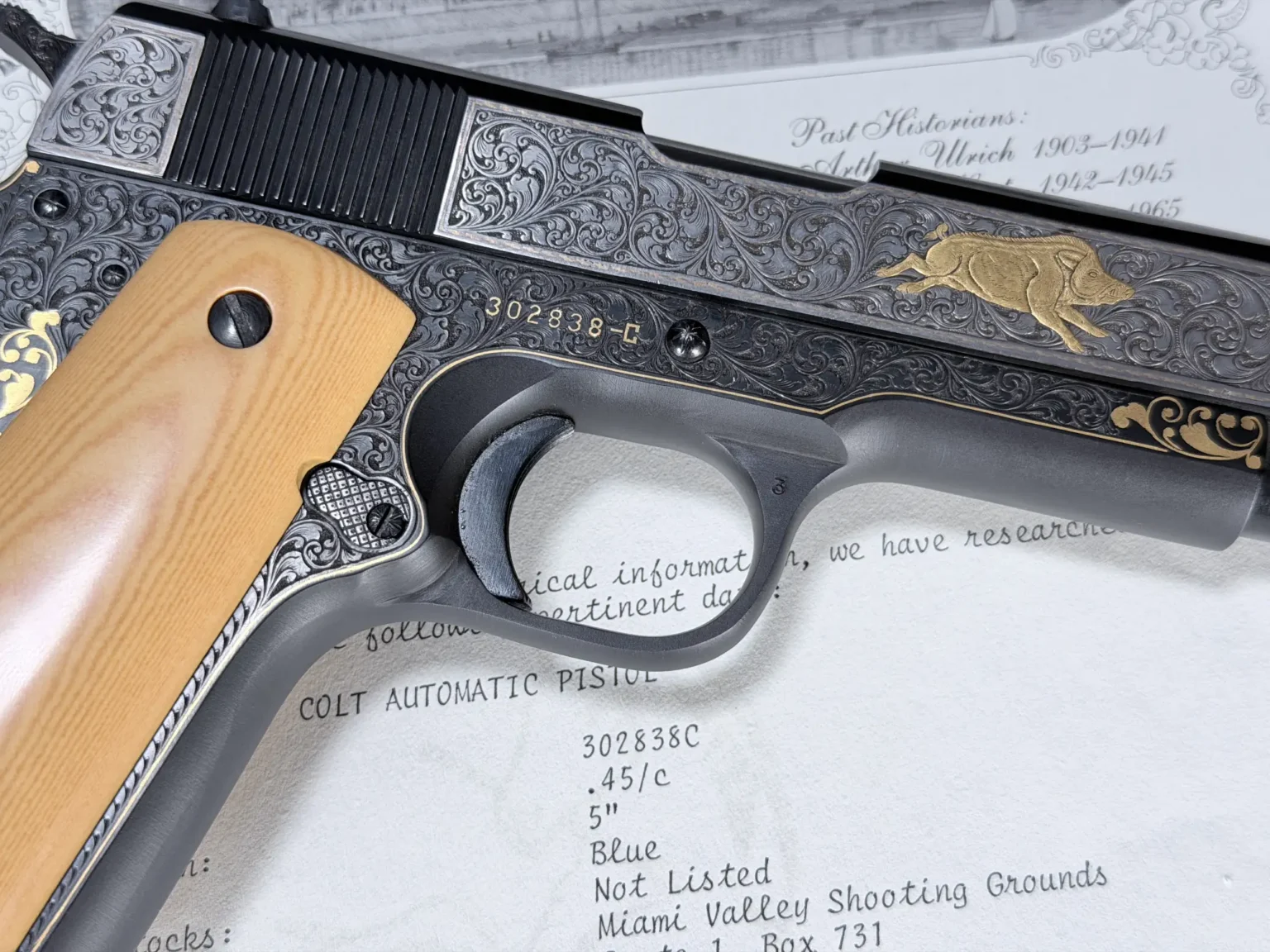
American manufacturers used serial numbers long before federal serialization requirements took effect. Colt maintains historical records that can document the original specifications and shipment details of eligible firearms. The Cody Firearms Museum holds 286 Winchester ledgers dating from 1873 through the early twentieth century, along with additional Winchester index cards and surviving records from Marlin, L.C. Smith, and Ithaca.[1][2]
Modern federal regulations require licensed manufacturers and importers to place an individual serial number on the firearm’s frame or receiver. Depending on the firearm and applicable marking rules, required information may also include the manufacturer or importer, place of business, model if designated, and caliber or gauge.[3][4]
A serial number is not necessarily unique throughout the firearms industry. The regulation prohibits a licensee from duplicating a number on another firearm produced or imported by that licensee. Another manufacturer may have used the same numerical sequence.[3] A reliable identification therefore usually requires the manufacturer or importer, model, caliber or gauge, and serial number, not the serial number alone.
The absence of a serial number does not automatically indicate unlawful alteration. ATF states that not every firearm is required to bear a serial number. Some older firearms were manufactured without one, and qualifying privately made firearms may also have been produced without manufacturer-applied numbers. Current regulations require a federal firearms licensee to mark an unserialized privately made firearm after acquiring it, within the prescribed period and before disposition.[3][5]
A serial number also does not automatically establish an exact manufacturing date, original purchaser, or service history. Colt describes the dates generated by its public serial-number lookup as approximate and directs researchers to its archival service for more complete information.[1] Records for other manufacturers may be incomplete, restricted to certain models, or entirely lost.
Proof Marks
A proof mark records testing under a particular proof system. It should not be confused with a manufacturer’s trademark, military-acceptance stamp, inspection mark, or ownership mark.
The London Proof House traces its authority to a royal charter granted by King Charles I on March 14, 1637. Its historic marks include the crowned letters “GP” and “V,” which continue to appear on firearms proved in London. The same official history records the establishment of a second British proof house in Birmingham in 1813 and the later recognition of certain European proof marks through international agreement.[6]
Proof marks must be interpreted according to the country, proof house, period, and type of test. Similar crowns, letters, eagles, or heraldic devices can have different meanings in different systems. Their location may also matter: marks on the barrel, action, bolt, or other pressure-bearing component do not necessarily establish that every part of the firearm was tested together in its present configuration.
A proof mark records a test or inspection performed at a particular point in the firearm’s history. It does not establish current mechanical condition, continued suitability for use, or the originality of every component. Later replacement, rechambering, repair, or alteration may separate the firearm’s present configuration from the configuration in which it was originally proved.
Inspection, Acceptance, and Rebuild Marks
Military organizations, arsenals, factories, and individual inspectors have applied marks to record inspection, acceptance, inventory, repair, or rebuild work. These marks may appear as initials, numbers, symbols, cartouches, or coded stamps.
Their meaning is specific to the administrative system that created them. A stamped letter may represent an inspector on one firearm and an assembly or production code on another. A military-acceptance mark can support identification of the government contract under which a firearm was received, but it does not necessarily prove combat use or assignment to a particular unit.
Rebuild and arsenal marks can be especially important. They may explain why a receiver, barrel, stock, bolt, or other component differs from the firearm’s original factory configuration. Such differences are not automatically evidence of improper alteration; they may reflect documented military maintenance or refurbishment. The mark must still be authenticated against records or authoritative references for the specific arsenal and period.
Manufacturer and Importer Markings
Manufacturer names, trademarks, barrel addresses, patent legends, model designations, and caliber markings can help place a firearm within a production period. Foreign-made firearms imported into the United States may also bear the importer’s name and location, along with country-of-origin information.[4]
ATF instructs investigators to record all visible markings because an incomplete or inaccurate description is a common reason a trace cannot be completed. ATF also notes that aftermarket modifications and difficult-to-read markings can complicate identification.[4]
The marking on a component establishes what is stamped on that component, not necessarily the configuration of the complete firearm. A caliber-marked barrel may have been replaced or fitted to a different receiver. A slide, cylinder, bolt, magazine, or stock may also have been exchanged during civilian repair or military service.
Manufacturer trademarks deserve similar caution. Differences in lettering, punctuation, font, placement, and stamping technique can be useful, but a trademark alone does not authenticate a firearm. It must agree with the serial-number range, construction, model features, finish, and other markings expected for the claimed production period.
Matching and Nonmatching Numbers
Numbers may appear on the frame or receiver, barrel, slide, cylinder, crane, bolt, stock, magazine, or small internal components. Not every repeated number is a legal serial number. Some are abbreviated serial numbers, assembly numbers, lot codes, drawing numbers, or inventory markings.
Matching numbers can support the conclusion that numbered components were assembled together at some point. They do not automatically prove that a firearm is untouched or completely original. Manufacturers varied widely in which parts they numbered, and military repair facilities sometimes replaced or renumbered components.
Nonmatching numbers require interpretation rather than an immediate conclusion. They may indicate a replacement part, an arsenal rebuild, an armorer’s repair, or the later assembly of parts from different firearms. The significance depends on the model, the marking practices in use at the time, and the available documentation.
Factory Records and Provenance
The strongest identification combines physical examination with an appropriate primary record. Colt archival letters may confirm recorded specifications and delivery information for eligible firearms.[1] The Cody Firearms Museum’s surviving records can document selected Winchester and other firearms, although handwritten entries may be incomplete, difficult to interpret, or overwritten with later repair information.[2]
A factory record establishes only what the surviving record states. A shipping entry may document the firearm’s original configuration and destination without identifying every later owner or alteration.
Military provenance presents an additional challenge. The National Archives reports that its Civil War ordnance records cannot generally be searched by firearm serial number. Scattered unit records occasionally identify individual arms, but there is no comprehensive serial-number index connecting Civil War firearms to particular soldiers.[7]
Claims of military use, presentation, famous ownership, battlefield recovery, or association with a historical event therefore require evidence beyond an appropriate model and serial-number range. Credible provenance may include factory ledgers, government inventories, period correspondence, photographs, presentation inscriptions, bills of sale, estate records, or a documented chain of ownership. Family tradition can guide research, but it is not independent proof.
Altered and Obliterated Numbers
Federal law prohibits knowing possession or receipt of a firearm whose manufacturer’s or importer’s serial number has been removed, obliterated, or altered when the firearm has moved in interstate or foreign commerce.[8]
Attempting to recover an obliterated number is specialized forensic work. ATF provides advanced training to firearm and toolmark examiners in methods used to raise damaged or removed serial numbers.[9] Research published through the National Institute of Standards and Technology has also demonstrated that deformation beneath a die-stamped number may remain detectable after the visible characters have been polished away. The researchers used electron backscatter diffraction to visualize subsurface deformation in stainless steel test specimens.[10]
These techniques belong in qualified forensic laboratories. Abrading, polishing, chemically treating, or restamping a questionable area can destroy evidence, damage the firearm, and create serious legal problems.
A Disciplined Examination
Document the firearm before cleaning or disassembly. Photograph both sides, then record close views of every visible number, inscription, symbol, and cartouche. Note the precise location of each mark and whether it appears stamped, engraved, cast, etched, or applied with an electric pencil.
Use angled light and magnification to examine shallow or worn markings. Avoid abrasive cleaning, refinishing, or aggressive polishing. Such work can permanently reduce the legibility of markings and erase evidence of original manufacture, use, or alteration.
Examine the frame or receiver, barrel, slide, cylinder, crane, bolt, trigger guard, magazine, butt, and stock where applicable. Components should not be removed solely to search for additional markings unless the examiner understands the firearm and can perform the work without damage.
The research process should move from physical evidence to documentation: identify the manufacturer and model, record every marking, examine construction and configuration, consult official factory or proof-house information, and compare the findings with surviving archival records. Conclusions should clearly separate what the firearm proves from what later accounts merely claim.
Properly interpreted, firearm markings are compact historical records. They can establish identity, manufacture, importation, testing, inspection, and alteration. Their real value emerges only when each mark is read within the specific system that created it and tested against the firearm and documentary evidence as a whole.
Frequently Asked Questions
A serial number may help identify a firearm’s production range and connect it with surviving factory records. It does not automatically establish an exact date, original owner, or complete history.
No. Some older and qualifying privately made firearms were lawfully produced without serial numbers, although federal and state requirements vary.
A proof mark records testing under a particular proof system at a specific point in the firearm’s history. It does not guarantee the firearm’s present condition or prove that every component is original.
No. Matching numbers can support the conclusion that numbered components were assembled together, but they do not conclusively prove untouched factory originality.
Compare the firearm’s markings and configuration with factory ledgers, government records, period correspondence, photographs, and documented ownership records. Historical claims should not be accepted without supporting evidence.
Sources
- Colt’s Manufacturing Company, Archive Services.
- Kirsten Belisle, Cody Firearms Museum, “Setting the Records Straight”.
- Bureau of Alcohol, Tobacco, Firearms and Explosives, 27 C.F.R. § 478.92—Identification of Firearms.
- Bureau of Alcohol, Tobacco, Firearms and Explosives, Properly Identify a Firearm for the Purpose of Tracing.
- Bureau of Alcohol, Tobacco, Firearms and Explosives, Privately Made Firearms.
- Worshipful Company of Gunmakers, The Heritage of the London Proof House.
- Michael P. Musick, National Archives and Records Administration, “Firearms Genealogy: Researching Civil War Arms and Equipment”.
- U.S. House of Representatives, Office of the Law Revision Counsel, 18 U.S.C. § 922(k).
- Bureau of Alcohol, Tobacco, Firearms and Explosives, Serial Number Restoration Training.
- Ryan M. White and Robert R. Keller, National Institute of Standards and Technology, “Restoration of Firearm Serial Numbers with Electron Backscatter Diffraction”.