
Key Takeaways:
- The Swiss military adopted the pistol in 1949 as the Pistole 49, while Denmark adopted it as the m/49.
- Original Swiss commercial models included the standard P210-1 and the target-oriented P210-5 and P210-6.
- Swiss, German and American P210 pistols represent distinct production periods and should not be treated as mechanically identical.
The SIG P210 earned its place among collectible military pistols through a combination of documented service history, distinctive engineering and specialized commercial variants. Its history, however, spans several manufacturers and generations that collectors should evaluate separately.
Origins and Military Service
The P210’s lineage begins with Charles Gabriel Petter and the French Modèle 1935A pistol. Petter filed a Swiss patent for an improved automatic pistol in 1935.[1] SIG subsequently developed the concept into a 9 mm service pistol, retaining such features as a removable lockwork assembly and a slide traveling within the frame rails.[2]
The resulting SP 47/8 was adopted by the Swiss military in 1949 as the Pistole 49, or P49. Denmark adopted the design during the same period under the designation m/49.[3][4]
The Swiss service pistol was developed and manufactured by Schweizerische Industrie-Gesellschaft (SIG) at Neuhausen am Rheinfall. Referring to the original 1949 pistol as a “SIG Sauer” is historically inaccurate because that name belongs to a later corporate and manufacturing era.
The P49 remained Switzerland’s standard service pistol until the adoption of the SIG P220, designated Pistole 75, in 1975.[4] Commercial and sporting P210 production continued after its front-line Swiss military service ended.
Design and Construction
The original P210 is a hammer-fired, single-action pistol operating through short recoil and a locked breech. Locking ribs on the barrel engage corresponding recesses in the slide, while a machined cam controls unlocking during recoil.[5]
The slide travels inside the frame rather than wrapping around external frame rails, as it does on most semiautomatic pistols. The P210 also employs a removable lockwork unit descended from Petter’s earlier design.[2] These features distinguish the Swiss pistol mechanically, but neither should be treated as an automatic guarantee of accuracy. The performance of any individual example depends on its mechanical condition, barrel fit, sights, trigger and ammunition.
A period SIG brochure lists the standard P210 with a 120 mm barrel and an eight-round magazine. It also documents 9 mm and 7.65 mm Parabellum configurations, together with a .22-caliber system.[5]
Swiss Commercial and Target Models
SIG offered several commercial and sporting configurations. Period factory literature identifies the P210-1 as a standard model with wooden grips and a polished finish. The P210-5 was a target model with a 150 mm barrel, while the P210-6 combined target features with the standard-length 120 mm barrel.[5]
The P210-5 and P210-6 employed adjustable target sights and lighter trigger specifications than the standard pistol.[5] These models should not be confused with later German or American target pistols bearing the P210 name.
Swiss military examples also changed during production. Documented P49 groups differ in finish, grips, slide-stop and safety details, magazine treatment and other features.[6] Consequently, a feature correct for an early pistol may be inappropriate for a later example.
Collectors should identify a pistol through the combined evidence of its serial number, markings, finish, grips, sights, barrel configuration and controls. Appearance alone is not sufficient.
Later German and American Production
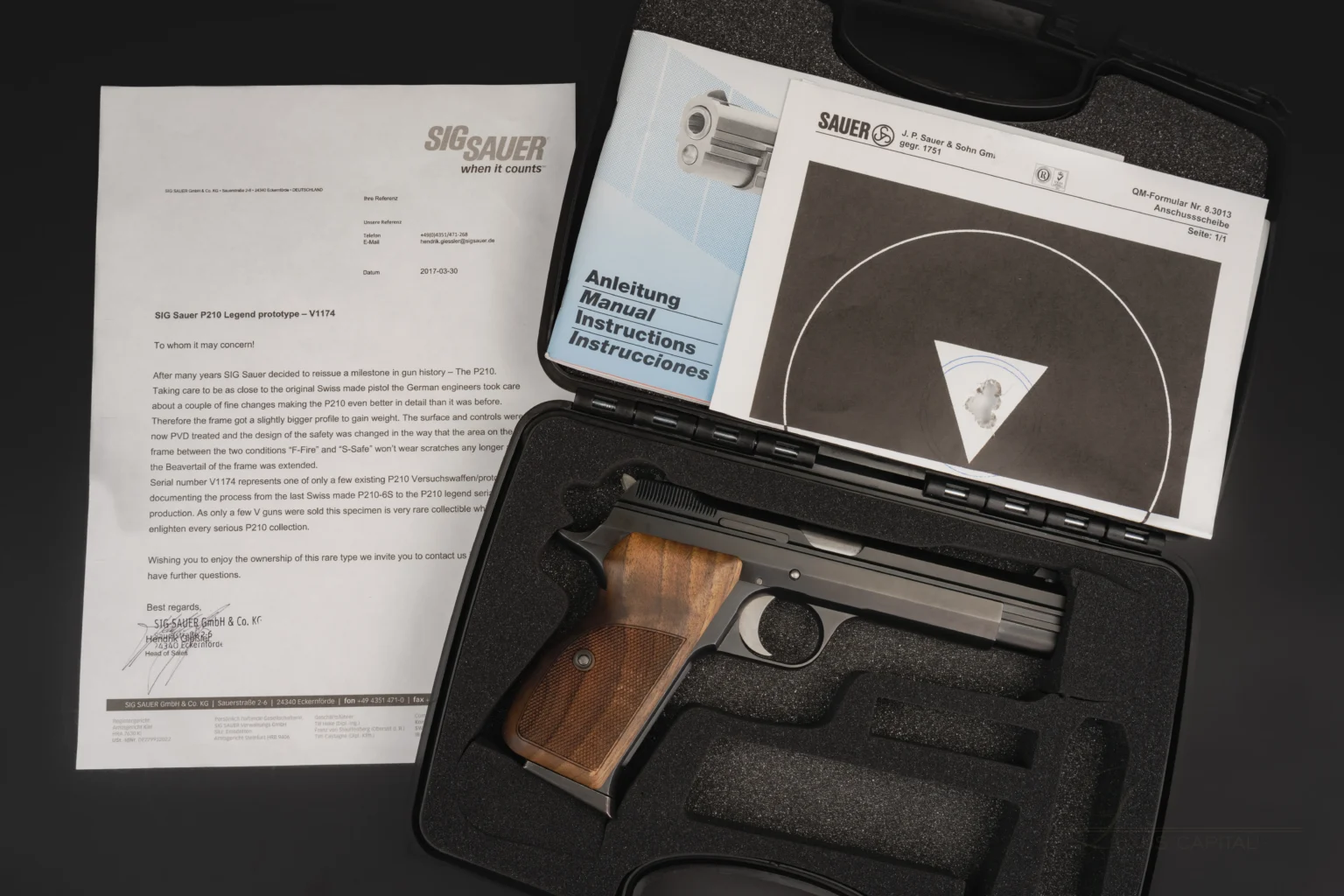
After Swiss production ended, the P210 name continued through later German-manufactured P210 Legend pistols and a separately developed American line.[4] These pistols preserved the general appearance and internal slide-rail arrangement of the Swiss design but incorporated material, manufacturing, and mechanical changes.
The American-made P210 uses a revised locking system in which the barrel hood engages the ejection port, a design closer to later SIG P-series pistols than to the original Swiss locking-lug arrangement.[2] It also introduced a magazine release behind the trigger guard, an extended beavertail, and revised safety and slide-stop controls.[2]
SIG Sauer’s current documentation describes the American P210 family as single-action, hammer-fired pistols using eight-round, single-stack magazines.[7] The American Target model adds adjustable sights and target-oriented grips, but it is not mechanically identical to a Swiss P210-5 or P210-6.
Swiss, German, and American P210 pistols are therefore separate collecting categories. A later pistol may be an excellent shooter, but it should not be represented as an original Swiss P210 or evaluated according to the same historical criteria.
Evaluating a Collectible P210
A credible evaluation should establish:
- Manufacturer and country of manufacture
- Military, commercial or sporting configuration
- Serial number and all property, proof and inspection marks
- Correctness of the barrel, slide, frame, sights, grips and controls
- Originality of the finish
- Presence of permanent alterations
- Correct magazines, box, manuals, test target and accessories
- Documentary support for any military, police or private provenance
Rarity should never be inferred from a model name alone. A claim that a pistol is an unusually scarce variation requires reliable production records, factory documentation or a defensible comparison with documented surviving examples.
Condition also requires precision. “Original finish,” “matching” and “unfired” are factual claims, not promotional descriptions. Each should be supported by physical examination and, when available, factory or service records.
The P210’s collector appeal is strongest when its identity is specific and documented. A Swiss P49, a commercial P210-1, a long-barreled P210-5, a German Legend and an American P210 Target may all be desirable, but they represent different periods, manufacturers and collecting priorities.
Frequently Asked Questions
The SIG P210 is a single-action, locked-breech pistol developed from design principles associated with Charles Petter. The Swiss military adopted it in 1949 as the Pistole 49.
Schweizerische Industrie-Gesellschaft manufactured the original pistols at Neuhausen am Rheinfall, Switzerland. Calling a 1949 service pistol a “SIG Sauer” is historically inaccurate.
The P210-1 was a standard commercial model, while the P210-5 and P210-6 were target models. The P210-5 used a 150 mm barrel, whereas the P210-6 retained the standard 120 mm barrel.
No. Later German and American pistols retained elements of the original design but incorporated different controls, manufacturing methods and mechanical features.
Collectors should examine the manufacturer, country of origin, serial number, markings, configuration, finish and supporting documentation. Claims involving rarity, originality or provenance should be independently substantiated.
Sources
- Charles Gabriel Petter, “Pistolet automatique perfectionné,” Swiss Patent CH185452A, filed February 25, 1935; published July 31, 1936.
- Wiley Clapp, “Tested: SIG Sauer’s Made-In-America P210 Pistol,” American Rifleman, December 21, 2018.
- Ian McCollum, “Danish m/49 Service Pistol by SIG,” Forgotten Weapons, August 21, 2017.
- Keith Wood, “SIG Sauer P210 Review,” Guns & Ammo, February 12, 2020.
- Schweizerische Industrie-Gesellschaft, SIG Pistols P210, period manufacturer’s brochure.
- Ian McCollum, “Military SIG P-49 Variations,” Forgotten Weapons, February 23, 2018.
- SIG Sauer, Inc., SIG P210 Operator’s Manual: Handling & Safety Instructions, Rev. 05.