
Key Takeaways
- The company that became SIG began as a Swiss wagon manufacturer in 1853 and entered firearms production during the 1860s.
- The Swiss Army adopted the P210 as the Pistole 49, while the P220 entered service as the Pistole 75.
- Collectors should evaluate proof marks, military markings, serial numbers, factory configuration, and documented provenance, not merely the SIG Sauer name.
The history behind the SIG Sauer name begins in 1853, when Friedrich Peyer im Hof, Heinrich Moser, and Conrad Neher established a wagon factory near Switzerland’s Rhine Falls. Initially devoted to railway equipment, the Schweizerische Waggon-Fabrik entered firearms development after the Swiss military solicited a new service rifle. In 1864, the company received an order for 30,000 Prélaz-Burnand muzzleloading rifles and adopted the name Schweizerische Industrie-Gesellschaft, better known as SIG.[1]
That transition did not immediately create the modern SIG Sauer organization. It established SIG as a Swiss arms manufacturer and began a design lineage that would eventually include some of the twentieth century’s most recognizable European service pistols.
The P210 and the Pistole 49
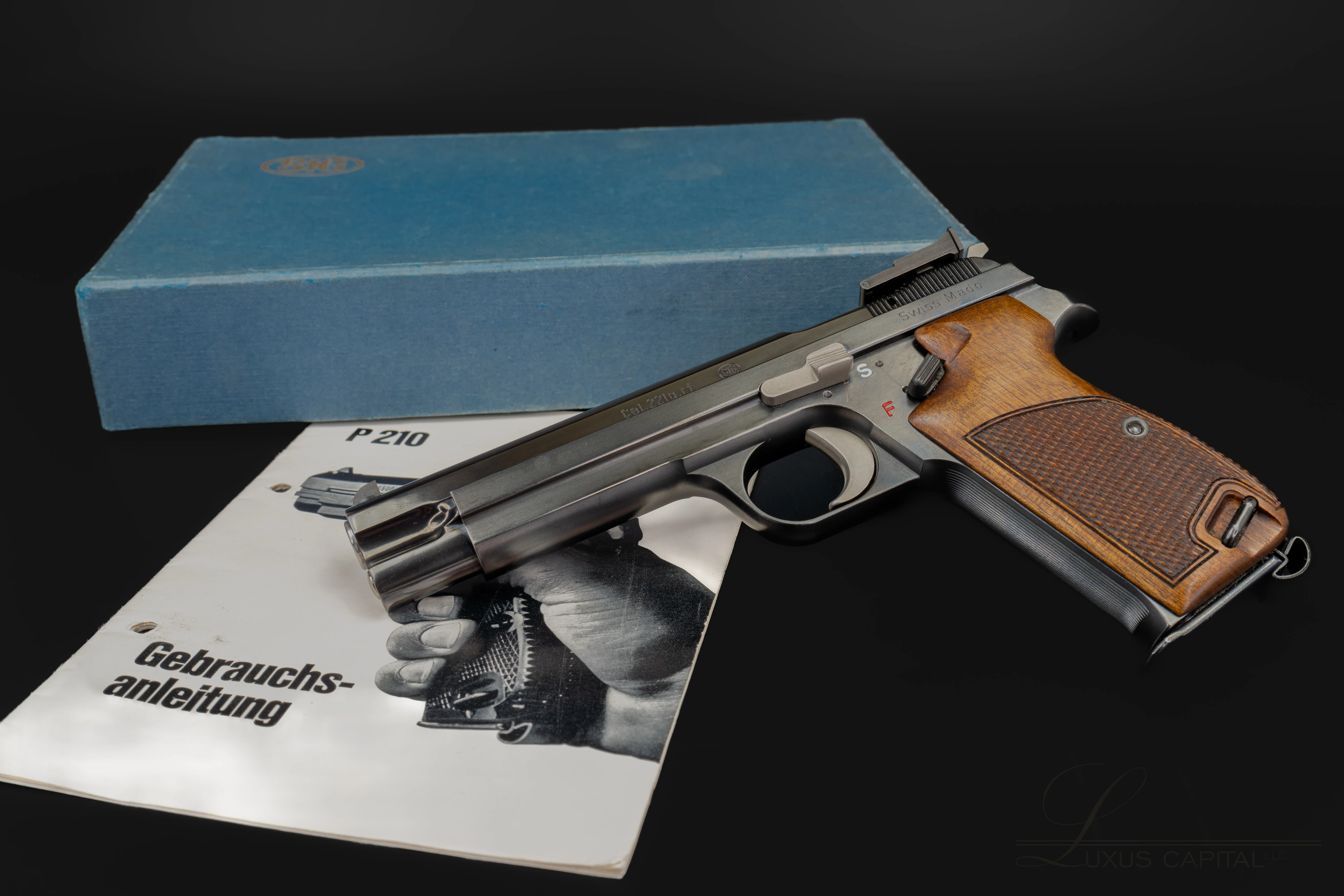
SIG’s defining early handgun was the pistol later known commercially as the P210. Its design incorporated elements developed by Charles Petter for the French Model 1935A service pistol. SIG extensively reworked that foundation into a locked-breech, single-action pistol with all-steel construction and an eight-round, single-column magazine.[2]
The Swiss Army adopted the design in 1949 as the 9 mm Pistole 49, or P49. Current Swiss military documentation identifies the Pistole 49 directly with the SIG P210 and continues to list it among the ordinance handguns authorized for federal shooting exercises.[3]
The original Swiss P210’s reputation rests on its precise construction and accuracy. Its slide travels inside the frame rails, producing extensive bearing surfaces between the two components. Combined with a carefully fitted barrel and single-action trigger mechanism, this arrangement helped distinguish the pistol from less costly service handguns designed primarily for mass production.[2]
The terminology matters to collectors. Pistole 49 denotes the Swiss military arm, while P210 became the broader commercial model designation. Later German- and American-made pistols carrying the P210 name are related to the Swiss design but belong to different manufacturing periods. Military markings, proof marks, serial numbers, mechanical configuration, and country of manufacture must therefore be examined before assigning a specific pistol to a historical category.
The P220 and the SIG-Sauer Partnership
By the 1960s, the Swiss Army was seeking a less expensive and more modern replacement for the P49. An official Swiss government history states that the resulting P220 was developed principally through cooperation between the army and SIG. Adopted as the Pistole 75 in 1975 and issued beginning in 1976, it introduced double-action operation and could be carried with its hammer lowered.[4]
Production of the new pistol also created the partnership behind the SIG Sauer name. J.P. Sauer & Sohn’s official history records that SIG selected the West German company as a production partner in 1972. Sauer possessed the capacity and technical experience required to bring the P220 and P230 into series production. SIG Holding acquired 90 percent of J.P. Sauer & Sohn in 1976 and completed the acquisition during the 1980s.[5]
The P220 represented a substantial departure from the P210. Most versions used double-action/single-action lockwork, an aluminum-alloy frame, a frame-mounted decocking lever, and a single-column magazine. Early pistols employed a fabricated steel slide fitted with a separate pinned breechblock. The barrel locked to the slide at the ejection port, eliminating the separate locking recesses used in many earlier Browning-derived designs.[6]
These features reduced manufacturing complexity while retaining the characteristics required of a military service pistol. The P220 did not invent double-action/single-action operation, but its particular combination of lockwork, decocking system, and simplified barrel-to-slide engagement became the mechanical foundation of the classic SIG Sauer pistol family.
Collectors should distinguish Swiss military P75 pistols from West German and later commercial P220s. They share a basic design, but their markings, chamberings, controls, slides, proofing, and contractual histories can differ. Early American-market examples sold under the Browning BDA name form another identifiable branch of the P220 story.[6]
The P225 and West German Police Service
The P225 followed in 1980 as a smaller 9×19 mm adaptation of the P220 system. It was developed for West German police requirements and entered German police service under the P6 designation. Like the P220, it used a single-column magazine and double-action/single-action lockwork, but its shorter dimensions made it better suited to both uniformed and plainclothes police use.[6]
The P225 is sometimes described chiefly as an early concealed-carry pistol. That description overlooks its actual institutional origin. Its historical importance lies in the West German police-pistol programs of the 1970s and the resulting P6 service contracts. Commercial P225s and police-surplus P6 pistols should not be treated as identical merely because they share the same underlying design.
The P226 and the American Military Trials
The P226 enlarged the P220 concept to accept a double-column, 15-round magazine. SIG developed the full-size 9×19 mm pistol for the United States military service-pistol competition intended to replace the M1911A1 and consolidate several handguns then in service.[6]
A 1986 report by the U.S. General Accounting Office identifies the SIG P226 and Beretta 92SB-F as the two technically acceptable finalists in the 1984 competition. Beretta won the contract that resulted in adoption of the M9.[7] The P226 therefore was not selected as the standard U.S. military sidearm, despite occasional accounts that blur the distinction between participation, technical acceptance, and final adoption.
Its performance in the trials nevertheless gave the P226 international visibility. Mechanically, it retained the P220 family’s ejection-port locking system and frame-mounted decocking lever while providing substantially greater magazine capacity. It subsequently became an important commercial and law-enforcement pistol, establishing the double-column format as a central part of the SIG Sauer catalog.[6]
SIG Sauer in the United States
SIG established SIGARMS, Inc. in Virginia in January 1985 to import the P220 and P230. The company moved to Herndon in 1987 and expanded its American offerings to include the P225, P226, and P228. It later relocated its operations to New Hampshire and changed its name from SIGARMS to SIG Sauer on October 1, 2007.[1]
This corporate history explains why the SIG Sauer name appears on firearms produced in different countries and under different organizational structures. A Swiss P210, West German P220, police-issued P6, and American-market P226 may share elements of design and branding, but they do not share the same provenance.
For collectors, the name on the slide is only the beginning. Country-of-origin markings, proof and acceptance stamps, serial numbers, factory configuration, agency markings, and documentary provenance determine where an individual pistol belongs within the broader history.
The P210 represents SIG’s Swiss precision-manufacturing tradition and the postwar Pistole 49 program. The P220 established the technical architecture of the classic SIG Sauer service-pistol family. The P225 adapted that system to West German police requirements, while the P226 expanded it for the American military trials and the international service-pistol market. Together, these models document the evolution of SIG from a nineteenth-century Swiss industrial company into a major name in modern handgun design.
Frequently Asked Questions
SIG’s predecessor was established as a Swiss wagon factory in 1853. It received an order for 30,000 Prélaz-Burnand rifles in 1864.
The Swiss Army adopted the design in 1949 as the Pistole 49, or P49. P210 became the broader commercial designation associated with the pistol family.
The Swiss Army adopted the P220 as the Pistole 75 in 1975. Its operating system became the foundation for several later SIG Sauer service pistols.
No. The P226 was a technically acceptable finalist in the 1984 competition, but Beretta’s submission won the M9 contract.
Collectors should check its country-of-origin markings, proof and acceptance marks, serial number, configuration, and documentation. Similar model names do not establish identical provenance.
Sources
- SIG Sauer, “History,” corporate history, accessed August 6, 2026.
- Wiley Clapp, “Tested: SIG Sauer’s Made-In-America P210 Pistol,” American Rifleman, December 21, 2018.
- Swiss Armed Forces, “Hilfsmittelverzeichnis 2025,” Regulation 27.132, January 1, 2025.
- Swiss Federal Office for Buildings and Logistics, “Handfeuerwaffen der Schweizer Armee feiern Jubiläum,” 2025.
- J.P. Sauer & Sohn, “History: 270 Years of Sauer,” corporate history, accessed August 6, 2026.
- NRA Staff, “SIG Sauer P226,” American Rifleman, March 15, 2012.
- U.S. General Accounting Office, “Pistol Procurement: Allegations on Army Selection of Beretta 9-mm. as DOD Standard Sidearm,” GAO/NSIAD-86-122, June 1986.