
Key Takeaways
- Samuel Colt’s 1836 patent described a rotating, chambered cylinder that aligned and locked into position as the hammer was cocked.
- The Paterson, Walker, Single Action Army, M1911, and Python represent distinct periods in Colt firearm development.
- Authentication requires examination of the firearm and supporting records, while preservation requires controlled storage and careful handling.
From Patent to Production
Samuel Colt’s U.S. patent of February 25, 1836, described a firearm with a rotating, chambered cylinder linked to the lock. Cocking the hammer rotated the cylinder, aligned a chamber with the barrel, and locked it in position for firing. The patent also specified a separate percussion nipple for each chamber.[1]
Colt’s first factory-produced revolvers were in Paterson, New Jersey, from 1836 until 1842. These early arms used percussion ignition, so powder, projectile, and percussion cap were loaded separately. A surviving No. 3 Belt Model in the Metropolitan Museum of Art, serial number 156, dates to about 1838 and is recorded as .34 caliber with a 5 1/2-inch barrel.[2]
In 1847, Samuel Colt and Samuel H. Walker collaborated on the revolver now called the Colt Walker. The arms were manufactured by Whitney. National Park Service records describe a production total of 1,100 .44-caliber, six-shot revolvers; the Springfield Armory collection’s example is marked “E Company No. 58” and retains matching numbers.[3]
Colt then established a larger manufacturing base in Hartford. The earliest buildings of the East Armory were completed in 1855, and the factory was producing 150 finished firearms per day by 1857. Its production system relied on precision machinery, while a separate workshop employed decorators who applied scroll engraving, figural work, and, on deluxe arms, precious-metal inlay.[4][2]
The Single Action Army
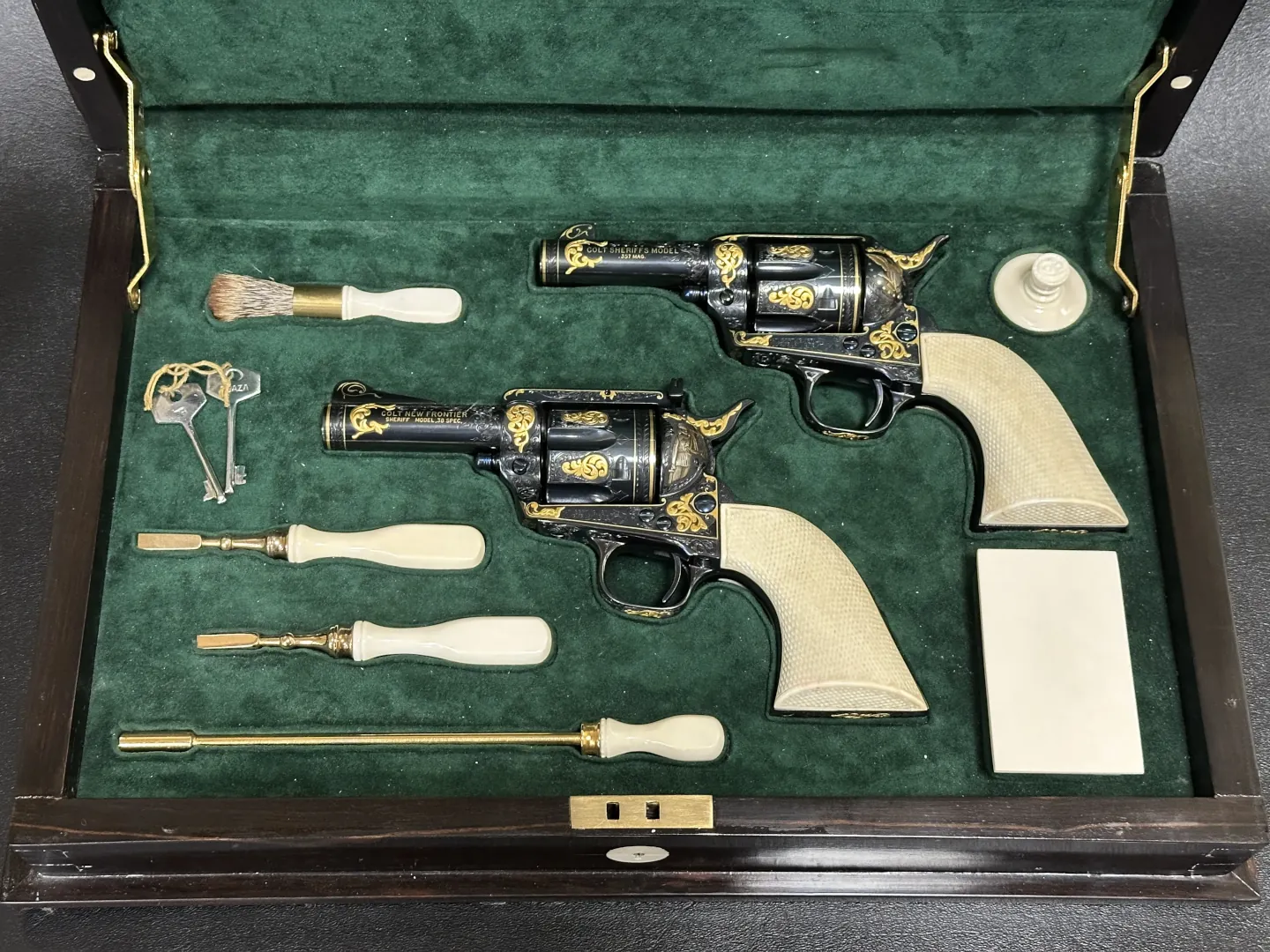
Colt introduced the Single Action Army in 1873. Its cylinder accepts self-contained metallic cartridges rather than the separate powder, projectile, and cap used by percussion Colts. The single-action mechanism requires the hammer to be cocked before each shot.[5][2][6]
The M1911
The M1911 marked Colt’s move into a different operating system and a new category of military sidearm. Designed by John M. Browning, the short-recoil, .45-caliber semiautomatic pistol was adopted by the U.S. Army in March 1911, replacing .38-caliber Long Colt revolvers.[7]
For collectors, “M1911” should therefore be treated as a design and military designation, not as proof that every example was made in the same year or carries the same configuration. Maker, serial number, military markings, finish, small parts, and documented alterations must be evaluated on the individual pistol.
The Python
Colt introduced the Python in 1955. The original model was a .357 Magnum double-action revolver assembled and finished with extensive hand fitting. Colt later ended original-series production and returned the Python to regular production in 2020 with revised manufacturing and internal design.[8][5] The shared name does not make an original-series Python and a 2020-production Python interchangeable in collector categories.
That distinction matters when cataloging finish, barrel length, sights, stocks, markings, packaging, and factory documentation. A description should identify the production period and the features actually present rather than applying the reputation of the original model to every revolver bearing the Python name.
Authentication and Documentation
A sound examination begins with the firearm itself. Record the complete serial number, all visible markings, caliber designation, barrel length, finish, stocks or grips, sights, engraving, and signs of replacement or refinishing. Photographs should cover both sides, markings, the serial-number area, and any feature supporting a claim of special order, military issue, presentation, or previous ownership.
Factory documentation can establish facts that the firearm alone cannot. Colt Archive Services states that its historians search company records for the original specifications and delivery information of individual firearms. It also cautions that the information available varies by model and by the surviving records.[9] An archive letter should be read for exactly what it confirms. A shipping destination, for example, does not by itself establish every later owner.
Provenance requires a documented chain connecting the firearm to the person or event claimed. Names engraved on a gun, family tradition, and later sales descriptions may guide research, but they are not substitutes for contemporary correspondence, receipts, institutional records, or other authenticated documents. Each link in the chain should identify the same firearm through a serial number, distinctive configuration, or another specific characteristic.
Preservation
Historic firearms combine materials that respond differently to handling and the environment. National Park Service guidance calls for stable relative humidity, protection from sunlight, gloves during handling, regular inspection, and separate storage of ammunition and leather accessories. It also recommends documenting condition before and after maintenance.[10]
Cleaning and disassembly require specialist knowledge, and metal tools can scratch finished wood and polished metal. The National Park Service advises consulting a firearms conservator when dismantling or specialist cleaning is required.[10] Preservation should protect the existing object and its documented history, not make an old firearm appear new.
Frequently Asked Questions
The article covers the Paterson, Walker, Single Action Army, M1911, and Python.
The patent described a rotating, chambered cylinder connected to the firearm’s lock. Cocking the hammer rotated, aligned, and locked the cylinder for firing.
Samuel Colt and Samuel H. Walker collaborated on the revolver in 1847. National Park Service records document 1,100 .44-caliber, six-shot examples manufactured by Whitney.
Colt introduced the Single Action Army in 1873, and the U.S. Army adopted the M1911 in March 1911. Colt introduced the Python in 1955 and returned it to production with design revisions in 2020.
Examine its serial number, markings, configuration, finish, and documentation, including applicable factory records. Store it in stable conditions and consult a firearms conservator before specialist cleaning or disassembly.
Sources
[1] Colt, Samuel. “Improvement in Fire-Arms.” U.S. Patent X9,430I, February 25, 1836.
[2] Metropolitan Museum of Art. “Colt Paterson Percussion Revolver, No. 3, Belt Model, Serial No. 156, with Case and Accessories.” Metropolitan Museum of Art, n.d.
[3] National Park Service. “Arms Collecting.” Springfield Armory National Historic Site, February 26, 2015.
[4] National Park Service. “The East Armory Complex.” Coltsville National Historical Park, April 26, 2022.
[5] Colt’s Manufacturing Company LLC. “The Colt Story.” Colt’s Manufacturing Company LLC, n.d.
[6] National Park Service. “1873 Colt Revolver.” Fort Smith National Historic Site, April 10, 2015.
[7] Keilers, John. “Arming the Army, John M. Browning.” U.S. Army Military History Institute, January 12, 2009.
[8] Clapp, Wiley. “Colt Python Review.” American Rifleman, March 23, 2020.
[9] Colt’s Manufacturing Company LLC. “Archive Services.” Colt’s Manufacturing Company LLC, n.d.
[10] National Park Service. Caring for Historic Longarms: Storage and Handling Requirements. Conserve O Gram 10/1, May 1999, pp. 1-3.