
Key Takeaways
- Cabot distinguishes its 1911 pistols through billet-steel construction, closely controlled component dimensions, and extensive hand finishing.
- The National Standard and Vintage Classic follow the traditional single-stack format, while the Insurrection is a double-stack 9mm.
- Collectibility depends on the individual pistol’s originality, condition, documentation, production status, and market demand, not promotional claims alone.
The M1911 entered U.S. military service in March 1911. Designed by John M. Browning and originally chambered in .45 ACP, the short-recoil, semiautomatic pistol remained the U.S. Army’s standard sidearm until 1985.[1] Its long service life established the basic design as one of the most recognizable handgun platforms in American firearms history.
More than a century after its adoption, the 1911 remains in production across a broad market, from relatively conventional factory pistols to extensively hand-fitted custom guns. Cabot Guns occupies the high end of that spectrum, combining precision machining, hand finishing, limited production, and unconventional materials.
A Different Manufacturing Approach
Rob Bianchin founded Cabot Guns in 2011 after learning that Pennsylvania-based Penn United Technologies was applying its precision-manufacturing experience to 1911 components. Cabot introduced its pistols publicly at the 2011 NRA Annual Meetings in Pittsburgh.[2]
The company’s defining feature is not a fundamental reinvention of Browning’s operating system. It is the method used to manufacture and finish the pistol. Cabot says it machines its frames, slides, and numerous smaller components from solid steel billet rather than beginning with cast or forged frame and slide blanks. The company states that it manufactures 31 components in-house and applies separate heat-treatment specifications to its frames and slides.[3]
This approach differs from the traditional custom-gun model, in which a gunsmith selects commercial components and hand-fits them into an individual pistol. Writing in GUNS Magazine, Jeremy D. Clough reported that Cabot’s tightly controlled component dimensions allow parts to be produced with a degree of repeatability and interchangeability unusual among custom 1911s.[2] Handwork remains part of the process, particularly in barrel fitting, blending, polishing, finishing, and final assembly.
Cabot also states that its pistols are made from domestically sourced materials and that their components, assembly, and finishing originate in the United States.[4] Such statements establish the company’s disclosed manufacturing policy, although they should not be treated as independent certification of every component in every pistol.
The National Standard and Vintage Classic
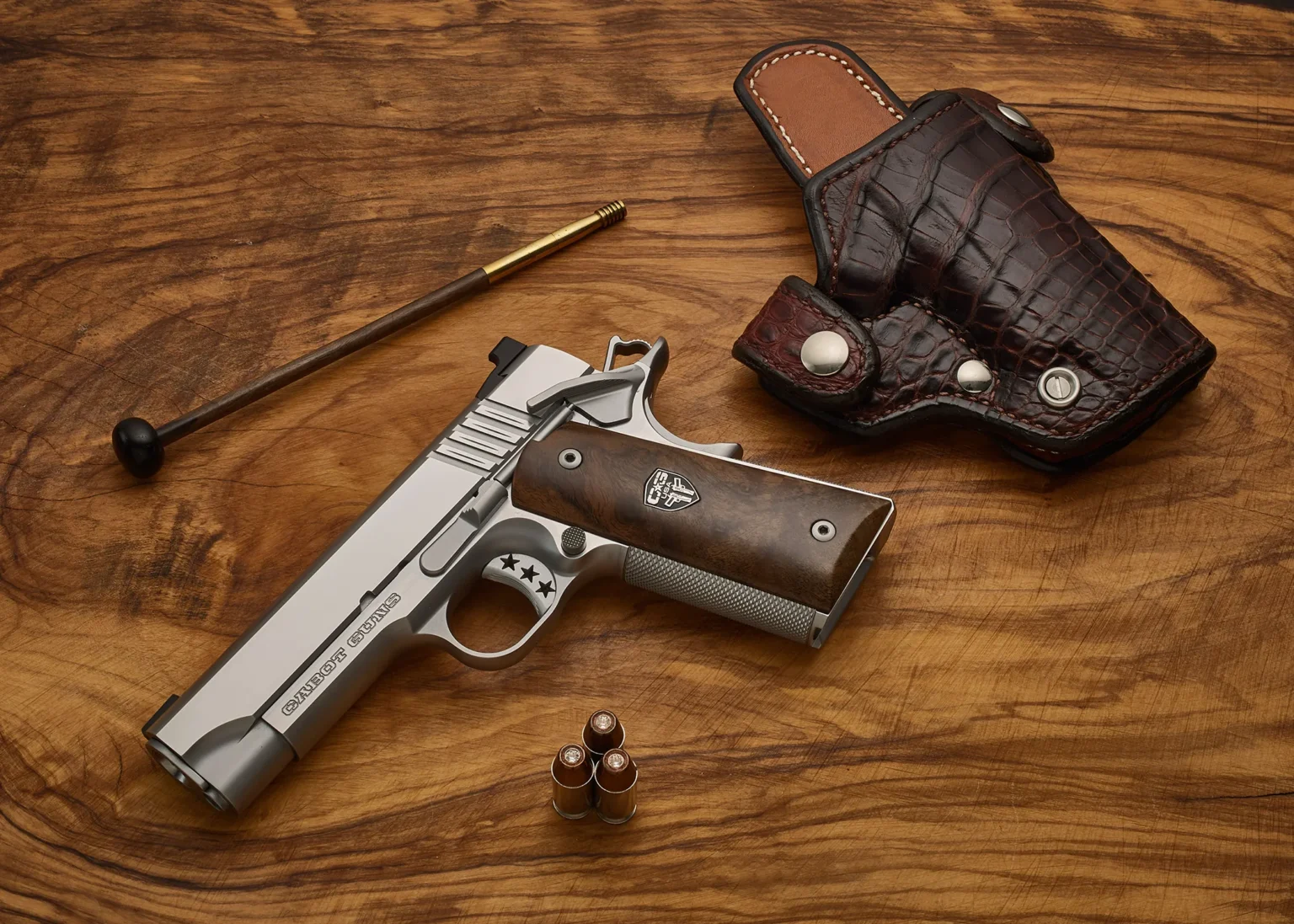
The National Standard illustrates Cabot’s core single-stack format. Cabot offers it in Government and Commander configurations, with respective barrel lengths of 5 and 4.25 inches, and in .45 ACP or 9mm. Its frame and slide are machined from 416 stainless-steel billet. Listed features include a hand-fitted barrel, 24-lines-per-inch frontstrap checkering, a machined barrel bushing, billet controls, walnut grips, and eight-round .45 ACP or nine-round 9mm magazines. Cabot guarantees groups smaller than 1.5 inches at 25 yards for its pistols.[5] That figure is a manufacturer’s warranty standard, not an independent comparison with every competing 1911.
The Vintage Classic uses the same basic choice of Government or Commander dimensions and .45 ACP or 9mm chambering, but pairs the stainless-steel construction with a proprietary distressed finish. Other identifying features include Cabot’s Trinity Stripe slide serrations, a gold-bead front sight, 24-lines-per-inch checkering, and figured walnut grips. Cabot’s current listing limits the 2026 Vintage Classic run to 30 pistols and identifies that allocation as sold out.[6]
These models demonstrate why Cabot pistols interest collectors as well as shooters. The relevant distinctions are identifiable construction methods, model-specific details, documented production limits, and labor-intensive finishes—not an unsupported assertion that every Cabot is categorically superior to every custom 1911.
The Insurrection Double-Stack
The Insurrection represents a more substantial departure from the traditional single-stack configuration. It is a double-stack 9mm built around Cabot’s proprietary stainless-steel frame and grip. Cabot offers 5-inch Government and 4.25-inch Commander versions, each with a hand-fitted stainless-steel barrel.[7]
The company lists a 3.5-pound trigger, an internal “Advantage” extractor, a fiber-optic front sight, an unloaded weight of 42 ounces, and two 17-round magazines. Optional configurations include a ported or threaded barrel and an optic mount using the Trijicon RMR footprint.[7] These are meaningful mechanical and dimensional differences from Cabot’s single-stack pistols, rather than cosmetic variations alone.
Customization, Artistry, and Collectibility
Cabot’s catalog includes choices in caliber, barrel length, sights, grips, safeties, finishes, magazine wells, and optic provisions. Its more elaborate work extends to limited editions, one-of-a-kind commissions, engraving, Damascus steel, and meteorite components. Such features can make individual pistols visually distinctive, but elaborate materials do not by themselves establish historical importance or future value.
For collectors, the strongest examples will generally be those that retain their original configuration and accessories and are accompanied by factory documentation. A stated production limit is useful only when it can be tied to a specific model and year. Condition, provenance, originality, aesthetic merit, and documented secondary-market demand remain separate considerations.
A Cabot pistol should therefore be evaluated as a particular firearm, not merely as a brand name. Its construction, configuration, production status, documentation, and condition matter more than promotional superlatives. Cabot’s genuine distinction lies in its combination of billet-steel manufacturing, closely controlled component dimensions, extensive hand finishing, and limited-production presentation. Whether that combination makes a given Cabot preferable to a pistol from another respected maker ultimately depends on the collector’s purpose and the evidence attached to the individual gun.
Frequently Asked Questions
Cabot machines frames, slides, and numerous smaller components from steel billet before completing the pistols with hand fitting and finishing. This manufacturing approach differs from the traditional practice of extensively fitting commercially sourced components.
The National Standard and Vintage Classic have frames and slides machined from 416 stainless-steel billet. Cabot states that its pistols are made from domestically sourced materials.
The Insurrection is a double-stack 9mm offered with a 5-inch Government or 4.25-inch Commander barrel. Cabot lists an internal extractor, 17-round magazines, and optional barrel and optic configurations.
Some Cabot models receive documented annual production limits. Collectors should verify the exact model, production year, and factory records rather than assuming every Cabot pistol is equally scarce.
No firearm is guaranteed to appreciate in value. A Cabot pistol’s market value depends on factors including rarity, originality, condition, provenance, documentation, and collector demand.
Sources
- John Keilers, “Arming the Army: John M. Browning,” U.S. Army Military History Institute, January 12, 2009.
- Jeremy D. Clough, “Cabot Guns,” GUNS Magazine, April 2023, pp. 30–35.
- Cabot Guns, “The Anatomy of a Cabot”.
- Rob Bianchin, “Our Made in America Manifesto,” Cabot Guns.
- Cabot Guns, “The National Standard”.
- Cabot Guns, “The Vintage Classic”.
- Cabot Guns, “Insurrection: A Double-Stack 1911”.