
Key Takeaways:
- Switzerland adopted the pistol as the Pistole 49 in 1949; the SIG Sauer P220 succeeded it as the standard sidearm in 1975.
- The P210 combines Charles Petter’s removable lockwork with internal slide rails and carefully fitted steel construction.
- Contract markings, serial numbers, originality, condition, and documented provenance are essential when evaluating a collectible P210.
Few service pistols combine military history, mechanical refinement, and competitive accuracy as convincingly as the SIG P210. Adopted by Switzerland after the Second World War, the pistol was expensive to manufacture and limited in capacity, but its precise construction and unusually smooth operation established a reputation that still shapes its collector appeal.
From the Model 1935A to the Pistole 49
The P210’s lineage begins with Charles Gabriel Petter, the Swiss-born designer of France’s Model 1935A service pistol. Petter’s patented design placed much of the firing mechanism in a removable assembly, simplifying disassembly and maintenance. Schweizerische Industrie-Gesellschaft, better known as SIG, acquired rights to the Petter system in 1937 and used it as the foundation for a new Swiss military pistol.[1][2]
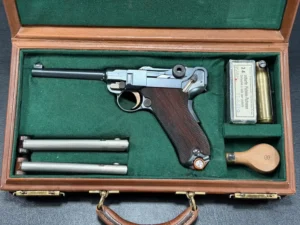
Development continued through several experimental configurations, including a double-column version. The final service pistol used an eight-round, single-column magazine and was chambered for the 9×19 mm cartridge. Switzerland adopted it in 1949 as the Pistole 49, or P49, replacing the Swiss military’s Luger-pattern pistols. SIG subsequently applied the P210 designation to commercial production.[2][3]
The P49 remained Switzerland’s standard military pistol until the adoption of the lighter and less costly SIG Sauer P220, designated Pistole 75, in 1975. Replacement was gradual, and P49 pistols continued to circulate within Switzerland’s military and civilian shooting system long afterward.[2][4]
The Design Behind the Reputation
The original P210 is a recoil-operated, locked-breech, single-action pistol. Its barrel and slide initially recoil together before the barrel unlocks, allowing the slide to complete the loading cycle. The military pistol feeds from an eight-round detachable magazine and uses a heel-mounted magazine catch.[2][4]
Two features distinguish the P210 from most contemporary service pistols. First, its slide runs inside the frame rails instead of wrapping around the outside of the frame. The resulting long bearing surfaces help control lateral and vertical movement. Second, the lockwork is contained in a removable unit derived from Petter’s design, making the mechanism easier to service as an assembly.[1][2]
The original pistols were machined from steel and required extensive fitting. That manufacturing approach produced exceptionally smooth slide travel and consistent lockup, but it also made the P210 costly compared with service pistols designed around stamped components, alloy frames, or less labor-intensive production.[2][4]
The design’s accuracy was not merely a matter of reputation. The Swiss military required the pistol to demonstrate demanding performance at 50 meters, while later commercial target versions incorporated adjustable sights, specialized triggers, longer barrels, and heavier frames.[4] The P210’s balance, single-action trigger, and comparatively low relationship between the bore and the shooter’s hand also made recoil easy to manage, although these characteristics do not eliminate the importance of ammunition, maintenance, and shooter technique.
Military and Commercial Variants
Military P49 pistols are generally identifiable by serial numbers beginning with the letter “A.” Commercial Swiss P210 pistols usually carry a “P”-prefix serial number. Pistols transferred from Swiss military ownership may bear an additional “P” ownership mark, making the placement and form of that mark relevant when evaluating an individual example.[4]
The principal Swiss variants include:
- P210-1, P210-2, and P210-3: Closely related service and commercial configurations distinguished largely by finish, grips, sights, and other production details. The P210-2 is particularly associated with the Swiss military pattern and black synthetic grips.
- P210-4: Produced for the West German Bundesgrenzschutz, or Federal Border Guard. These pistols are commonly associated with “D”-prefix serial numbers, a loaded-chamber indicator, and the absence of the Swiss-pattern lanyard loop.
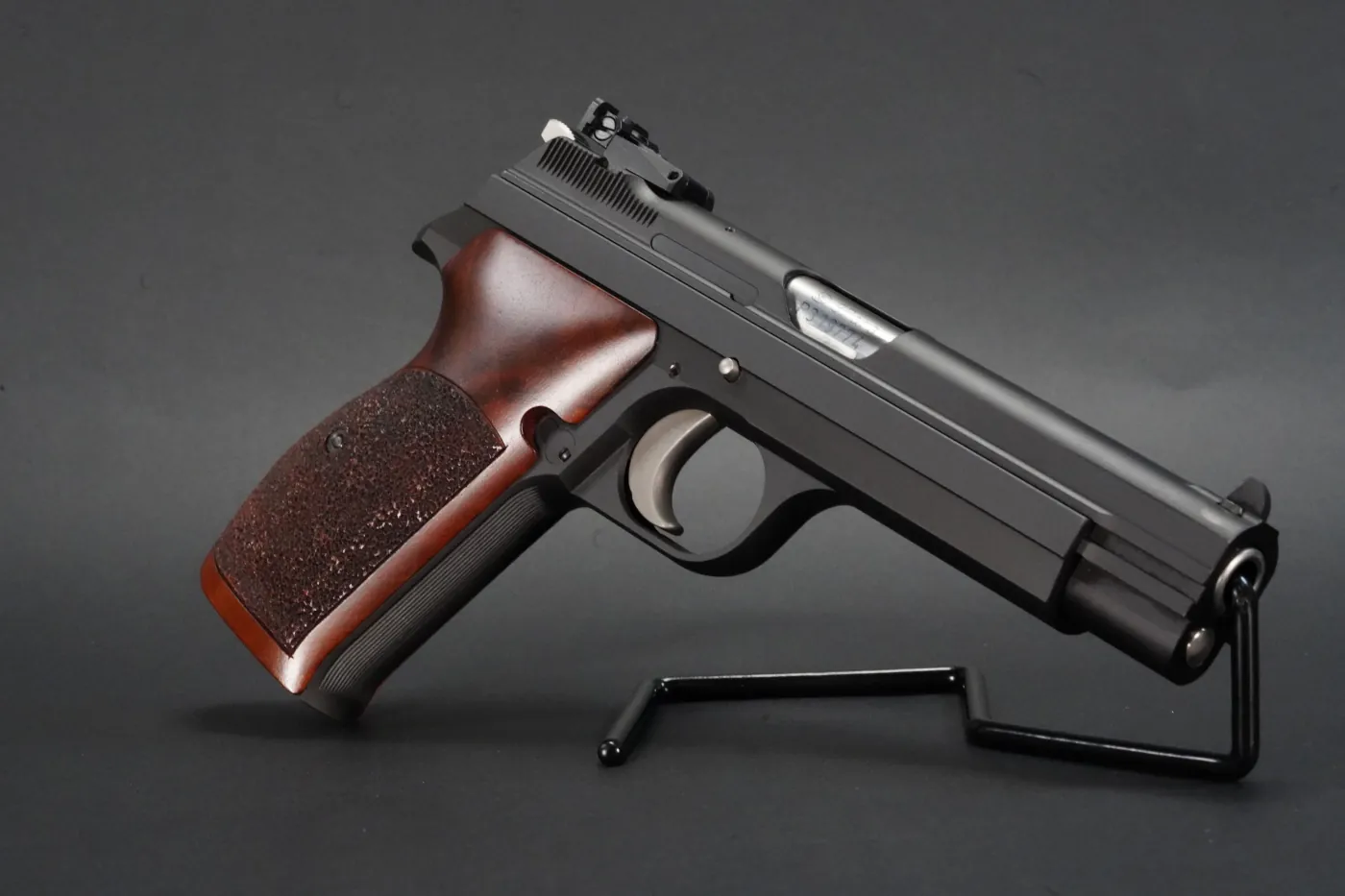
- P210-5: A target model generally fitted with adjustable sights, a specialized trigger, and an extended barrel.
- P210-6: A sporting version normally using a standard-length barrel and offered with fixed or adjustable sights. Examples were produced with both standard and heavier frames.
- P210-7: A .22 Long Rifle version operating by simple blowback. SIG also offered .22-caliber conversion assemblies for centerfire P210 frames.
- P210-8: A later sporting configuration developed for the American market with a frame-mounted push-button magazine release.[4]
SIG also supplied versions of the pistol to Denmark, where it was designated the m/49, and to other government users. Contract markings, serial-number conventions, proof marks, and configuration details therefore matter more than the model name alone when identifying a collectible example.[4]
Special editions occupy a separate part of the market. One of the best documented is the commemorative P210 produced for the 700th anniversary of the Swiss Confederation in 1991. The National Firearms Museum’s example is one of a reported 2,000 pistols made for the occasion and features a presentation case, gold details, commemorative inscriptions, and ivory stocks.[5]
The American P210
SIG Sauer introduced an American-made P210 in 2017, with production centered in New Hampshire. Although visually and mechanically related to the Swiss pistol, the American version is not an exact reproduction. It retains the internal slide rails, single-action operation, manual safety, and eight-round magazine, but incorporates modern manufacturing and substantial mechanical and ergonomic changes.[2][6]
The American P210 Target uses a five-inch barrel, adjustable sights, an extended beavertail, a push-button magazine release, and a Nitron-finished stainless-steel frame and slide. It also replaces the original barrel’s locking lugs with a system in which the barrel hood locks into the slide’s ejection port. SIG’s manual identifies the pistol as a single-action, hammer-fired 9 mm with an eight-round, single-stack magazine.[2][6]
Accuracy testing published by American Rifleman provides a useful measure of the modern pistol’s capabilities. From a mechanical rest at 25 yards, the reviewed P210 Target averaged 0.91 inch across five commercial loads, with the best individual group measuring 0.49 inch. Those results apply to the tested pistol and ammunition, not necessarily to every example, but they substantiate the continued emphasis on precision.[2]
SIG Sauer followed with the P210 Carry, announced as shipping in February 2022. That model uses an aluminum-alloy frame, a 4.1-inch barrel, fixed night sights, G10 grips, and the same eight-round capacity. At 29 ounces, it is materially lighter than the all-steel Target model.[7]
Evaluating a Collectible P210
Swiss, German, and American P210s should be treated as related but distinct collecting categories. A Swiss military P49, a commercial P210-6, a German Border Guard P210-4, and an American P210 Target differ in historical context, construction, markings, and intended use.
For an original pistol, identification should begin with the complete serial number, manufacturer and import markings, proof marks, caliber, frame profile, sights, grips, magazine release, and presence or absence of a lanyard loop or loaded-chamber indicator. Matching numbered components can support originality, but markings must be interpreted in the context of the particular contract and production period.
Condition also requires careful judgment. Honest military wear may be consistent with an issued P49, while refinishing, altered sights, replacement grips, or modified controls can diminish historical integrity. Conversely, a documented target pistol may legitimately include factory sporting features that would be incorrect on a service example.
Original holsters, spare magazines, manuals, test targets, conversion units, and factory cases add context only when they can be connected convincingly to the pistol. A collection of period accessories is not the same as documented provenance. Claims of military issue, police service, competition use, or ownership by a notable individual require records rather than inference from wear or markings alone.
The P210’s lasting importance rests on an unusual combination: it was a genuine service arm built with the precision normally associated with a specialized target pistol. Its limitations are equally clear. It is heavy, holds eight rounds, and was costly to manufacture. Those characteristics eventually worked against it as a military sidearm, but they are central to its standing among collectors. The best examples preserve not merely a famous model name, but identifiable evidence of a particular military contract, commercial configuration, or stage in the P210’s long production history.
Frequently Asked Questions
Switzerland adopted the military version in 1949 under the designation Pistole 49, or P49. SIG later used the P210 name for commercial pistols.
Its internal slide rails, consistent barrel lockup, precise construction, and single-action trigger contribute to its accuracy. Performance still depends on the individual pistol, ammunition, and shooter.
Important examples include Swiss military P49 pistols, West German Border Guard P210-4s, and the target-oriented P210-5 and P210-6. Each requires careful verification of markings and configuration.
No. The American model retains the internal slide rails and basic operating concept but uses updated controls, construction, ergonomics, and barrel lockup.
Collectors should examine the serial number, proof and import marks, finish, grips, sights, frame type, numbered components, and accompanying accessories. Claims of military service or special provenance should be supported by documentation.
Sources
- Petter, Charles Gabriel. “Automatic Pistol, U.S. Patent No. 2,139,203.” United States Patent Office, December 6, 1938.
- Clapp, Wiley. “Tested: SIG Sauer’s Made-In-America P210 Pistol.” American Rifleman, December 21, 2018.
- SIG Sauer. “History.” SIG Sauer.
- Tactical Life Staff. “SIG Sauer P210 and the Swiss Army P49.” Athlon Outdoors.
- Schreier, Philip. “Classics: SIG Sauer’s P210 Pistol.” Shooting Illustrated, January 6, 2022.
- SIG Sauer. “P210 Owner’s Manual: Handling and Safety Instructions.” SIG Sauer.
- SIG Sauer. “SIG Sauer Releases P210 Carry.” February 10, 2022.