
Key Takeaways:
- Colt introduced the Super .38 Government Model in 1929 as a higher-performance development of the older .38 Automatic cartridge.
- Improved barrel headspacing helped establish the .38 Super as an accurate and influential practical-shooting cartridge.
- Collectibility depends on documented originality, condition, factory configuration, and provenance—not unsupported claims of rarity or historical importance.
The .38 Super Government Model occupies a distinctive place in Colt history. Introduced in 1929, it combined the familiar handling and mechanics of the Government Model with a smaller-diameter cartridge operating at considerably higher velocity than the .45 ACP. The resulting pistol developed several separate identities: commercial sporting arm, limited law-enforcement pistol, international status symbol, competition platform, and modern collectible.
From Browning’s .38 Automatic to the Government Model
The .38 Super’s ancestry predates the M1911. Colt placed John Moses Browning’s recoil-operated .38-caliber Model 1900 on the market in February 1900. That pistol and its successors used the .38 Automatic cartridge, commonly known as the .38 ACP.[1]
Browning’s designs continued to evolve, culminating in the .45-caliber Model 1911. Colt records that the U.S. armed forces officially adopted the Browning-designed pistol in 1911 after extensive testing and competition.[2] Colt sold the commercial version as the Government Model.
In 1929, the company introduced the Super .38 Automatic Pistol. Period Colt literature described it as being modeled after the Government Model .45 and promoted its power, accuracy, and utility as a sporting sidearm. Although later usage reversed the words to “.38 Super,” Colt continued to use the “Super .38” designation for years.[3]
The cartridge was based on the older .38 Automatic case but loaded for substantially greater performance. A conventional 130-grain full-metal-jacket load produced approximately 1,200 feet per second from a five-inch barrel, although actual velocity varies with the firearm and ammunition.[4] That was impressive performance for a self-loading pistol of the period, but claims that the .38 Super was the first pistol cartridge to exceed 1,000 feet per second are unsupportable and should not form part of its history.
The Super’s importance rests elsewhere: it placed a high-velocity cartridge in a full-size, proven commercial pistol without requiring Colt to develop an entirely new platform.
A Commercial Colt, Not a Military M1911
The .38 Super Government Model is routinely called a “1911.” Mechanically, the description is understandable. Historically, however, the M1911 and M1911A1 were military .45-caliber service pistols, while the .38 Super was a commercial Colt Government Model derived from the same Browning system.
The .38 Super retained the platform’s locked-breech recoil operation, single-action trigger, detachable single-column magazine, grip safety, and manual thumb safety. Colt adapted caliber-specific components—including the barrel, breech face, extractor, ejector, recoil system, and magazine—to accommodate the narrower cartridge.
The steel Government Model provided a practical foundation for the higher-velocity loading. Compared with the .45 ACP, the .38 Super fired a lighter and smaller-diameter bullet at markedly greater velocity. The combination offered a flatter trajectory, generous magazine capacity for a single-column pistol, and manageable recoil.
Law-Enforcement Reputation: Fact and Embellishment
Much of the .38 Super’s reputation concerns its ability to penetrate automobile bodies and the steel-reinforced protective vests encountered during the Depression-era crime wave. Some of that reputation is supported by documented use, but later accounts often overstate the cartridge’s original purpose and adoption.
Contemporary Colt advertising did not present the Super .38 solely as a police pistol. The company also promoted it for hunting, outdoor use, and general sporting purposes. A 1940 Colt description characterized it as a powerful auxiliary arm for hunters.[3]
The FBI did acquire a number of .38 Super Government Models after federal agents received expanded arrest and firearms authority in 1934. The Bureau also obtained .357 Magnum revolvers. Both chamberings were valued for their ability to penetrate automobile bodies and the steel-plate vests sometimes used by criminals.[5]
This evidence establishes legitimate federal use, but it does not demonstrate that the .38 Super was universally adopted—or even widely standardized—by American police departments. Describing it as an essential or ubiquitous police cartridge goes beyond the available documentation.
The introduction of the .357 Magnum gave law-enforcement agencies a more powerful high-velocity option in a familiar revolver. Nevertheless, the .38 Super remained in production and retained a following among civilian shooters, international customers, gunsmiths, and collectors.
Early Accuracy and Improved Headspacing
The original .38 Automatic and .38 Super cases are semi-rimmed: the rim projects slightly beyond the case body. Early Colt barrels were intended to position, or headspace, the cartridge on that rim.
In some pistols, the arrangement permitted inconsistent cartridge positioning. Early Super .38 Government Models consequently acquired an uneven reputation for accuracy. The cartridge itself was not inherently inaccurate; the difficulty lay principally in how it was supported in the chamber.
John Rollins and Richard Shockley described a case-mouth-headspacing barrel modification in the June 1961 issue of American Rifleman. Properly fitted barrels using that principle produced substantially better consistency. Commercial barrel makers later adopted similar chamber arrangements, helping establish the .38 Super as a credible target and competition cartridge.[4]
The original semi-rimmed case remains in use. Competition-oriented rimless derivatives, including .38 Super Comp, were subsequently developed to improve cartridge stacking and feeding in double-column magazines. These related cartridges should still be identified precisely rather than treated collectively as ordinary .38 Super ammunition.
Practical Shooting and the Race Gun
The .38 Super acquired a second life through practical pistol competition. In modified pistols, it could meet Major power-factor requirements while allowing greater magazine capacity than the .45 ACP. Its case capacity also suited compensated pistols, which use propellant gases to reduce muzzle movement.
The United States Practical Shooting Association identifies .38 Super and its variants as established Open Division chamberings.[6] Open Division permits features such as optical sights, compensators, and extended magazines, creating the environment in which highly modified .38 Super pistols became prominent.[7]
Rimless Super derivatives and high-performance 9 mm competition loads have broadened the field. The original cartridge no longer occupies the position alone, but its role in the development of the modern compensated competition pistol is firmly established.
Evaluating a Collectible Colt .38 Super
“Colt .38 Super” describes nearly a century of production rather than a single model. The category includes prewar Super .38 pistols, postwar commercial guns, engraved examples, later Government Models, Series 70-marked pistols, Gold Cups, and modern Competition models.
Collectors should first establish exactly what a pistol is. The serial number, roll marks, sights, barrel, magazine, grips, finish, mechanical configuration, box, and accompanying papers should be examined together. A date derived from a serial-number table does not, by itself, authenticate the pistol’s complete configuration.
Originality is particularly important. Refinished surfaces, replacement barrels, enlarged ejection ports, altered sights, aftermarket triggers, and competition conversions can materially change a pistol’s historical character. Custom work may possess considerable craftsmanship or competition history, but it should not be represented as factory original without convincing documentation.
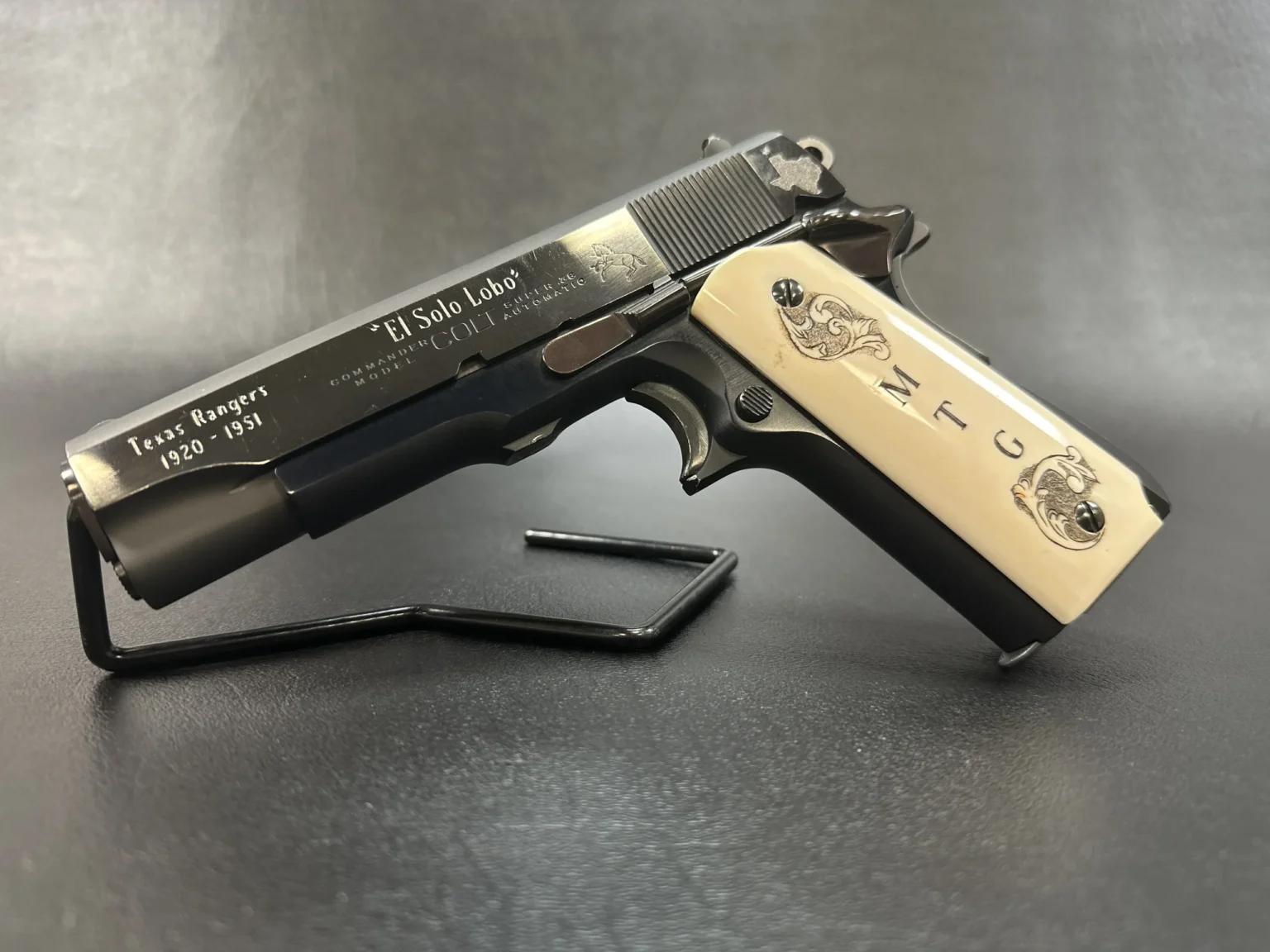
Engraving requires equal care. Factory engraving, recognized period work, and recent aftermarket decoration belong to different collecting categories. Quality alone does not establish when, where, or by whom the work was performed.
Colt states that its online serial-number lookup is approximate and not comprehensive. For eligible firearms, a Colt Archive Letter may provide the original specifications, shipment date, destination, and special features recorded in company files.[8] Such a letter does not prove that every component presently on the firearm is original, but it supplies an authoritative point of comparison.
Condition should also be evaluated honestly. Wear consistent with documented use may be preferable to a polished and refinished surface that has removed markings or changed the pistol’s contours. Rarity and value should never be inferred solely from age, caliber, ornamentation, or a seller’s description.
A Continuing Colt Chambering
The .38 Super is not merely a historical cartridge. Colt’s 2026 commercial catalog lists .38 Super versions of its stainless Competition pistol, Gold Cup Trophy, and Gold Cup National Match.[9] That continuing factory presence, nearly a century after the original Super .38 appeared, reflects the cartridge’s persistent appeal.
Its history does not need embellishment. The .38 Super was not the first pistol cartridge to surpass 1,000 feet per second, nor was it a universal police standard. Its documented achievements are significant enough: Colt successfully paired a high-velocity cartridge with the Government Model, later barrel development addressed the early headspacing problem, and practical shooters transformed the chambering into an influential competition platform.
For collectors, surviving pistols document each stage of that development. Their importance depends on demonstrable originality, condition, provenance, factory configuration, and historical context—not mythology.
Frequently Asked Questions About the 1911 .38 Super
Colt introduced the Super .38 Automatic Pistol in 1929. It was built on the company’s commercial Government Model platform.
No reliable evidence supports that claim. Its importance comes from combining high velocity with the established Government Model pistol.
Early barrels positioned the semi-rimmed cartridge on its rim, sometimes producing inconsistent headspace. Later barrels that positioned it on the case mouth generally improved accuracy.
The cartridge could meet Major power-factor requirements while supporting competitive magazine capacity. It also performed effectively in compensated Open Division pistols.
Collectors should examine the serial number, markings, finish, barrel, sights, grips, magazine, mechanical configuration, and documentation. A Colt Archive Letter may help confirm the firearm’s recorded factory configuration and shipping history.
Sources
- Browning, “Historic Timeline,” including Colt’s February 1900 introduction of the Browning-designed .38-caliber recoil-operated pistol. Browning
- Colt’s Manufacturing Company, “The Colt Story,” documenting the development and 1911 military adoption of Colt’s Browning-designed pistol. Colt
- NRA Publications, “The Super .38,” including reproductions and descriptions of Colt’s 1929 catalog, period advertising, and later factory literature. American Rifleman
- Brad Miller, “Super-Accurate .38 Super Loads,” addressing cartridge development, performance, semi-rimmed construction, early headspacing problems, and later rimless derivatives. Shooting Times
- NRA Publications, “A History of FBI Handguns,” documenting the Bureau’s acquisition and use of .38 Super Government Models and .357 Magnum revolvers. American Rifleman
- United States Practical Shooting Association, “Getting Started Competing in USPSA,” discussing .38 Super and related cartridges in Open Division. USPSA
- United States Practical Shooting Association, USPSA Competition Rules. USPSA
- Colt’s Manufacturing Company, “Archive Services” and “Serial Number Lookup.” Colt Archive Services and Colt Serial Number Lookup
- Colt’s Manufacturing Company, 2026 Commercial Catalog, listing current Competition and Gold Cup pistols chambered in .38 Super. Colt