
Key Takeaways:
- Confirm the SKU, action, chambering, construction, and factory configuration rather than relying on the P226 name alone.
- German Mastershop X-Five and X-Six pistols belong to a discontinued factory program and should not be confused with current American XFive models.
- Mechanical condition, cosmetic condition, originality, and documented provenance must be evaluated separately.
The used SIG Sauer P226 market includes standard service pistols, specialized factory configurations, and German Mastershop models built for competition or individual presentation. These pistols share a common mechanical ancestry, but they differ substantially in construction, action, frame material, barrel length, sights, finish, and intended use. The exact variant matters more than the P226 name by itself.
Service-Pistol Origins
SIG Sauer developed the 9 mm P226 for the U.S. military’s XM9 service-pistol competition. Testing began in 1984 and covered endurance, reliability, environmental exposure, firing-pin energy, and accuracy. The P226 and Beretta 92SB-F were the two designs that completed the requirements. Beretta received the contract, and its pistol became the M9 in January 1985.[1]
The P226 adapted the earlier P220 pattern to a double-column magazine holding 15 rounds of 9 mm ammunition. Traditional examples use a locked-breech, short-recoil operating system and double-action/single-action lockwork. The frame-mounted decocking lever lowers the cocked hammer to a safety intercept notch without requiring a press of the trigger.[2][3]
The model later entered documented U.S. naval service. American Rifleman identified the 9 mm Mk 25 as a Navy SEAL handgun in 2013.[4] SIG Sauer’s commercial MK25 uses a hard-anodized alloy frame, stainless-steel slide, 4.4-inch barrel, M1913 accessory rail, and DA/SA action.[5] A 2023 U.S. Navy publication stated that the M18 was designated to replace the Navy’s M9, M11, P226, and MK25 pistols.[6]
The MK25’s service association is relevant to collectors, but an anchor engraving does not prove that an individual commercial pistol was government-owned or operationally issued. Such provenance requires documentation tied to that firearm.
Identifying Standard and Premium Variants
Earlier P226s may use the separate slide and breechblock retained by nested roll pins shown in American Rifleman‘s technical treatment.[2] The current MK25 instead uses a stainless-steel slide and alloy frame.[5] Later P226 families introduced accessory rails, revised grips, specialized sights, and additional trigger systems.
Action type must be confirmed on the pistol itself. SIG Sauer’s Classic Line manual covers DA/SA, double-action-only, and single-action-only systems.[3] The P226 Legion has been produced in both DA/SA and SAO form. The DA/SA version uses a decocking lever, while the SAO version uses an ambidextrous manual safety.[7] A family name such as “Legion,” “Elite,” or “X-Five” is therefore incomplete without the SKU, chambering, action, and physical configuration.
German Mastershop P226s
The German Mastershop produced a distinct group of P226-based competition and presentation pistols. SIG Sauer’s German sports catalog described individually configured work involving triggers, sights, barrel weights, grips, compensators, and finishes. It listed the P226 X-Five Open, X-Six PPC, X-Six Scandic, X-Six Black & White, X-Five Golden Dragon, X-Five Blue Perl, X-Five Short, Majesty, and Heritage.[8]
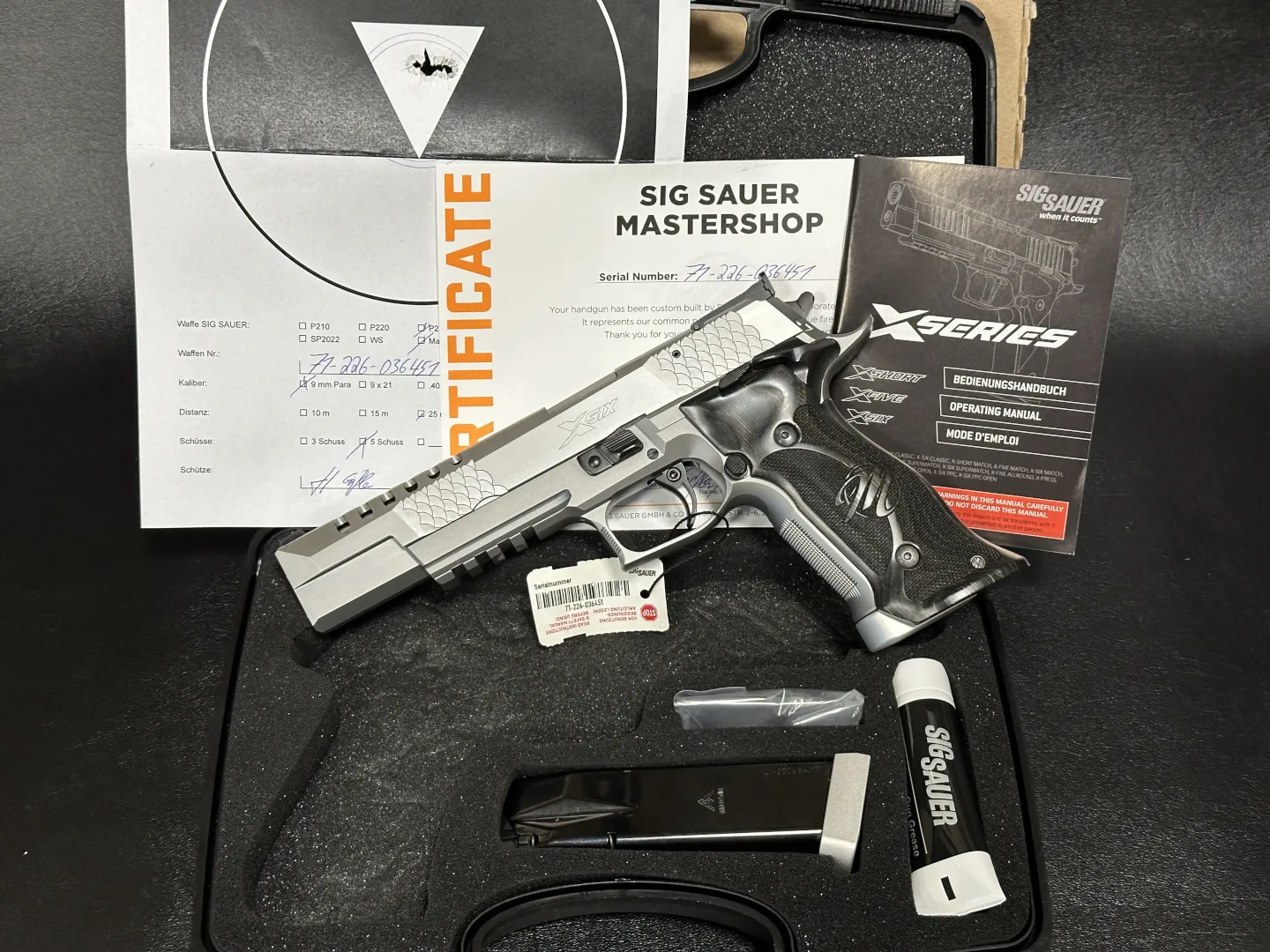
Specifications varied considerably. The cataloged 9 mm X-Five used a 127 mm, or 5-inch, barrel and 19-round magazine. The standard X-Five was single-action, while the X-Five Allround used DA/SA lockwork. The 9 mm X-Six used a 153 mm, or 6-inch, barrel, an extended frame and slide, an ambidextrous manual safety, an adjustable trigger, a magazine funnel, and adjustable sights. SIG Sauer also cataloged aluminum-frame X-Five and X-Six models alongside the heavier steel versions.[8]
Some Mastershop pistols were dedicated competition guns. The X-Five Open incorporated an optic mount, Aimpoint sight, compensator, and skeletonized components. The X-Six PPC used an Aristocrat rear sight and extended wooden grips with an integrated magazine funnel. Other versions emphasized factory finishing and engraving. The Golden Dragon used a copper-colored finish and dragon engraving, while the Majesty featured arabesque engraving, gold inlays, and walnut grips.[8]
SIG Sauer’s 2020 German product catalog divided the later Mastershop program into Sport, Prestige, and Individual categories. P226-based offerings included the X-Six Skeleton, X-Five Open, X-Five Performance, X-Five and X-Six Scandic, Violine and Chrome & Carbon versions, P226 Facettes, and a 24-carat-gold-finished Limited Gold Edition.[9]
SIG Sauer AG subsequently confirmed the closure of SIG Sauer GmbH in Eckernförde.[10] German Mastershop pistols therefore come from a discontinued factory program. The present P226 XFive is a separate U.S.-built SIG Custom Works model with a 5-inch barrel, stainless frame, SAO action, adjustable trigger, accessory rail, and optics-ready slide.[11]
The distinction is important. “German X-Five” does not identify one standard configuration, and a German Mastershop X-Five should not be confused with the current American XFive. Frame material, barrel length, action, sights, controls, grips, finish, magazines, and accessories must correspond to the claimed model. Factory cases, test targets, manuals, tools, spare magazines, and labeled packaging can help establish the original configuration.
Inspecting a Used P226
With the pistol unloaded and the seller’s permission, have it field-stripped according to the correct factory manual. Inspect the frame rails, locking surfaces, barrel and bore, extractor, breech face, slide, and pins for cracks, chips, pitting, deformation, or improper work.[3][12]
Compare the grips, sights, trigger, hammer, controls, magazines, finish, and accessory rail with the appropriate factory catalog. Aftermarket parts may be acceptable on a shooter, but undocumented substitutions weaken a claim of factory originality. This is especially significant on a Mastershop pistol whose controls, engraving, grips, or finish helped define the variant.
The unloaded action should receive the factory function check for its exact trigger system. On a DA/SA pistol, that includes the decocking lever, double-action and single-action trigger functions, slide catch, and hammer safety-intercept function. SIG Sauer restricts disassembly beyond the manual’s user-level procedures to a certified armorer or professional gunsmith.[3]
Mechanical condition, cosmetic condition, originality, and provenance are separate questions. A pistol can be mechanically sound but refinished, visibly worn but internally sound, or completely original without documented service history. A properly identified used P226 is one whose markings, components, documentation, and condition support the seller’s description.
FAQs About Buying a Used SIG P226
The used market includes discontinued service, competition, and Mastershop configurations that are no longer available as standard-production pistols.
German Mastershop pistols were specialized factory models with configurations that could include adjustable triggers, extended barrels, competition sights, engraving, distinctive finishes, and other factory-selected features.
Cataloged German X-Five models generally used 5-inch barrels, while X-Six models used 6-inch barrels and correspondingly longer slides. Action systems, frame materials, sights, and finishes varied by model.
No. The commercial MK25 carries a naval-style anchor marking, but individual military ownership or issuance requires firearm-specific documentation.
Inspect the frame rails, locking surfaces, barrel, bore, extractor, breech face, slide, pins, controls, and unloaded action. Compare its features with the correct factory catalog or manual to identify alterations.
Sources
[1] McClellan, Angus. “The Beretta M9: 25 Years of Service.” American Rifleman, November 12, 2009.
[2] NRA Staff. “SIG Sauer P226.” American Rifleman, March 15, 2012.
[3] SIG Sauer, Inc. Classic Line Pistols Operator’s Manual: Handling & Safety Instructions. 1204276-01 Rev. 04, n.d., pp. 24-27, 60-77.
[4] Giddings, Caleb. “SIG Sauer P226 Elite SAO.” American Rifleman, September 16, 2013.
[5] SIG Sauer, Inc. “P226 MK25.” SIG Sauer, n.d.
[6] Codrington, Rion. “CLDJ Transitions Deployed Sailors to the M18.” Commander, Navy Region Europe, Africa, Central, July 10, 2023.
[7] SIG Sauer, Inc. “P226 Legion.” SIG Sauer, n.d.
[8] SIG Sauer GmbH. Sports Catalog. n.d., pp. 5, 7, 10, 19-21.
[9] SIG Sauer GmbH. 2020 SIG Sauer Product Catalog. 2020, pp. 47-63.
[10] SIG Sauer AG. Stellungnahme der SIG Sauer AG Schweiz zur Schliessung des Standorts in Eckernförde. n.d., p. 1.
[11] Martens, Jake. “Review: SIG Sauer P226 XFive.” Shooting Sports USA, May 29, 2023.
[12] Keel, Tamara. “Guide to Buying Used Guns.” Shooting Illustrated, October 17, 2014.