
Key Takeaways:
- The P226 was developed for the XM9 trials and was one of two pistols to complete the testing requirements.
- Early examples used multipart folded-steel slides, while later production adopted machined one-piece slides.
- Military-style markings or commercial model names do not prove government issuance; authentic service provenance requires firearm-specific documentation.
The SIG Sauer P226 was developed as a full-size, high-capacity 9×19 mm pistol for the U.S. military’s XM9 service-pistol trials. Its design drew heavily from the earlier P220 but used a wider frame and double-column magazine with a 15-round capacity.[1]
Eight pistols entered the XM9 evaluation, which began in 1984 and included testing for endurance, reliability, environmental resistance, firing-pin energy and accuracy. The P226 and Beretta 92SB-F were the two designs that completed the testing requirements. Beretta ultimately received the military contract, and its pistol entered service as the M9.[2]
The available evidence does not support the familiar claim that the P226 failed because it was inherently inferior to the Beretta. It also does not establish the opposite—that the P226 was conclusively the better pistol. Those judgments go beyond what the cited record demonstrates.
Design and Operation
The traditional P226 is a locked-breech, hammer-fired semiautomatic pistol. Its barrel locks against the front of the slide’s ejection port, an operating arrangement carried over from the P220 family.[1]
Most early and standard-production P226 pistols use double-action/single-action lockwork. Pressing the trigger for the first shot cocks and releases the hammer. Operation of the slide then leaves the hammer cocked for subsequent single-action shots.
A frame-mounted decocking lever allows the hammer to be lowered to a safety intercept position without pressing the trigger. SIG Sauer’s manual also identifies a firing-pin safety lock within the slide. The magazine release can be configured for right- or left-handed operation on applicable models.[3]
Later versions expanded the platform to include double-action-only and single-action-only configurations. Single-action-only models use a manual safety and omit the decocking lever. SIG Sauer has also offered the Short Reset Trigger, which reduces trigger travel during reset.[3]
Production Development
Early P226 pistols used a multipart slide formed principally from sheet steel, with a separate breechblock retained by roll pins.[1] SIG Sauer later standardized machined one-piece slides across its classic P-series. This construction was first adopted in related models developed for cartridges such as .40 S&W and .357 SIG, which imposed different operating demands from the original 9 mm design.[4]
The change provides collectors with a useful dividing line. Early folded-slide pistols represent the P226’s original European manufacturing method, while later examples reflect the transition to machined-slide production. Neither construction should be dismissed automatically as inferior; they belong to different periods in the model’s development.
The P226 family eventually included pistols chambered in 9 mm, .40 S&W and .357 SIG. Specifications vary by model and production period, so caliber-conversion claims should not be generalized across the entire family without consulting the applicable factory documentation.
Variants and Related Models
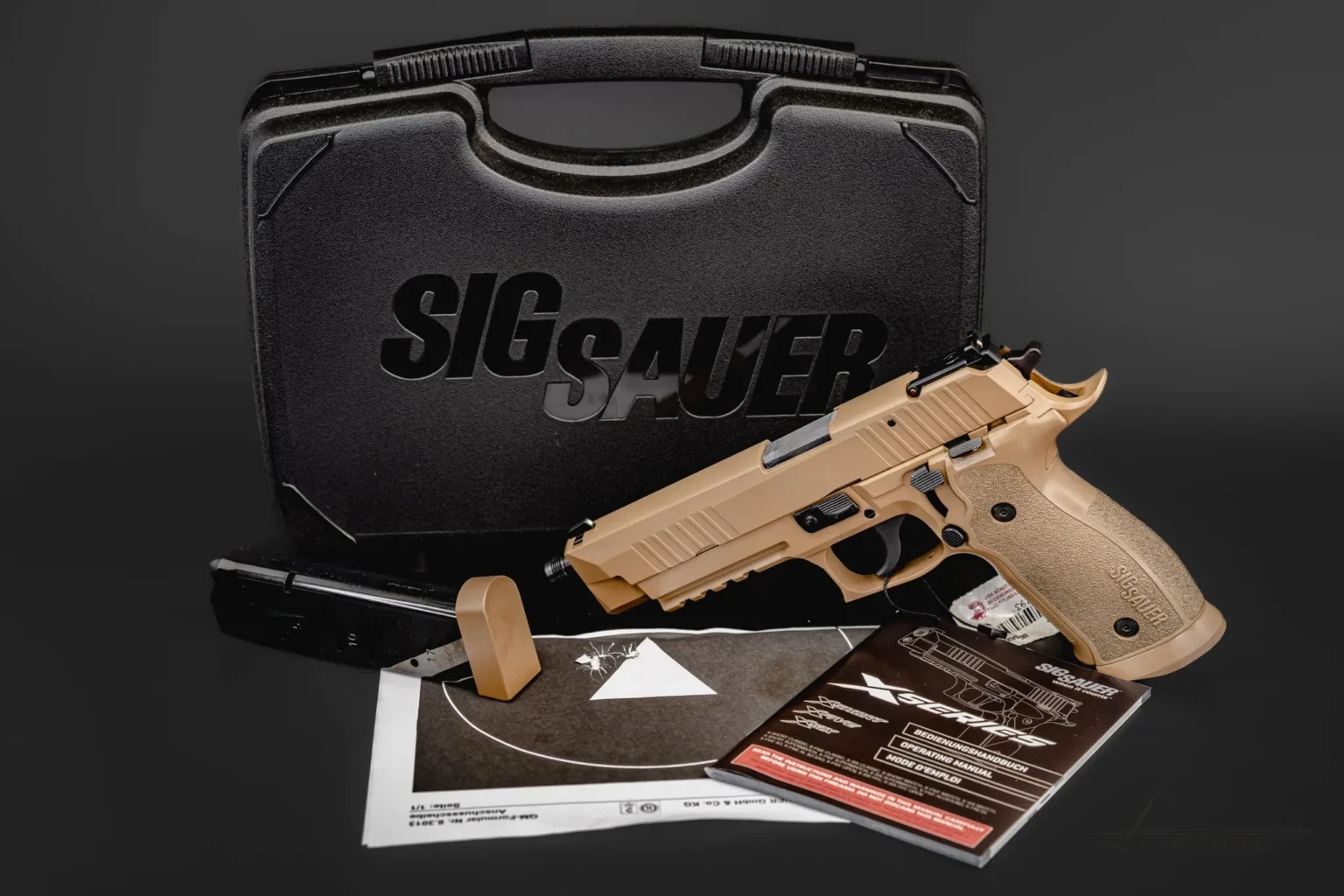
SIG Sauer developed the P226 into a broad family of service, sporting and premium pistols. Factory literature has listed standard models alongside the MK25, Legion and competition-oriented configurations. Depending on the version, distinguishing features may include different sights, trigger systems, frame contours, grips, finishes and corrosion-resistant treatments.[3][5]
The MK25 is particularly recognizable. SIG Sauer’s catalog describes it as a 9 mm P226 with an anchor engraving, identification label, corrosion-resistant internal coating and phosphate-coated, chrome-lined barrel.[5] Those commercial factory features do not, by themselves, prove that an individual pistol was issued to a military unit. Documented government ownership requires firearm-specific provenance.
The P226 should also be distinguished from the M11. The U.S. military’s M11 was based on the smaller P228, which entered service in 1988 with a 13-round magazine. SIG Sauer’s later commercial M11-A1 was built on the P229 pattern rather than the full-size P226.[4]
Collecting the P226
The P226’s collecting interest rests on its identifiable production history rather than exaggerated claims about perfection or invulnerability. Relevant distinctions include slide construction, proof and import marks, country of manufacture, caliber, factory configuration, finish, serial-number range and accompanying documentation.
Condition and originality remain important, but provenance must be evaluated separately. Military-style markings, commemorative features or a model name associated with government service do not establish that a particular firearm was actually issued. Agency or military history should be supported by records tied to the individual pistol.
The P226 has a documented place in modern firearms history. It was developed for a major U.S. military competition, became an established service-pistol design and evolved through several distinct manufacturing periods and factory configurations.[1][2] For collectors, that combination of historical context, mechanical continuity and visible production variation is more meaningful than the mythology that has accumulated around it.
Frequently Asked Questions
SIG Sauer developed the P226 as a high-capacity 9 mm candidate for the U.S. military’s XM9 service-pistol trials.
No. The Beretta 92SB-F received the contract and entered U.S. service as the M9.
Most traditional P226 pistols use hammer-fired double-action/single-action lockwork with a frame-mounted decocking lever.
No. The military M11 was based on the smaller P228, while the later commercial M11-A1 follows the P229 pattern.
Collectors should examine slide construction, markings, manufacture, caliber, factory configuration, condition, and documentation. Claims of military or agency service require provenance tied to the individual firearm.
Sources
- NRA Staff, “SIG Sauer P226,” American Rifleman, March 15, 2012.
- NRA Staff, “The Beretta M9: 25 Years of Service,” American Rifleman, November 12, 2009.
- SIG Sauer, “Classic Line Pistols Operator’s Manual,” document 1204276-01, Rev. 04.
- Wiley Clapp, “Service Grade: SIG Sauer’s M11-A1,” American Rifleman, March 22, 2013.
- SIG Sauer, “2019 Commercial Catalog,” P226 Classic Line specifications, 2019.