
Key Takeaways:
- Official records identify the military pistol as the M9, not the “M9-P.”
- The Army awarded Beretta the initial M9 contract in 1985 to replace older .45- and .38-caliber handguns.
- The M9A3 was proposed as an upgraded M9 variant but did not replace the M9 as the standard U.S. service pistol.
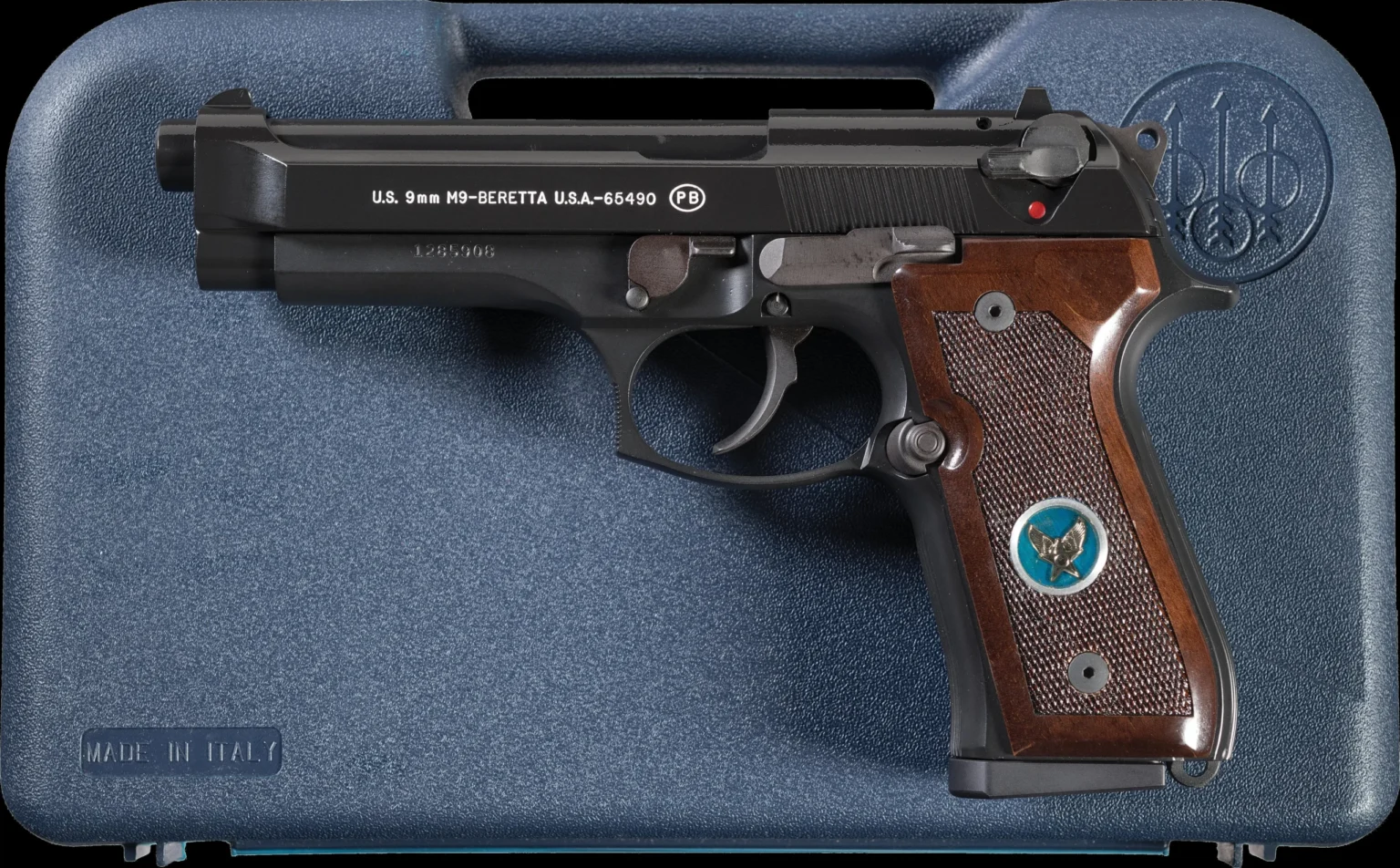
The Beretta M9 occupies a consequential place in modern American firearms history. Official military, government, and manufacturer records identify the pistol as the M9, not the “M9-P.” Unless that suffix appears in authenticated factory or government documentation for a particular firearm, collectors should not treat “M9-P” as a distinct military model or recognized variant.
From the M1911A1 to the M9
The Department of Defense sought a common 9×19 mm service pistol to replace several aging handguns, principally the .45-caliber M1911A1 and .38-caliber revolvers. After military testing, the Army awarded Beretta U.S.A. a contract on April 10, 1985, for 315,930 pistols. The quantity was subsequently increased to 321,260. Government records designated the new sidearm the M9.[1]
The selection was historically important, but the familiar claim that the M9 simply replaced a pistol used unchanged for more than 70 years is imprecise. The M1911 and improved M1911A1 had served since the early twentieth century, but the armed forces also maintained other handguns, including .38-caliber revolvers. The M9 procurement consolidated those requirements around a NATO-standard 9 mm pistol.[1][2]
The selection process was not free from controversy. A 1986 Government Accountability Office investigation concluded that Smith & Wesson had been unfairly eliminated from the competition because the Army incorrectly determined that its submission failed two testing requirements. That finding did not reverse the Beretta contract, but it remains part of the M9’s documented procurement history.[3]
Mechanical Design
The M9 is a full-size, magazine-fed, recoil-operated semiautomatic pistol chambered for the 9×19 mm cartridge. Its operating system uses a short-recoil mechanism and a pivoting locking block rather than the tilting-barrel arrangement common to many other service pistols. The standard military magazine holds 15 cartridges.[4]
Its trigger system is double-action/single-action. With the hammer lowered, the first trigger pull both cocks and releases the hammer. Cycling of the slide then cocks the hammer for the lighter single-action pulls that follow. The mechanism also permits another trigger pull following a misfire, although military immediate-action procedures should take precedence over relying on a second primer strike.[4][5]
The slide-mounted control is ambidextrous and functions as both a decocking lever and a manual safety. When engaged, it lowers the hammer, rotates the firing-pin striker out of alignment, and disconnects the trigger. Additional safeguards include a firing-pin block and a half-cock notch. The extractor also serves as a tactile and visual loaded-chamber indicator.[4]
Beretta’s open-top slide is one of the pistol’s most recognizable features. The design provides a large ejection opening, while the locking-block system allows the barrel to move substantially in line with the frame during cycling. These features are fundamental to the broader Beretta 92-series design, from which the M9 was developed.[5]
Service Record and Engineering Changes
Early production was accompanied by legitimate safety and quality concerns. By September 1988, the Army had documented frame cracks and 14 slide failures, four of which injured shooters. Beretta attributed the slide failures to improper ammunition, while the Army identified metal fatigue as the principal cause. The Army issued a safety message and Beretta implemented an engineering change intended to prevent a separated slide from traveling off the rear of the frame.[6]
These events should not be omitted from a serious history of the pistol. Neither, however, should they be used to characterize every M9 indiscriminately. A February 1988 Army assessment concluded that then-current production pistols continued to meet the 1984 requirements and had not been materially degraded by contract changes.[6]
The M9 remained in widespread American military service for more than three decades. In 2017, the Army selected SIG Sauer’s Modular Handgun System, subsequently designated the M17 and M18. Fielding began that year, and the new pistols progressively replaced aging M9s rather than removing every Beretta from service at once.[7]
The M9A3 Is a Separate Variant
The M9A3 should not be described as a routine late-production M9. Beretta submitted it to the Army in December 2014 as an engineering-change proposal under an existing M9 contract. Its proposed features included a Vertec-style frame with a slimmer grip, a removable wraparound backstrap, a MIL-STD-1913 accessory rail, removable tritium sights, an extended threaded barrel, a convertible safety/decocker system, and a 17-round sand-resistant magazine.[8]
Although conceived as a potential military upgrade, the M9A3 did not replace the M9 as the standard U.S. service pistol. It subsequently entered the commercial market. Its configuration and procurement history therefore differ materially from those of an original government-contract M9.[8]
Understanding Collectibility
The M9’s collector interest rests on its documented role in the transition from the M1911A1 era to the NATO-standard 9 mm service-pistol era. That historical association does not make every Beretta 92-series pistol a military M9, nor does a commercial M9 necessarily have military provenance.
For a particular pistol, value and historical importance depend on evidence: model and manufacturer markings, serial number, configuration, condition, alterations, factory records, government documentation, and a credible chain of ownership. Military-style markings alone do not establish that a firearm was issued by the United States government.
The strongest examples are therefore not simply pistols advertised as “military,” “early,” or “rare.” They are firearms whose physical characteristics and documentary records agree. In a collecting field where the M9, commercial M9 pistols, the 92FS, M9A1, and M9A3 are sometimes conflated, precise identification is more important than an appealing description.
Frequently Asked Questions
The M9 is a 9×19 mm, double-action/single-action semiautomatic pistol adopted for U.S. military service following a 1985 Army contract.
Official military, government, and manufacturer records reviewed for the article identify the pistol as the M9. “M9-P” should not be treated as a distinct variant without supporting factory or government documentation.
The standard military M9 magazine holds 15 cartridges.
No. Beretta proposed the M9A3 as an engineering change in 2014, but it did not replace the M9 as the standard U.S. service pistol.
Collectibility depends on verified configuration, markings, condition, serial number, provenance, and supporting records. Military-style markings alone do not prove government issuance.
Sources
- U.S. Government Accountability Office, B-232681.2, B-232681.3: Pistol Procurement, February 9, 1989.
- U.S. Army Center of Military History, Department of the Army Historical Summary, Fiscal Year 1987.
- U.S. Government Accountability Office, Pistol Procurement: Allegations on Army Selection of Beretta 9-mm. as DOD Standard Sidearm, June 16, 1986.
- U.S. Marine Corps Training and Education Command, Field Medical Service Officer Student Handbook, M9 pistol section.
- Beretta U.S.A., 90 Series Operator’s Manual.
- U.S. Government Accountability Office, Quality and Safety Problems With the Beretta M9 Handgun, September 15, 1988.
- U.S. Army, “Army Fields New Handgun System to Military Police”, February 15, 2019.
- Beretta U.S.A., M9 Engineering Change Proposal—The M9A3, December 2014.