
Key Takeawys:
- The four handguns demonstrate different approaches to military requirements, operating systems, materials, and manufacturing.
- Serial numbers and markings can help identify a firearm, but they do not prove ownership or service history without supporting documentation.
- Refinishing, replacement parts, improper storage, and aggressive cleaning can destroy evidence needed to assess originality.
A coherent handgun collection does not require examples from every manufacturer or period. Four contrasting designs can document major differences in service requirements, operating systems, construction, and cultural history: the M1911, Smith & Wesson Model 29, Glock 17, and Luger P08.
M1911
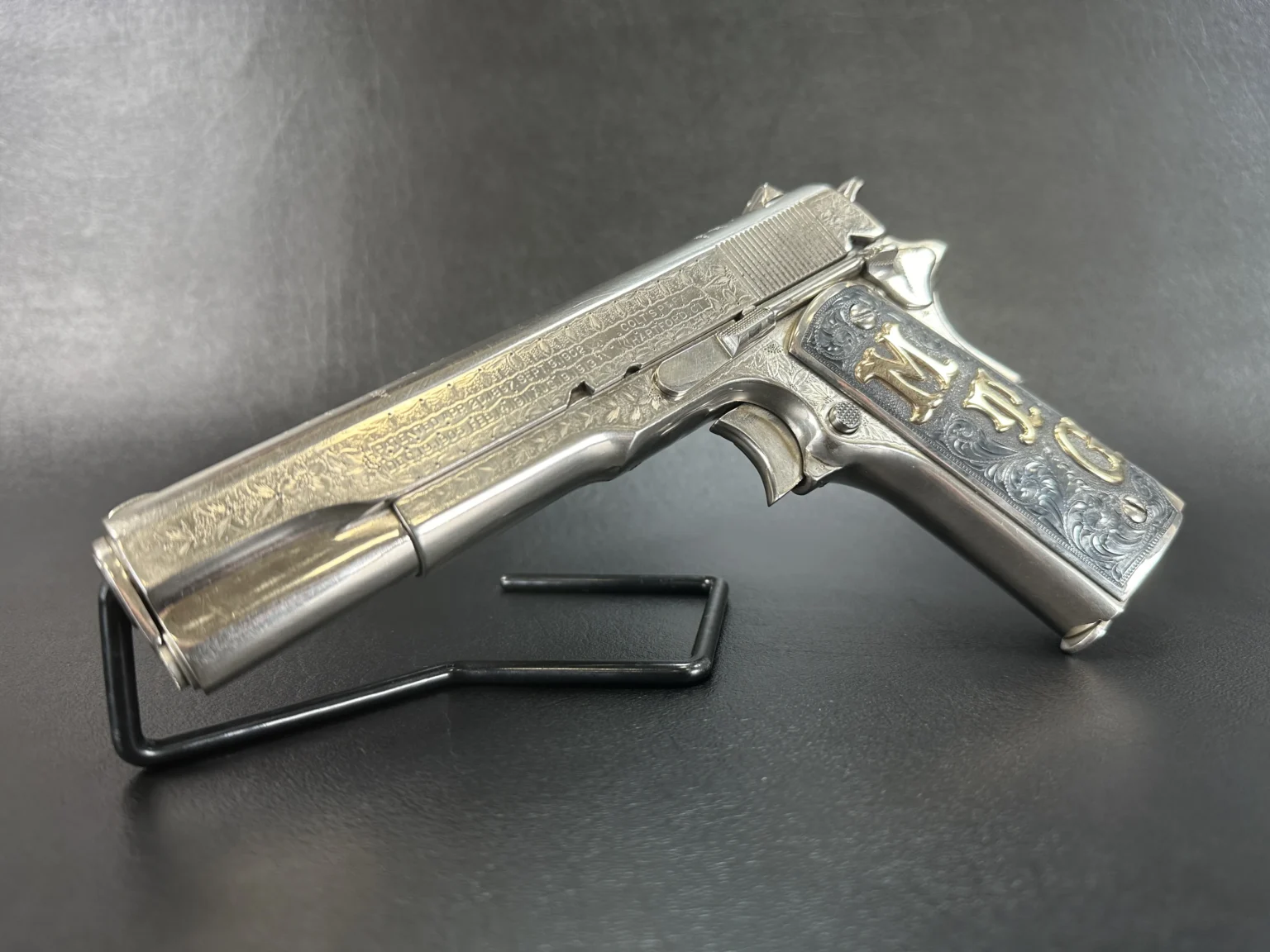
John M. Browning designed the .45-caliber M1911, which the United States Army adopted in March 1911.[1] A Colt-manufactured example in the Smithsonian’s National Museum of American History is identified as a semiautomatic military pistol made in 1918. The museum records the M1911 as an official U.S. military sidearm from 1911 until 1986.[2]
“M1911” now describes a large family of military, commercial, and custom-built pistols. Collectors should identify the manufacturer, production period, serial number, markings, and component configuration of each example. A pistol assembled from parts may still be historically interesting, but it should not be represented as an untouched military or factory-original firearm without supporting evidence.
Specific claims of wartime use or personal ownership require documentation linking the individual pistol to the person, unit, or event. Military markings and a period-correct serial number establish characteristics of the firearm, not its complete service history.
Smith & Wesson Model 29
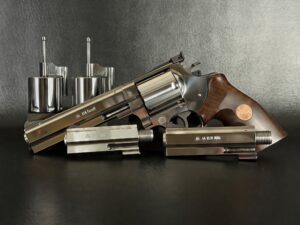
Smith & Wesson completed its first .44 Magnum revolver on December 29, 1955. The revolver was initially cataloged as the “.44 Magnum.” It became the Model 29 in 1957 when Smith & Wesson introduced model-number markings across its revolver line. Early cataloged barrel lengths included four inches and 6 1/2 inches, with an 8 3/8-inch version added in 1958.[3]
The Model 29 also illustrates the effect of popular culture on firearms collecting. Clint Eastwood carried a 6 1/2-inch Model 29 as Inspector Harry Callahan in Dirty Harry. Released in December 1971, the film closely associated the character with the .44 Magnum and brought the revolver broad public recognition.[3][4]
Early production characteristics, barrel length, finish, grips, sights, and model suffix are all relevant to identification. An unusual configuration should not automatically be treated as a factory variation. Replacement barrels, refinishing, altered sights, and non-original grips must be considered before originality is claimed.
Glock 17
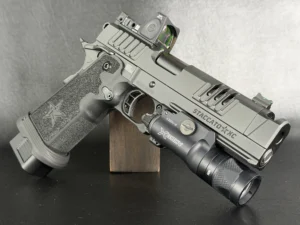
The Glock 17 represents a different manufacturing and design period from the steel-framed M1911 and P08. The current Glock 17 Gen5 is a 9×19 mm semiautomatic pistol with a polymer frame, the company’s Safe Action system, a standard 17-round magazine, and a 4.49-inch barrel.[5]
Production generations should be treated as distinct collecting subjects. The Gen5 configuration has no molded finger grooves and incorporates an ambidextrous slide-stop lever, a reversible magazine catch, and a flared magazine well.[5] Earlier examples differ in frame texture, grip shape, finish, recoil assemblies, controls, and internal components.
Replacement sights, triggers, barrels, magazines, and other aftermarket parts are common. An example represented as factory-original should be checked for generation-correct components. Original packaging, manuals, test-fire materials, and dated sales records can help document its configuration and period of sale.
Luger P08
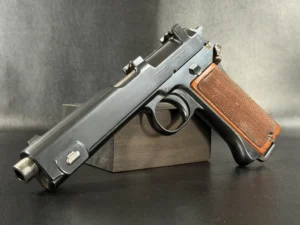
Georg Luger developed his pistol from Hugo Borchardt’s earlier toggle-breech design. The German Army adopted the 9 mm Pistole 08 in 1908. Early P08 pistols lacked some features found on later production, including the hold-open device.[6]
The P08 uses a short-recoil, toggle-locked action. After the barrel and receiver begin moving rearward under recoil, the toggle joint rises, opening the breech and allowing the fired case to be extracted and ejected. Luger’s 1906 U.S. patent describes the toggle links, breech bolt, and spring arrangement used in this type of recoil-operated firearm.[7]
Imperial War Museums records a 9×19 mm P08 manufactured by Deutsche Waffen-und Munitionsfabriken in Berlin in 1910. The museum’s catalog associates that particular pistol with the German Army’s Uhlan Regiment No. 4.[8] This is an example of object-specific documentation: the record supports the date, manufacturer, caliber, and association of that firearm, not every surviving P08.
Manufacturer, chamber date, proof and acceptance marks, serial-number placement, safety markings, and unit marks are central to P08 identification. Matching numbers can support originality, but they must be considered alongside stamp style, finish, proofs, and evidence of renumbering or replacement.
Documentation and Preservation
Each firearm should have an individual record containing its manufacturer, model, serial number, caliber, markings, visible component numbers, condition, and known alterations. Photographs should document both sides of the firearm, proof and inspection marks, import marks, and areas of wear or damage. Factory letters, military papers, purchase records, correspondence, and earlier catalog descriptions should remain with the firearm.
Historic handguns combine materials that respond differently to humidity, temperature, light, and handling. The National Park Service recommends documenting condition before and after maintenance, removing fresh fingerprints from metal, avoiding direct sunlight, and storing firearms separately from ammunition. It also warns against prolonged storage in leather holsters because leather can contribute to metal deterioration and attached hardware can scratch finished surfaces.[9]
Refinishing, polishing, or replacing original components can remove physical evidence needed for identification. Firearms with active corrosion, mechanical damage, or uncertain previous work should be examined by a conservator or qualified specialist before treatment.[9]
Frequently Asked Questions
They represent contrasting designs, including a revolver, a toggle-locked pistol, a steel-framed service pistol, and a polymer-framed pistol.
Manufacturer, production period, markings, component configuration, condition, and documented provenance distinguish one M1911 from another.
Clint Eastwood carried a 6 1/2-inch Model 29 as Inspector Harry Callahan in the 1971 film. The appearance brought the revolver broad public recognition.
The P08 uses a jointed toggle that rises to open the breech. The M1911 uses a short-recoil system with a reciprocating slide.
Keep detailed condition records and protect the firearm from unstable humidity, direct sunlight, fingerprints, and prolonged contact with leather. Consult a qualified specialist before treating corrosion or dismantling an unfamiliar firearm.
Sources
[1] Army Military History Institute. “Arming the Army: John M. Browning.” U.S. Army, January 12, 2009.
[2] National Museum of American History. “Colt U.S. Model 1911 Pistol.” Smithsonian Institution, n.d.
[3] Campbell, Dave. “A Look Back at the Smith & Wesson Model 29.” American Rifleman, May 15, 2013.
[4] Lohr, Matt. “Dirty Harry.” Library of Congress, n.d., pp. 1–2.
[5] GLOCK, Inc. “G17 Gen5.” GLOCK, Inc., n.d.
[6] Triggs, James M. “Exploded View: Luger P08.” American Rifleman, August 21, 2023.
[7] Luger, Georg. Recoil-Operated Firearm. U.S. Patent 839,778, December 25, 1906.
[8] Imperial War Museums. “Pistole 08, First Issue, and Luger.” Imperial War Museums, n.d.
[9] Montgomery, Allan L. Caring for Historic Longarms: Storage and Handling. National Park Service, Conserve O Gram 10/1, May 1999, pp. 1–3.