
Key Takeaways:
- Define a clear collecting theme before purchasing firearms.
- Treat provenance as unproven unless documentation connects the specific firearm to its claimed history.
- Preserve original finishes, markings, components, and records instead of attempting aggressive restoration.
A strong handgun collection needs a clear purpose. Price, appearance, and quantity matter less than historical coherence, accurate identification, documented provenance, and responsible preservation.
Begin with a defined subject: American military sidearms, influential operating systems, a particular manufacturer, law-enforcement firearms, or the transition from traditional steel construction to polymer frames. A focused collection makes research easier and exposes gaps that random purchasing tends to conceal.
Three Historical Reference Points
The M1911
John Moses Browning designed the .45-caliber semiautomatic pistol adopted by the U.S. Army in March 1911. The M1911 used a short-recoil operating system and replaced the Army’s .38-caliber revolvers.[1]
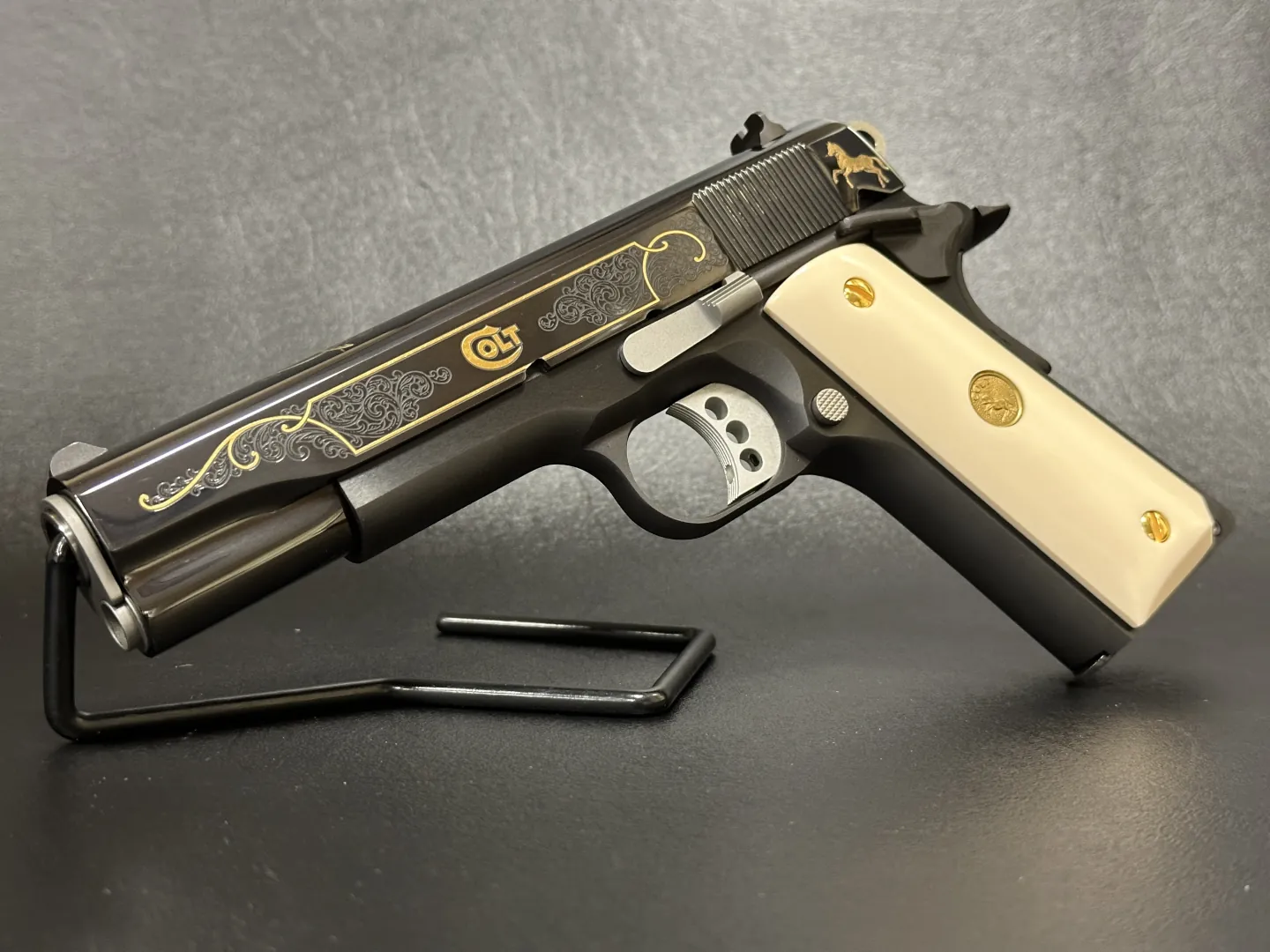
Collectors must distinguish an original military M1911 from the modified M1911A1, commercial Government Models, arsenal-rebuilt pistols, and modern 1911-pattern firearms. These categories share a design lineage, but they do not have the same historical or collecting significance.
Identification should account for the frame and slide markings, serial-number range, inspection and acceptance marks, finish, grips, and small components. A pistol assembled from mismatched military parts may still be historically interesting, but it should not be represented as an untouched original.
The Glock 19
The Glock 19 represents a later manufacturing era built around polymer-frame construction, simplified controls, and striker-fired operation. Glock developed its first service pistol in response to an Austrian military requirement during the early 1980s. The Austrian Army accepted the design in 1983, and Glock entered the American market during the middle of that decade.[2]
The Glock 19 is the compact member of that design family. The current Glock 19 Gen5 is chambered in 9×19mm, uses Glock’s Safe Action system, and has a standard 15-round magazine and a 4.02-inch barrel.[3] Those specifications describe the cited Gen5 model; earlier generations and specialized variants must be researched separately.
For collectors, the important questions concern generation, production period, factory configuration, markings, finish, original magazines, packaging, manuals, and documented institutional use. A commonplace modern pistol does not become rare merely because it has been discontinued or appears infrequently for sale.
The Smith & Wesson Model 29
Smith & Wesson completed its .44 Magnum revolver in 1955. It was initially offered with 4-inch and 6½-inch barrels, with an 8⅜-inch version added later. The revolver subsequently became known as the Model 29.[4]
Demand declined during the 1960s but increased substantially after the Model 29 appeared in the 1971 film Dirty Harry.[4] That association is part of the model’s cultural history, but it does not establish the rarity or value of an individual revolver.
Collectors should distinguish among barrel lengths, finishes, engineering revisions, factory presentation cases, commemorative versions, and later-production variants. Each example must be evaluated on its own configuration and documentation.
Provenance Must Be Proven
Provenance is evidence connecting a specific firearm to a previous owner, institution, or historical event. It is not an unsupported account repeated by successive sellers.
Reliable provenance may include:
- Factory records tied to the serial number
- Military or law-enforcement documentation
- Dated sales records and ownership documents
- Contemporary photographs showing identifiable features
- Correspondence with a demonstrable chain of custody
- Established auction or collection records identifying the firearm
A family story, handwritten label, old holster, or unsigned statement may justify further research, but it does not independently prove ownership or historical use.
Keep original documents with the collection and preserve separate digital copies. Record the manufacturer, model, serial number, caliber, markings, configuration, condition, acquisition date, seller, and supporting documentation for every firearm.
Originality and Condition Are Different
A firearm can be worn but substantially original. Another can look nearly new because it was polished, refinished, or assembled with replacement parts.
Before purchasing, examine:
- Serial numbers and numbered components
- Manufacturer, model, caliber, and importer markings
- Proof, inspection, acceptance, and property marks
- Finish consistency and signs of polishing
- Grips, sights, screws, magazines, and internal components
- Evidence of corrosion, repair, alteration, or refinishing
- Boxes, manuals, tools, receipts, and factory correspondence
Refinishing and replacement parts do not automatically destroy historical interest. They do, however, change the firearm’s identity as a collectible object and should be disclosed accurately.
Preserve Rather Than Restore
Aggressive cleaning can remove original finish, markings, patina, and evidence of manufacture or use. National Park Service conservation guidance recommends leaving metal objects untreated until a qualified objects conservator has examined them. The guidance warns that cleaning can expose fresh metal, increase corrosion, and create hazards involving solvents and chemicals.[5]
Active corrosion may appear as loose, powdery, flaky, or visibly expanding material. When it is present, obtain professional conservation advice rather than experimenting with abrasives, refinishing chemicals, or improvised coatings.[5]
Handle collectible firearms carefully, minimize unnecessary disassembly, and avoid altering historically significant surfaces. A qualified gunsmith can evaluate mechanical condition, but mechanical repair and historical conservation are different disciplines.
Acquire Slowly and Describe Honestly
A federal Type 03 collector’s license applies only to qualifying curio-or-relic transactions. It can permit certain interstate acquisitions, but it does not authorize the holder to operate as a firearms dealer.[6] Collectors must also comply with applicable state and local requirements.
Before buying, determine exactly what the firearm is, which claims can be documented, and whether its condition supports the seller’s description. If an important assertion cannot be verified, treat it as unproven.
A worthwhile collection does not need to be large. It needs to be coherent, properly documented, carefully preserved, and honestly described. Historical importance comes from the relationship between the physical firearm and reliable evidence, not from enthusiasm, marketing language, or price alone.
Frequently Asked Questions
Choose a defined historical or technical theme. This provides a clear standard for deciding which firearms belong in the collection.
Look for factory records, military documentation, dated ownership records, or other evidence tied to the firearm’s serial number. A seller’s story alone does not prove provenance.
Not necessarily, but it changes the firearm’s originality and must be disclosed. Refinishing can also remove markings, finish, and evidence of manufacture or use.
No. They are useful reference points for different periods of handgun development, but every acquisition should support the collection’s chosen theme.
Avoid aggressive cleaning, unnecessary disassembly, and unqualified restoration. Seek professional advice when corrosion, mechanical problems, or historically significant surfaces require attention.
Sources
- U.S. Army, “Arming the Army: John M. Browning.”
- Glock, “Glock History.”
- Glock, “Glock 19 Gen5: Technical Data.”
- Smith & Wesson, “Company History.”
- National Park Service, “Curatorial Care of Metal Objects.”
- Bureau of Alcohol, Tobacco, Firearms and Explosives, “Federal Firearms Licenses.”