

Key Takeaways:
- Rarity requires context: production totals, surviving examples, configurations, and documented demand are separate considerations.
- Provenance is credible only when ownership or historical associations are supported by reliable records.
- Refinishing, undocumented alterations, and improper cleaning can destroy evidence and diminish historical integrity.
A collectible firearm is more than an old, scarce, or unusual gun. Its significance rests on evidence: who made it, when it was produced, whether it retains its original configuration, and whether its history can be documented.
Rarity may attract attention, but rarity alone does not establish historical importance or desirability. A credible evaluation considers identity, originality, condition, provenance, mechanical significance, craftsmanship, and the quality of the supporting documentation.
Identity and Originality
The first step is to establish exactly what the firearm is. Record its manufacturer, model, serial number, caliber or gauge, dimensions, proof and inspection marks, mechanical configuration, and visible alterations.
These details must be considered together. A serial number may place a receiver within a production range, but it does not prove that the barrel, stock, finish, sights, grips, or smaller components were installed when the firearm left the factory. Factory letters, shipping records, military acceptance documents, period catalogs, and recognized reference works may help establish the original configuration.
Originality should not be confused with visual perfection. Honest wear can be consistent with age and documented use. Refinishing, replaced components, recut markings, and modern engraving may improve appearance while removing physical evidence of the firearm’s history.
Descriptions such as “original,” “unissued,” “factory engraved,” and “all matching” should be treated as claims requiring proof. A reliable description identifies what was examined, the evidence supporting the conclusion, and any remaining uncertainty.
Rarity Requires Context
Production figures must be defined carefully. Total factory output, military purchases, commercial sales, exports, and the number of surviving examples are different measurements. None should be presented as another.
Claims such as “one of ten known” are meaningful only when supported by factory records, a documented survey, or reproducible research. The number of examples appearing in recent auction catalogs does not establish either total production or the surviving population.
Configuration can matter as much as production. A widely manufactured model may be considerably scarcer in a particular caliber, barrel length, contract variation, finish, or presentation form. Conversely, a firearm produced in small numbers may be of limited historical interest if its background is undocumented or its original configuration has been substantially altered.
Provenance: Documentation Before Storytelling
Provenance is the documented history of an object’s ownership and associations. Strong provenance may include factory records, military documents, period correspondence, presentation inscriptions, estate inventories, dated photographs, sales receipts, and earlier collection or auction catalogs.
The strongest evidence forms an unbroken or substantially supported chain. A gap does not automatically disprove the claimed history, but it must be disclosed. Family tradition and previous sales descriptions can provide investigative leads; they do not independently authenticate ownership by a historical figure.
A cased pair of flintlock pistols by Nicolas-Noël Boutet in the Metropolitan Museum of Art demonstrates the importance of documented context. The museum identifies the pistols as having been presented to Spanish naval officer Cayetano Valdés y Flores. Because the donor, recipient, and circumstances of presentation are known, the set can be interpreted as a documented historical object rather than simply an elaborately decorated pair of pistols.[1]
An inscription by itself is not conclusive. It must be examined alongside manufacturing dates, ownership records, correspondence, photographs, and other evidence that can connect the firearm to the claimed person or event.
Mechanical and Historical Significance
Collectors often pursue firearms that represent identifiable stages in mechanical or industrial development. The important question is not whether a model is famous, but what a particular example can document.
Colt introduced the Single Action Army revolver in 1873. The company’s historical timeline records the delivery of more than 30,000 revolvers under a U.S. government contract between 1873 and 1891.[2] Within that history, individual examples may be distinguished by contract markings, inspection stamps, production period, caliber, barrel length, finish, unit association, or documented ownership.
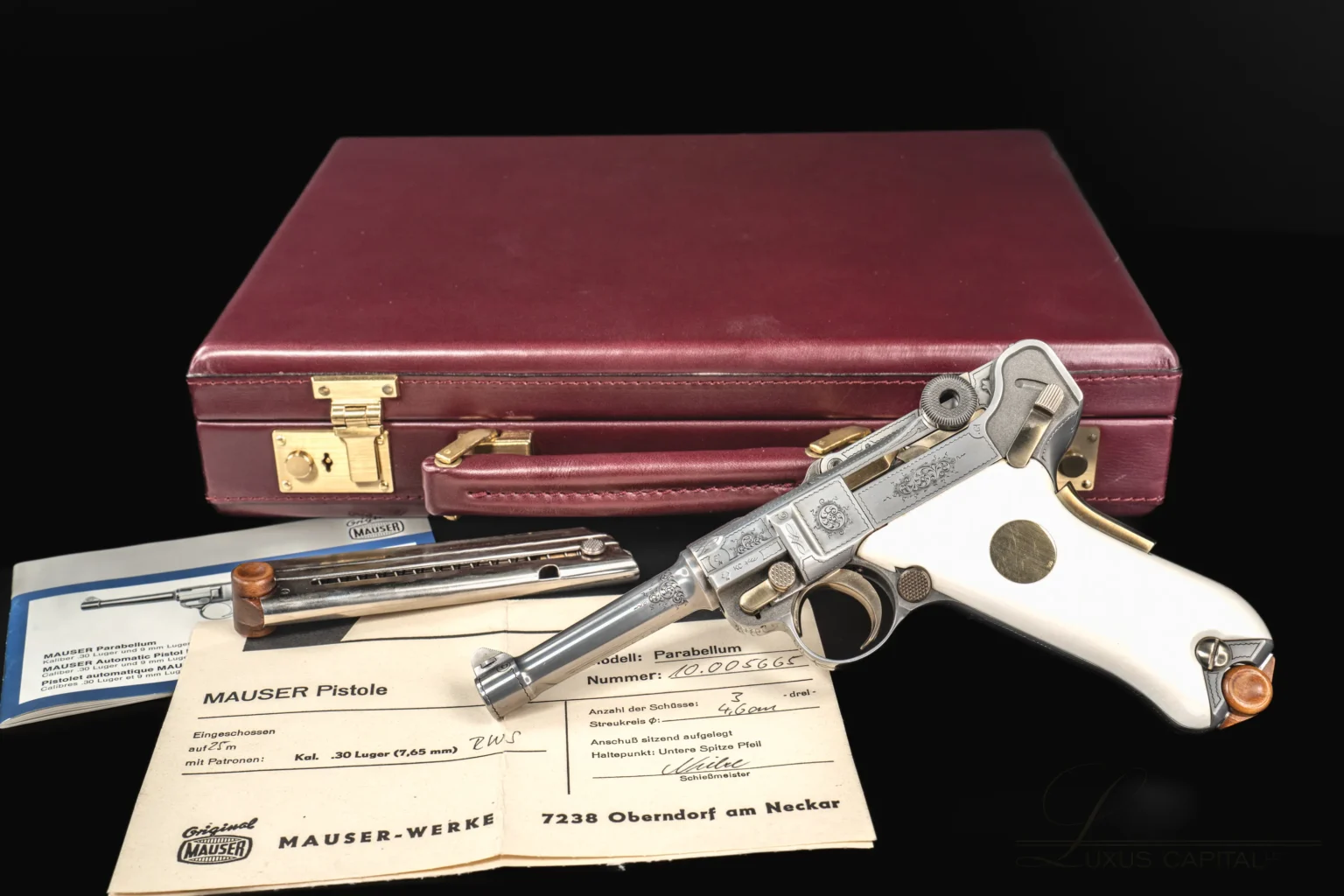
The Luger pistol presents a different history. Royal Armouries traces its development to Georg Luger’s redesign of Hugo Borchardt’s earlier self-loading pistol. The resulting design was finalized and patented in 1898. Switzerland adopted a 7.65×21 mm version in 1900, followed by German naval and army variants. The German Army’s Pistole 08 entered service in 1908 in 9×19 mm.[3]
Manufacturer, date, military acceptance marks, unit markings, and numbered components can help place an individual Luger within that development. These features must still be interpreted against reliable records. The presence of a marking proves that the marking exists, not every story subsequently attached to it.
Experimental and unconventional firearms deserve the same discipline. An unusual mechanism may document a serious attempt to solve a design problem even when it never achieved commercial or military success. Its importance should be based on what the firearm demonstrably represents, not on unsupported claims that it was revolutionary or unique.
Firearms as Decorative Art
Fine firearms can also be important examples of decorative art. Engraving, etching, gilding, inlay, carving, and controlled surface finishes required specialized labor and often reflected the artistic conventions of a particular place and period.
The Metropolitan Museum of Art describes engraving as the cutting of patterns or inscriptions into a metal surface. It documents the historical use of gold, silver, copper alloys, ivory, bone, horn, mother-of-pearl, and precious-metal wire as inlay materials. The museum also notes that bluing and browning provided decorative color while helping inhibit corrosion.[4]
Collectors must distinguish documented period work from later embellishment. Style alone is insufficient to identify an engraver. Signatures, factory records, engraver’s pulls, invoices, correspondence, and comparison with securely attributed work provide stronger evidence.
Later engraving is not necessarily without artistic merit, but it must be described accurately. Modern decoration should not be represented as factory or period work.
Evaluating an Acquisition
A disciplined examination should answer several questions:
- Is the firearm correctly identified?
- Are its serial number, markings, caliber, dimensions, and configuration consistent with reliable records?
- Which components appear original, replaced, restored, or refinished?
- Is the claimed rarity supported by production or survival data?
- Does the provenance rest on primary documents or repeated sales descriptions?
- Are the case, tools, accessories, and paperwork original to the firearm or merely period-correct?
- Has a qualified, independent specialist examined it?
- Does the written description identify uncertainties and alterations?
Auction catalogs can document when and how an item was offered. They do not independently prove every historical statement in a lot description. Material claims should be traced to factory, archival, museum, military, patent, or other primary documentation whenever possible.
Documentation and Recordkeeping
Documentation should begin at acquisition. A collection file should contain dated photographs, identifying information, markings, measurements, condition reports, purchase records, correspondence, prior catalog entries, appraisals, and provenance documents. Original records should be preserved without alteration.
Federal regulations require licensed collectors to maintain acquisition-and-disposition records for curios and relics. The prescribed information includes the manufacturer or importer, model, serial number, firearm type, caliber or gauge, and details concerning receipt and disposition.[5]
Comparable records are valuable to any collection because they preserve information that may otherwise be separated from the firearm. Documentation should distinguish verified facts from seller representations, family history, and unresolved attribution.
Preservation and Safe Storage
Historic firearms should be handled and stored in ways that protect both people and the objects. The National Park Service’s museum guidance instructs personnel to treat every firearm as loaded until verified otherwise, involve an experienced specialist when its status is uncertain, and store unloaded firearms in locking, museum-quality cabinets or gun safes. The guidance also calls for ammunition to be evaluated and stored separately and warns against permanent, irreversible alterations.[6]
Cleaning or restoration should not be undertaken simply to improve appearance. Aggressive polishing can remove finish, soften markings, erase tool marks, and destroy evidence of use. Improper disassembly can damage screws, wood, or closely fitted components.
When conservation is necessary, the work should be performed or directed by someone qualified to handle historic firearms. Every intervention, and every removed, repaired, or replaced component, should be documented.
Collecting with Discipline
The strongest collections are built around a defined subject and a consistent evidentiary standard. A focused collection organized around a manufacturer, military contract, mechanical system, engraver, region, or historical period permits deeper research and more meaningful comparison.
Patience remains one of the collector’s best safeguards. Rarity without documentation is a claim. Provenance without records is a story. Condition without a precise description is an opinion. A significant collectible firearm is strongest when the physical evidence, documentary record, and historical context agree.
Frequently Asked Questions
A firearm may be collectible because of its documented history, rarity, original configuration, craftsmanship, mechanical significance, or condition. No single attribute establishes importance by itself.
No. Rarity must be considered alongside condition, originality, provenance, configuration, and collector interest.
Look for factory records, military documents, period correspondence, dated photographs, estate records, and earlier catalogs. Family stories and seller descriptions are not conclusive without corroborating evidence.
Refinishing can remove original finish, soften markings, and erase evidence of manufacture or use. Any restoration or alteration should be identified and documented.
Keep them unloaded in secure, locking storage and store ammunition separately. Cleaning, disassembly, and conservation should be conservative and fully documented.
Sources
- The Metropolitan Museum of Art. “Cased Pair of Flintlock Pistols Presented to Captain Cayetano Valdés y Flores.”
- Colt’s Manufacturing Company. “Timeline.”
- Royal Armouries. “Arms of the First World War.”
- The Metropolitan Museum of Art. “Techniques of Decoration on Arms and Armor.”
- Bureau of Alcohol, Tobacco, Firearms and Explosives. “27 C.F.R. § 478.125: Record of Receipt and Disposition.”
- National Park Service. Museum Handbook, Part I, Appendix G: Museum Firearms, Small Arms Ammunition, Munitions, and Artillery


One Response
I won a custom Biesen Winchester made for a local Safari club raffle. It came in a custom case with a box of shells loaded by Jack O Connor. It is unfired and I have a picture of Al Biesen and I when I was given the rifle. What are some online platforms to list this rifle? Thank you